
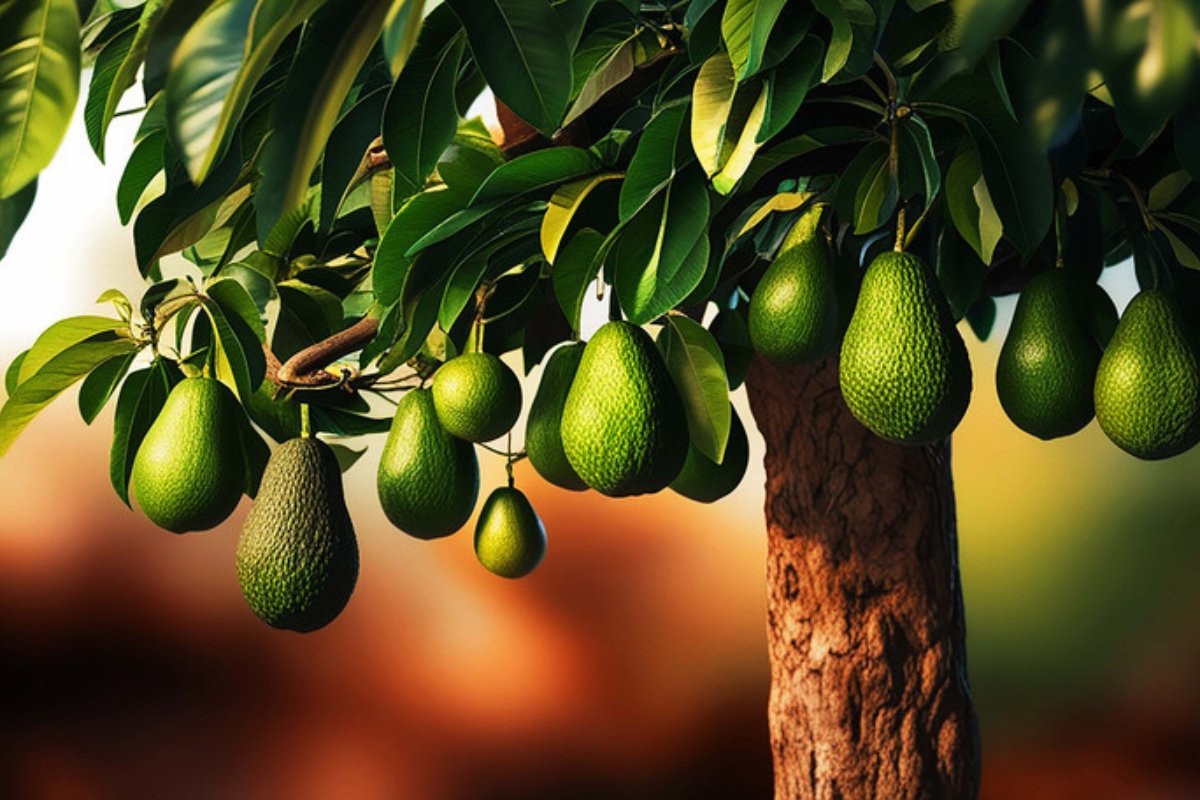
At Madrid's central wholesale market, Mercamadrid, the average price of Hass avocados from January to September 2026 was €4.00 per kilo, 15.5% higher than in the same months of 2025, according to a Wikifarmer analysis of the City of Madrid's open data. The rise in price did not come with fewer avocados on the market, as the EU imported 648,624 tonnes from outside the EU from January to August, the largest quantity for those months since 2010, according to Eurostat data. In Thessaloniki the avocado price in the bulletin of 2 November was €3.30 per kilo, against €3.00 a year earlier.
In Madrid the price in every month of 2026 was higher than in the same month of 2025
The average price of avocados at Mercamadrid, weighted by the quantities sold, was higher than in the same month of 2025 in each of the first nine months of 2026. The largest gaps were in August, with €3.52 per kilo against €2.53, or 39.2% higher, and in July, with €3.30 against €2.50, or 32.1% higher, while in May the price was almost the same, €4.14 against €4.10. In September 2026, the latest month with data, the price was €3.74 per kilo, against €3.48 in September 2025.
The average price from January to September was €3.34 per kilo in 2019, €3.10 in 2020, €3.18 in 2021, €2.92 in 2022 and €3.50 in 2023, rose to €4.67 in 2024, fell to €3.46 in 2025 and reached €4.00 in 2026, 14.3% below 2024. In the same months the market handled 36,012 tonnes of avocados in 2026, 7.2% more than the 33,587 tonnes of 2025, and only 2022, with 36,100 tonnes, had a larger quantity. Prices are in euros and are not adjusted for inflation.
Peru supplied 41.3% of the avocados sold at Mercamadrid from January to September 2026, with 14,883 tonnes, followed by Málaga with 12.1%, Mexico with 8.5%, Brazil with 8.2% and Granada with 5.9%. The two Spanish provinces, Málaga and Granada, together supplied 18.0% of the quantity.
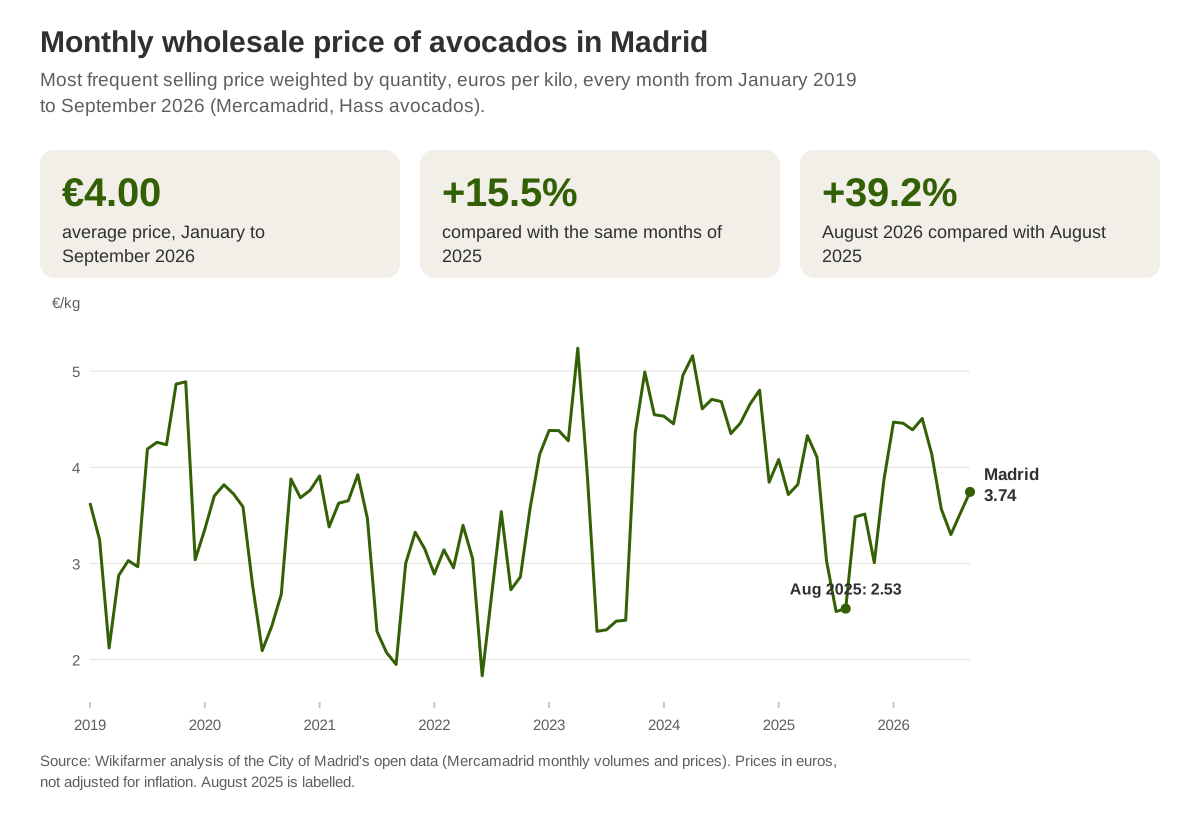
Source: Wikifarmer analysis of the City of Madrid's open data (Mercamadrid monthly volumes and prices). The August price was €2.53 per kilo in 2025 and €3.52 in 2026.
EU imports from outside the EU were the largest since 2010 for the first eight months
From January to August 2026 the 27 member states imported 648,624 tonnes of avocados from non-EU countries, 4.7% more than the 619,679 tonnes of the same months of 2025, according to Eurostat's Comext foreign trade database. It is the largest quantity for those months since 2010, the first year of the data analysed, and in 2025 imports for the whole year had already reached 917,928 tonnes, also the largest quantity since 2010.
The value of imports from January to August 2026 was €1.85 billion and the average declared value €2.86 per kilo, 4.4% higher than the €2.74 of 2025 and 5.5% lower than the €3.02 of 2024. For the whole of 2025 the average value was €2.63 per kilo, against €3.02 in 2024. So in both imports and the Madrid wholesale market the highest average price was in 2024, the price fell in 2025 and rose again in 2026 without reaching the 2024 level.
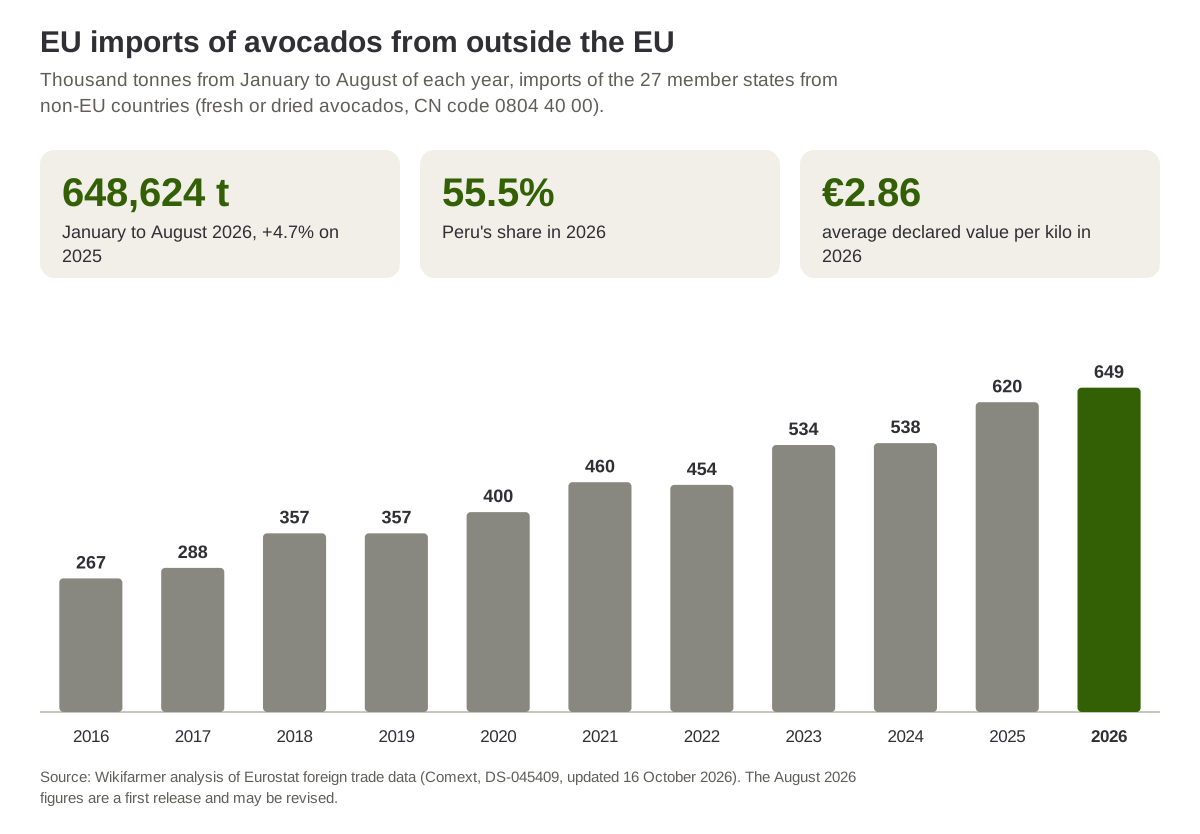
Source: Wikifarmer analysis of Eurostat foreign trade data (Comext, DS-045409, updated 16 October 2026), CN code 0804 40 00. The August 2026 figures are a first release and may be revised.
Peru supplied more than half of the avocados the EU imported this year
From January to August 2026 Peru shipped 360,012 tonnes of avocados to the EU, 55.5% of imports from outside the EU, against 52.9% in the same months of 2025. Colombia followed with 61,783 tonnes (9.5%), South Africa with 48,678 tonnes (7.5%) and Israel with 47,303 tonnes (7.3%). Imports from Brazil rose to 31,231 tonnes, from 11,436 tonnes last year, while imports from Morocco fell to 32,198 tonnes, from 66,245, and from Kenya to 27,758 tonnes, from 42,752.
From April to September 2025 Peru, in the southern hemisphere, supplied 69.0% of imports, while from October 2025 to March 2026 Colombia came first with 20.8%, followed by Chile with 19.3%, Israel with 17.5%, Peru with 16.1% and Morocco with 13.4%, in line with the seasonal calendar of European avocado imports. Mexico, the largest producer in the global avocado market, supplied 14.4% of EU imports in 2019, with 76,788 tonnes, and only 0.7% in 2025, with 6,721 tonnes, although this year up to August it shipped 5,498 tonnes, against 171 tonnes in the same months of 2025.
In Athens and Thessaloniki the avocado price stayed between €2.50 and €3.30 per kilo
At the Central Market of Thessaloniki (KATH) the dominant price of avocados in the bulletin of 2 November 2026 was €3.30 per kilo, while the same bulletin gives €3.00 for the same day of 2025. From 1 October to 2 November 2026 the price was €3.00 in 8 bulletins and €3.30 in 13, an average of €3.19, while in the same period of 2025 it was €3.00 in every bulletin. Since 21 August 2024, the first day of the data analysed, the price has ranged from €2.80 to €3.30 per kilo.
In the bulletins of the Athens Central Market (OKAA) avocados have not yet appeared this season, up to the bulletin of 5 November 2026. Last season the price appeared in the bulletins from 3 November 2025 to 8 June 2026 and ranged from €2.50 to €3.00 per kilo, with an average of €2.93, while in the 2024/25 season, from 22 October 2024 to 26 June 2025, it ranged from €2.80 to €3.20, with an average of €3.06. Both markets quote prices to the nearest ten cents, so small differences carry little weight.
The prices matter to avocado growers and wholesale buyers
In Madrid the wholesale price of avocados this year has been higher than last year in every month up to September, although the nine-month average is lower than in 2024, and the average value of EU imports, with larger quantities, moved the same way. The picture matters to growers in Málaga and Granada, who supplied 18.0% of Mercamadrid's avocados this year up to September, to Greek growers who sell through the central markets of Athens and Thessaloniki, and to the importers, traders and shops that buy avocados wholesale. Those who sell avocados to other countries also need to know the quality standards and export specifications for avocados.
Eurostat's September data will show imports at the end of the Peruvian season, Mercamadrid's prices for October to December will come with the City of Madrid's next update, and the OKAA bulletins will show the price at which the new season starts in Athens.
The three sources measure different kinds of price
The analysis is by Wikifarmer, based on Mercamadrid's monthly volume and price data from the City of Madrid's open data portal (2019 to September 2026), on EU imports under CN code 0804 40 00 (fresh or dried avocados) from Eurostat's Comext database (dataset DS-045409, updated 16 October 2026, data from 2010 to August 2026) and on the price bulletins of the Athens Central Market (OKAA) and the Central Market of Thessaloniki (KATH, data from 21 August 2024). Mercamadrid records avocados only as Hass avocados, and its price is the most frequent selling price from each origin, weighted by quantity. The average import value is declared value divided by declared quantity and is not a purchase price. It changes a lot from month to month, so only longer periods are compared, and the August 2026 figures may be revised. OKAA gives the most frequent and KATH the dominant price of each bulletin, so price levels in the three markets are not comparable with each other. The OKAA data cover about three bulletins a week, and in some 2025 bulletins KATH also gave a lower price for second-class avocados, which is not included. Mercamadrid's 2020 file repeats December three times, and it was counted once. Prices are not adjusted for inflation, and the analysis does not examine the causes of the rise. All figures were recomputed independently from the original files. They describe what prices did and are not a forecast.
Sources
- Ayuntamiento de Madrid. (2026). Mercamadrid, volumen y precio de productos comercializados. City of Madrid open data portal.
- Eurostat. (2026). International trade in goods, Comext database (DS-045409), updated 16 October 2026.
- Central Markets and Fisheries Organisation (OKAA). (2026). Price bulletins (in Greek).
- Central Market of Thessaloniki (KATH). (2026). Fruit and vegetable price bulletins (in Greek).