

From the week of 7 September to the week of 19 October 2026 the average price of apples leaving the packing station was lower than in the same weeks of 2025 in eight of the eleven EU countries with comparable data, according to a Wikifarmer analysis of the weekly prices member states report to the European Commission. These prices come in a year for which the World Apple and Pear Association (WAPA) forecasts an EU apple crop 15.6% smaller than last year's, according to the forecast it presented at its Prognosfruit conference, as reported by FreshPlaza.
Hungary and Poland recorded the largest falls
In Hungary the average price over the seven weeks was €82.19 per 100 kg, against €117.58 in the same weeks of 2025, 30.1% lower; in Poland it was €58.57 against €78.86, 25.7% lower, and in Romania €67.75 against €90.27, 24.9% lower (European Commission, Agri-food Data Portal). In Germany the weighted national average of all varieties was €49.90 against €57.23, 12.8% lower, while smaller falls were recorded in Czechia, 6.5%, Italy, 6.0%, from €100.32 to €94.25, and Croatia, 2.2%. In Greece the price was almost unchanged, at €117.12 per 100 kg against €117.50 a year earlier, 0.3% lower.
In France and Portugal apples sold at higher prices
In France the average price over the same weeks was €148.39 per 100 kg against €130.08 in 2025, 14.1% higher, and in Portugal €126.79 against €106.69, 18.8% higher, while in Belgium the price stayed almost level, 0.5% above last year.
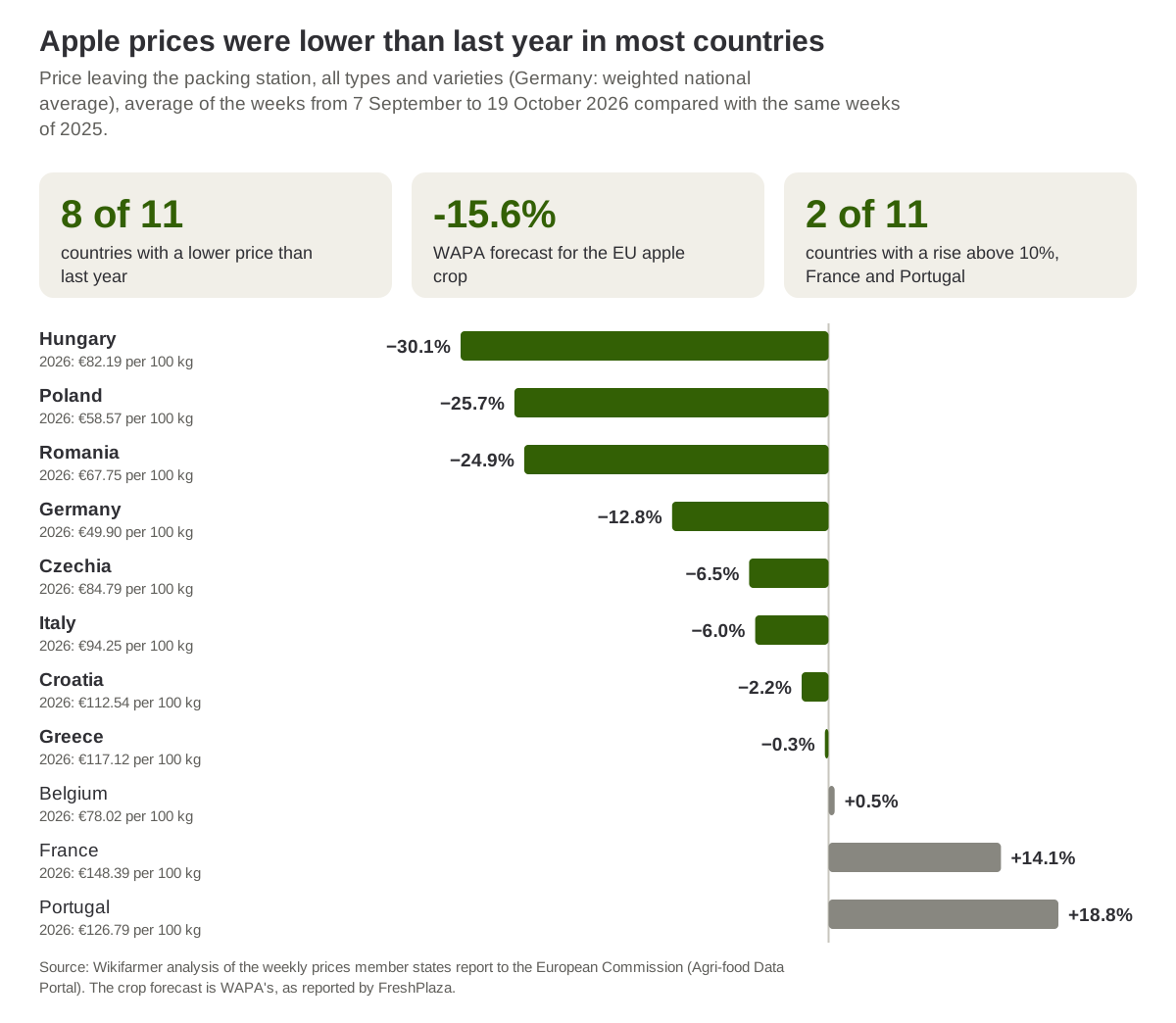
Source: Wikifarmer analysis of the weekly prices member states report to the European Commission (Agri-food Data Portal).
WAPA forecasts a smaller crop in most large producing countries
According to WAPA's first estimate, apple production in the EU's main producing countries will reach 9,496,047 tonnes, 15.6% less than the final figure for 2025 and 14.3% below the average of the previous three years (FreshPlaza). Fruitnet, reporting the same forecast, gives Poland, Europe's biggest apple producer, a crop of 2.6 million tonnes, 30% less than last season, with falls of about 10% for Germany, 24% for France, 25% for Belgium and 17% for the Netherlands, and a broadly stable crop for Italy. Of the countries with a large forecast fall and comparable prices, the packing station price was clearly higher than last year only in France, almost level in Belgium, and lower in Poland and Germany; the price analysis does not test what explains this difference.
Grower prices and the latest week give a more mixed picture
The Commission also publishes a farmgate price for apples, the price paid as the fruit leaves the farm, and with the same seven-week comparison it was lower than last year in Romania by 36.1%, Hungary by 24.2%, Germany by 13.0%, Belgium by 6.7% and Czechia by 1.2%, and higher in Poland by 0.2%, France by 5.0% and Italy by 6.6%. In Poland, then, the farmgate price stayed at its 2025 level while the packing station price was 25.7% lower. The latest week with data, starting 19 October, also reads differently in some countries: in Germany the packing station price was €58.05 per 100 kg, 6.6% higher than in the same week of 2025, and in Poland €65.35, level with last year, while in France it was 17.8% higher and in Hungary and Romania 23.4% and 28.2% lower respectively.
The comparison matters to those who sell and buy apples
Prices in the first weeks of the season concern growers and cooperatives selling to packing stations, the packing stations deciding how many apples to sell now and how many to store, and the buyers who supply the global apple market. The picture differs from other fresh produce of the same weeks, such as tomatoes, where prices in September and October were higher in most EU countries with data.
The comparison covers only the first seven weeks of the season, September and October, the northern hemisphere autumn, while much of the crop is sold in the following months. For Poland, Hungary, Romania and Czechia, which do not use the euro, prices are given in euros, and the analysis does not separate the effect of exchange rates. The data describe how prices moved without testing the causes, and they are not a forecast; the weekly prices of the coming weeks will show whether the gap with last year holds.
The analysis uses the weekly packing station (ex-packaging station) prices and farmgate prices for apples that member states report to the European Commission, as national averages in euros per 100 kg, for "all types and varieties" (for Germany, the weighted national average of all varieties). For each country the average of the weeks starting 7 September to 19 October 2026 is compared with the average of the same weeks a year earlier, starting 8 September to 20 October 2025, and a year counts only if it has a price for at least five of the seven weeks, as for Poland and Croatia in 2026 and Romania in 2025 at the packing station, and for Hungary (six weeks) and Poland (five) in 2026 and Romania (five) in 2025 at the farmgate. Spain is not included because since June 2026 it reports a weighted national average instead of the "all types and varieties" price, so the same series does not exist in both years, and the Netherlands has no prices for the same weeks of 2025. The "all types and varieties" price is a mix of varieties that can change from year to year, and the latest prices are revised by the Commission, as Hungary's farmgate price for the week of 12 October was, from €39.18 to €45.66 per 100 kg. The crop forecast is WAPA's as reported by FreshPlaza and Fruitnet and was not read in WAPA's own text. All price figures were recomputed independently from the Commission's original files.
Sources
- European Commission. (2026). Agri-food Data Portal, API guide and fruit and vegetable supply chain prices. Directorate-General for Agriculture and Rural Development.
- FreshPlaza. (2026). EU's 2026 apple harvest to decrease by 15.6%, pear harvest to grow by 5.5%.
- Maxwell, M. (2026, August 6). Inclement weather hits EU apple production, again. Fruitnet, Eurofruit.