


On 20 October a card network and two US software companies, one handling accounts payable for buyers and one handling receivables for suppliers, launched what they describe as the first live pilot in which AI agents start and complete invoice payments through suppliers' payment portals. An AI agent here is software that is allowed to carry out steps on its own on behalf of a company. The agent pays by card with tokenised credentials, so the buyer does not hand over its login to the supplier's portal, and each payment is tied to a specific invoice. According to the companies, the agent pays only invoices the buyer has already approved and makes no payment decisions. The pilot is processing payments with participating buyers, whose number the companies have not given.
The person approves the invoice and the agent carries out the payment
In a speech at the Sibos conference on 29 September, Christopher Waller, a member of the US Federal Reserve Board, described two models. In the first, a buyer uses an agent to search and compare, then decides and pays. In the second, the buyer gives the agent authority to buy and pay on its behalf, within limits the buyer sets. The pilot falls between the two, since the decision to pay stays with a person in the buyer's finance team while the agent takes over the step that someone used to do by hand, typing payment details into the supplier's portal. On the supplier's side, the portal recognises the registered agent instead of blocking it with the checks websites use to keep out automated traffic.
Waller also said that purchases between businesses may suit agents well, because they recur and follow set rules such as approved suppliers and budget limits. He added that the higher values involved increase the exposure when an agent makes an error or acts without authority, and that strong controls and monitoring will be needed.
Card networks and a standards body are defining how consent is recorded
According to Waller, card networks are publishing technical specifications that include ways to register agents and to log the cardholder's approval of an agent's payment. AP2, an open protocol for agent payments first published in September 2025, records what the user allowed in two signed digital credentials. One covers the items and terms agreed with the seller and the other authorises a payment from a specific card or account. Each starts as a set of limits, such as a budget, and is closed once a specific purchase and amount are approved, so the chain of credentials leaves an audit trail whether or not a person is present when the payment goes through.
In April the FIDO Alliance, an industry body that writes authentication standards, set up two working groups on agents. One deals with how users delegate actions to agents and how actions started by a user are told apart from actions started by an agent. The other writes specifications for payments that agents start. The work covers verifiable user instructions, agent authentication and delegation within limits the user controls, and AP2 was contributed to it.
Most payment value in the euro area moves by credit transfer
The pilot and the specifications are built for card payments, yet in the euro area credit transfers carried 92% of the value of non-cash payments in the second half of 2025, according to the European Central Bank. Card payments made up 57% of the number of transactions but €1.8 trillion of the €117.8 trillion total, about 1.5% of the value. In the olive oil trade, a buyer may pay in advance by bank transfer, through documentary collection, by letter of credit or on open account, and each method fixes a different point at which the buyer commits.
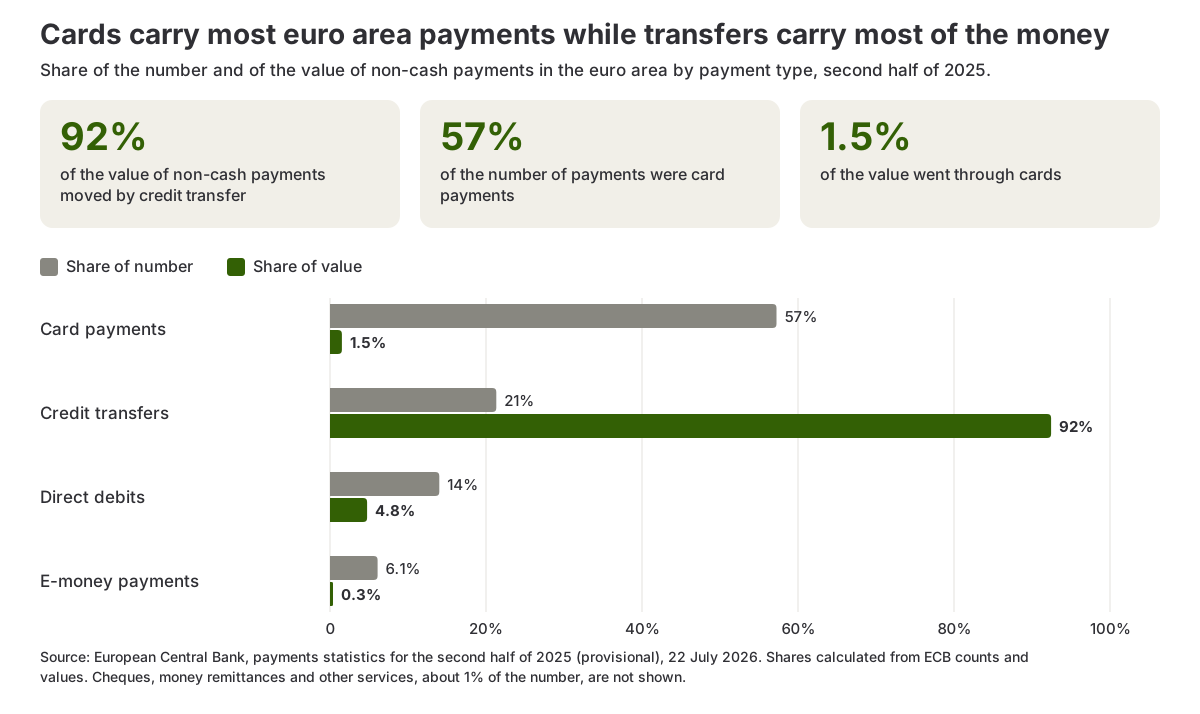
Euro area non-cash payments by type, share of number and share of value, second half of 2025. Source: European Central Bank.
Since 9 October 2025, before a payer in the euro area authorises a credit transfer, the payer's bank has had to verify whether the payee's name matches the account number, under the regulation on instant credit transfers. If the two do not match, the bank warns the payer that the money may reach an account the named payee does not hold, but it may not stop the payer from authorising the transfer. Business customers can opt out of the check when they send several payment orders as a package.
EU payment rules do not yet say who answers for an agent's mistake
Under the 2015 Payment Services Directive, which is still in force, a payment counts as authorised only if the payer has given consent in the form agreed with the bank, and the bank must refund a payment that was not authorised. For customers that are not consumers, the bank and the customer may agree that several of the liability provisions do not apply. The directive does not deal with AI agents. The regulation that is to replace much of it, agreed by Parliament and Council negotiators in November 2025, was still awaiting final adoption on 20 October 2026, with a Parliament plenary vote indicated for 14 December.
Waller's own summary of the problem was "Who is on the hook if an agent makes the wrong purchase?" An IMF note published in April recommends clarifying the legal framework for agents' actions in payments to reduce uncertainty over liability, and the ECB has invited firms to workshops in 2027 on AI agents in a possible digital euro, with applications open until 9 November.
Five points a buyer or supplier can settle before an agent pays
- Which payments: the invoices or suppliers an agent may pay, up to what amount, and who approves each payment before the agent acts.
- Limits: the budget, the list of approved suppliers and the link between each payment and an invoice, written down where the payment system can apply them.
- Payment method: whether the agent pays by card or by bank transfer, who receives the bank's warning when a payee's name does not match the account, and whether the company has opted out of that check for bulk payments.
- Records: what the person approved and what the agent did, kept side by side, since a dispute will turn on both. In freight booking too, the approval step sits in a different place on each system.
- Contracts: what the agreements with the bank and with the supplier say about a payment that turns out to be wrong, since business accounts can depart from the directive's liability rules.
Sources
- Visa, BILL and Billtrust. (2026). Visa, BILL and Billtrust launch first live pilot for trusted AI agent payments between buyer and supplier platforms. Business Wire, via Visa Investor Relations, 20 October 2026.
- Waller, C. J. (2026). Payments in the age of AI agents. Speech at Sibos 2026, Miami, 29 September 2026. Bank for International Settlements.
- Agent Payments Protocol. (2025). AP2: Agent Payments Protocol. AP2 project site.
- FIDO Alliance. (2026). FIDO Alliance to develop standards for trusted AI agent interactions. Business Wire, via StreetInsider, 28 April 2026.
- European Central Bank. (2026). Payments statistics: second half of 2025. ECB, 22 July 2026.
- European Parliament and Council of the European Union. (2024). Regulation (EU) 2024/886 as regards instant credit transfers in euro. Official Journal of the European Union.
- European Parliament and Council of the European Union. (2015). Directive (EU) 2015/2366 on payment services in the internal market. Official Journal of the European Union.
- European Parliament. (2026). Procedure file 2023/0210(COD): Payment services in the internal market. Legislative Observatory.
- Davidovic, S. and Tourpe, H. (2026). How agentic AI will reshape payments. IMF Note 2026/004. International Monetary Fund.
- European Central Bank. (2026). Call for expressions of interest in a new wave of digital euro innovation platform activities. ECB, 28 September 2026.