
Europe is losing its small farms at an alarming rate
Between 2010 and 2020, the European Union lost 3 million farms. That is a 24.8% decline in a single decade, according to Eurostat's 2020 agricultural census. Nearly all of those losses came from the smallest operations: farms under 5 hectares shrank by 2.7 million. At the same time, farms larger than 100 hectares grew in number by about 41,000, an increase of 14.3%.
The land itself did not disappear. The EU's total utilised agricultural area barely changed, falling by just 1.1% over that period. What changed was who controls it. A wave of mergers and acquisitions shifted farmland from millions of small holders to a much smaller number of large operations, and the consequences of that shift touch every part of European agriculture.
.png)
3.6% of farms now control more than half the land
In 2020, 63.8% of all EU farms were smaller than 5 hectares. Yet farms of at least 100 hectares, representing only 3.6% of total holdings, cultivated 52.5% of the EU's agricultural land. The average farm size was 17.4 hectares, but that figure hides an enormous gap between the many small, semi-subsistence operations and the relatively few large commercial enterprises.
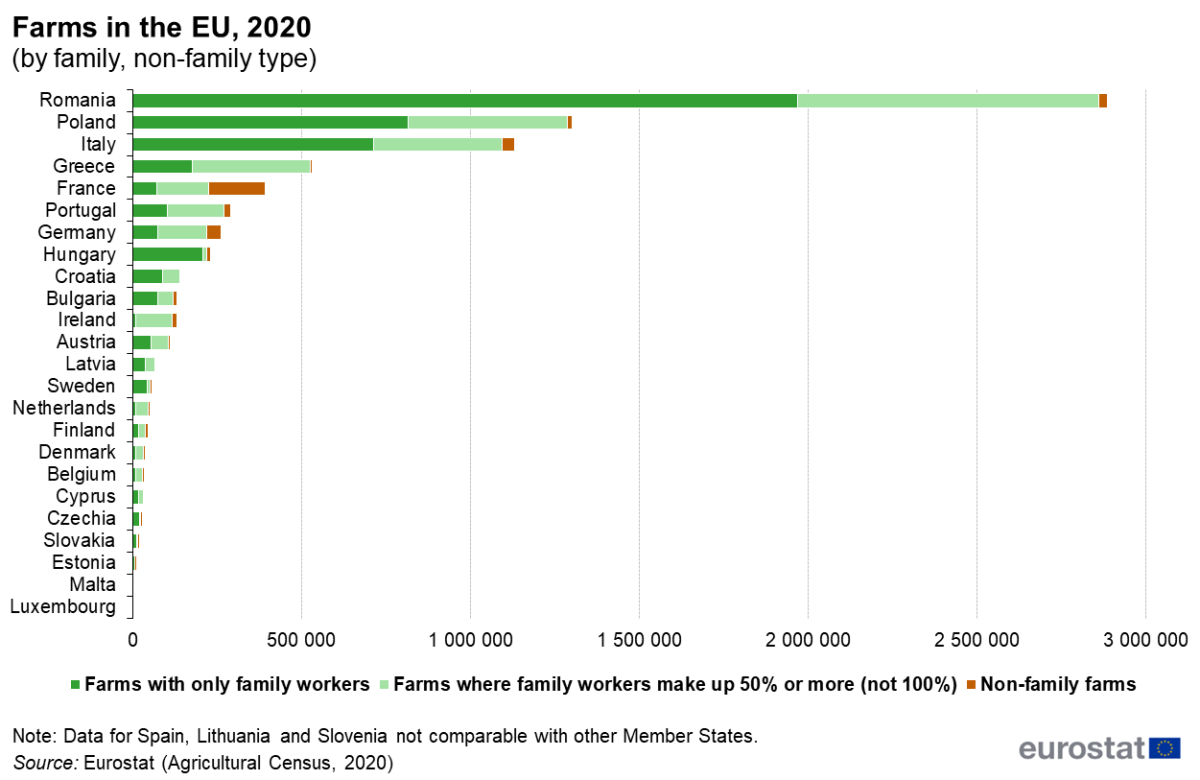
The distribution of farms across countries tells its own story. Romania alone accounted for nearly a third (31.8%) of all EU farms in 2020, followed by Poland (14.4%), Italy (12.5%), and Spain (10.1%). These four countries held more than two-thirds of Europe's farms, and they are home to the bulk of its smallholders.
The EU's utilised agricultural area covered 157.4 million hectares in 2020, or 38.4% of total land area. The share devoted to agriculture varied widely: less than a tenth in Sweden and Finland, over half in Hungary, Romania, and Denmark, and peaking at 71.7% in Ireland. France held the largest agricultural area at 27.4 million hectares (17.4% of the EU total), followed by Spain at 23.9 million hectares (15.2%).
What is pushing small farms out?
Mechanisation and automation favour farms that can justify capital investment in modern equipment. Between 2013 and 2023, the EU's agricultural workforce dropped from 5.2% to 3.9% of total employment, a pattern driven by precision agriculture and related labour-saving technologies. Romania saw the steepest decline: its agricultural employment share fell 8.9 percentage points from a starting level of 29.6%. Every single EU country recorded a drop over that decade.
Input costs compound the problem. When fertiliser prices surged 31.1% in 2022 following Russia's invasion of Ukraine, smaller farms with tighter margins were hit hardest. Although prices fell in 2023 and 2024 (fertilizer costs dropped 24.5% and 17.6% respectively), levels remain above pre-war baselines. The total cost of intermediate inputs for the EU's agricultural industry reached EUR 303.3 billion in 2024, and the ability to absorb those costs correlates directly with farm size.
The economics of the Common Agricultural Policy (CAP) further complicate the picture. CAP direct payments totaled EUR 28.8 billion in 2024, and while the 2023-2027 reform aims to redistribute support toward smaller farms and younger farmers, the structural advantages of scale remain. The dependence on direct payments varies dramatically across the EU. In Estonia, direct support accounts for 89.5% of agricultural factor income. In Latvia, it is 63.9%, and in Lithuania, 61.4%. At the other end, the Netherlands relies on subsidies for just 5.5% of farm income, Italy for 10.5%, and Cyprus for 10.7%. This gap reflects deep differences in farm structure, production intensity, and market access that policy alone cannot easily bridge.
An ageing workforce with few replacements
In 2020, 32.6% of EU farm managers were 65 or older, and they typically worked on small or semi-subsistence operations. Only 12.2% were under 40, and men accounted for 73.5% of that younger group. Among new farm managers (those who started within the preceding three years), 58.9% were already over 40. The pattern was most pronounced in southern Europe: in Greece, Portugal, Slovenia, and Spain, more than 70% of new entrants were older than 40. By contrast, Poland, Finland, and Austria saw a majority of new managers aged 40 or younger.
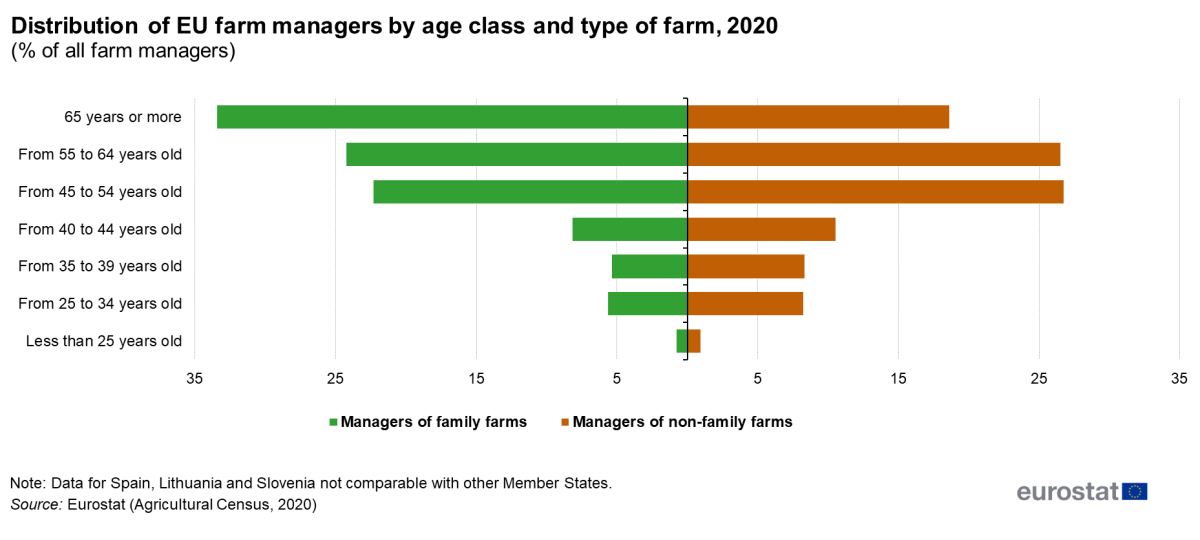
Source: Eurostat (online data code: ef_fsi_agesex)
The work itself is demanding and carries above-average risks. Average weekly hours in EU agriculture stood at 40.6 in 2024, compared with 35.5 across all sectors. Long working hours (49 or more per week) affected 22.0% of agricultural workers, compared with 6.5% economy-wide. Fatal workplace accidents in agriculture ran at 4.2 per 100,000 employed in 2022, 2.5 times the overall economy rate of 1.7.
Self-employment dominated the sector at 53.7%, and unpaid family work was far more prevalent in agriculture (9.4%) than in the wider economy (0.6%). Only 13.8% of the agricultural workforce held a tertiary degree, compared with 38.6% across all sectors. These conditions make farming less attractive to younger generations and accelerate the exit of smaller operations.
What does this mean for food and farming?
The consequences reach beyond farm gates. Small farms tend to grow a wider variety of crops and maintain more diverse landscapes than large monoculture operations. In 2020, 58.2% of EU farms specialized in crops, with about a third focused on field crops and a fifth on permanent crops. Mixed farms, combining crops and livestock, made up 19.3% of holdings. As small farms vanish, so does much of that diversity.
Organic farming offers a partial counterpoint. By 2023, organic land reached an estimated 10.8% of total utilized agricultural area. Between 2013 and 2023, the organic area of 26 EU countries expanded by 7.6 million hectares, an 84% increase. Organic farms averaged 42.4 hectares in 2020 compared with 15.9 for non-organic operations, and generated higher standard output per farm (EUR 86,400 versus EUR 37,500). The EU's target of 25% organic farmland by 2030 would require sharp acceleration, but the growth shows that sustainable farming practices can work at various scales.
Rural economies feel the strain most directly. Agricultural labour input fell 32.3% between 2009 and 2024, an average annual decline of 2.6%. Fewer farms means fewer families, fewer local businesses, and weaker rural infrastructure. Real factor income per annual work unit rose 93.6% over the same period, but that improvement came largely because a third of the workforce left the sector. Country-level differences were stark: Slovakia averaged 9.2% annual income growth per worker, Denmark 7.5%, and Bulgaria 7.4%, while France managed just 2.0% and Malta was the only EU country to record a real decline.
The CAP post-2027, currently under review by the European Parliament and Council, aims to make EU farming "more competitive, sustainable, resilient and fair." Whether it can reverse decades of consolidation will determine if European agriculture in 2030 still includes the small-scale, diversified operations that have shaped its landscapes and food security for centuries.
References
Eurostat. (2025). Key figures on the European food chain, 2025 edition. Publications Office of the European Union.