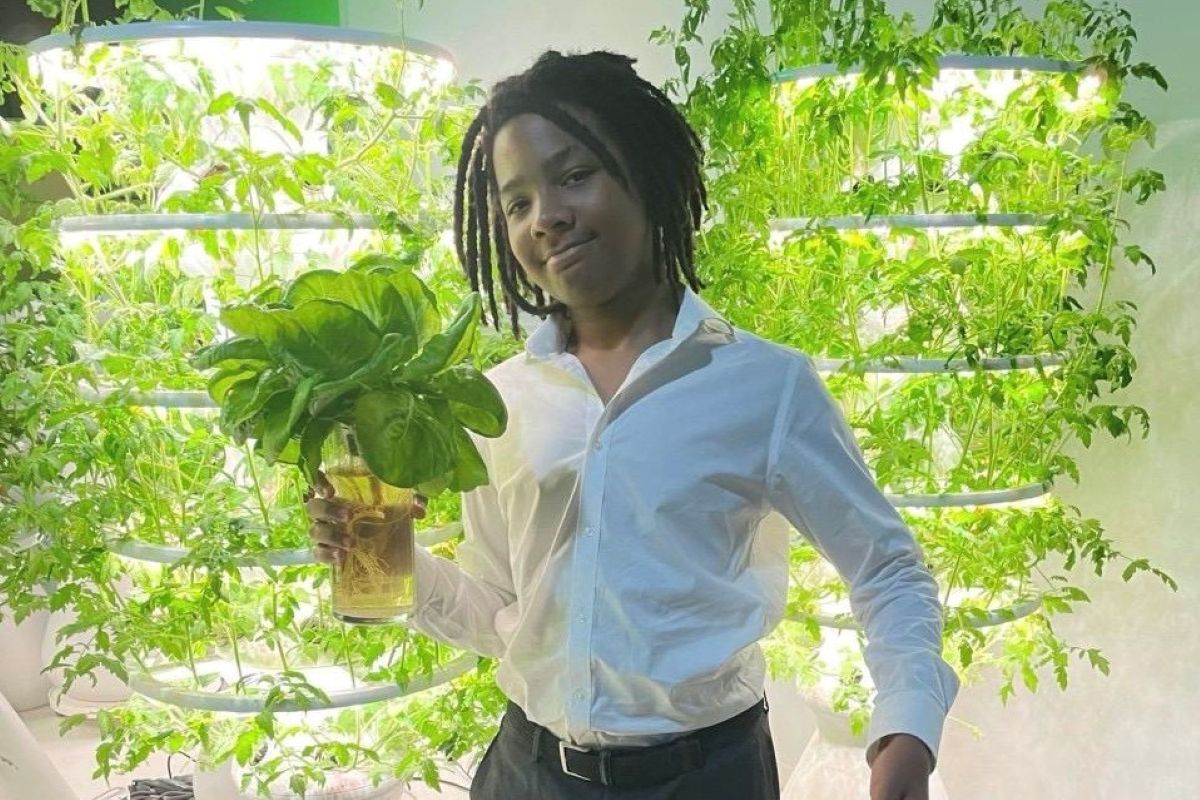
Fifteen-year-old Malon E.D. James of Atlanta, Georgia, U.S., has built a biosecure indoor hydroponic farm, cultivated more than 42 crop varieties, and works with universities to promote soil-free farming worldwide.
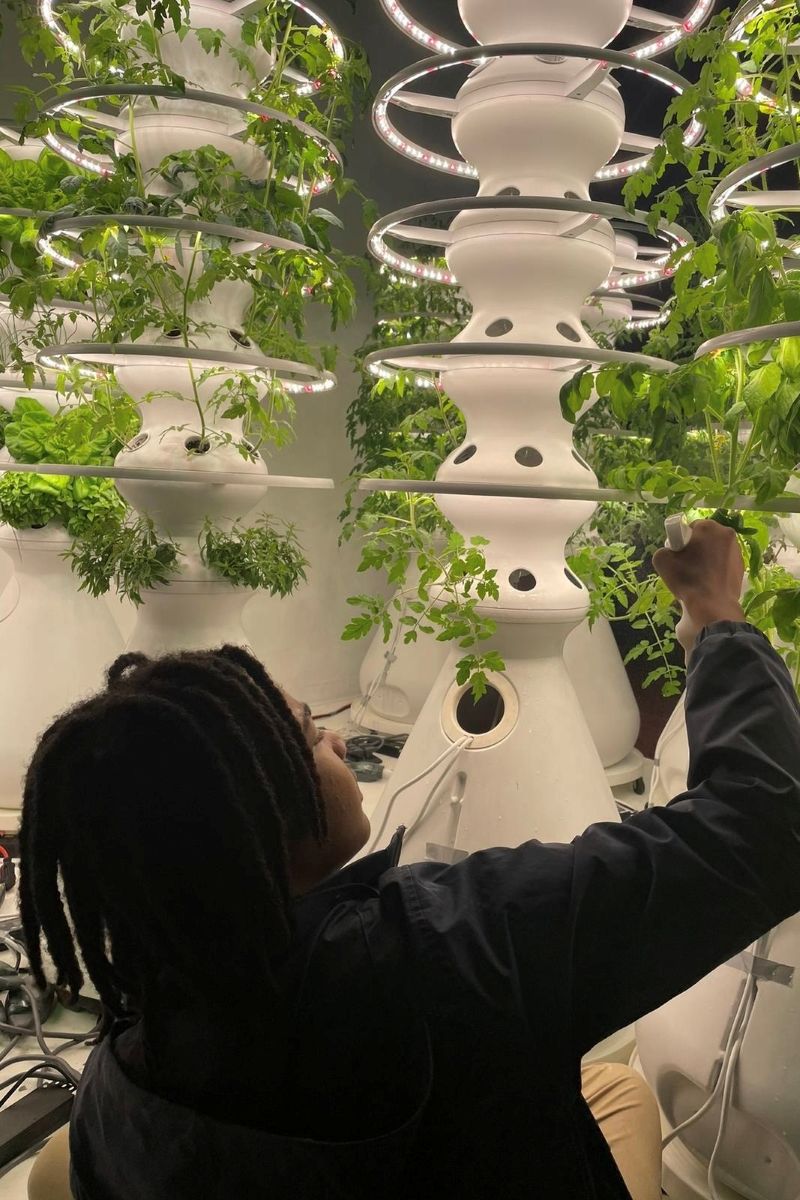
On most mornings in Atlanta, while many teenagers are still asleep, 15-year-old Malon E.D. James is already inside his indoor hydroponic farm-lab, checking nutrient reservoirs, adjusting LED lighting schedules and inspecting rows of seedlings growing without a single handful of soil.
Officially recognised as Georgia’s youngest certified hydroponic farmer, James graduated high school at 13 and has cultivated more than 42 varieties of fruits, vegetables and fibre crops — including experimental hydroponic cotton — inside a tightly controlled indoor environment. His research focuses on controlled environment agriculture (CEA), sustainable substrates and advanced lighting systems, work he has pursued in collaboration with the University of Georgia and Fort Valley State University.
But for James, hydroponics is not simply a scientific pursuit. It is a response to a problem he believes is increasingly urgent: global food insecurity.
How it all began
James traces the origin of his agricultural work to the early months of the COVID-19 pandemic in 2020.
“When COVID first struck, everybody was locked in,” he recalls. “Nobody knew what to do. I wanted to step up and help.”
He launched a grassroots campaign called Everyone Deserves a Mask, shipping protective and sanitation supplies from the U.S. to contacts he had made online in Liberia. Yet as aids began to arrive, a deeper vulnerability emerged. “We had masks, we had water, we had all these supplies,” he says. “But we didn’t have food.”
Markets had shut down, and many people lost income almost overnight. Access to fresh produce dwindled, and refrigeration infrastructure was limited. What began as a public health emergency rapidly evolved into a food security crisis.
“COVID supplies can only get you so far,” James says. “If you don’t have readily available food, what are you going to do?” The experience pushed him to search for a solution that did not rely on open markets, vast farmland or expensive agricultural infrastructure.
Discovering hydroponics
A Swiss physician first introduced James to hydroponics — the method of growing plants without soil using nutrient-enriched water in controlled systems.
“Before that, hydroponics was a foreign topic to me,” he says.
Agriculture, however, was not entirely unfamiliar. As a child, he watched his grandmother and mother grow tomatoes by a window, observing how water filtered through containers while roots absorbed what they needed. That early curiosity resurfaced as he explored vertical farming and soil-free cultivation systems.
Hydroponics, he discovered, could be adapted to different environments and resource levels. For communities with limited land access or disrupted supply chains, that flexibility was especially valuable.
“It can be complicated,” he says. “But it can also be as simple as you want it to be.”
Building an indoor farm-lab
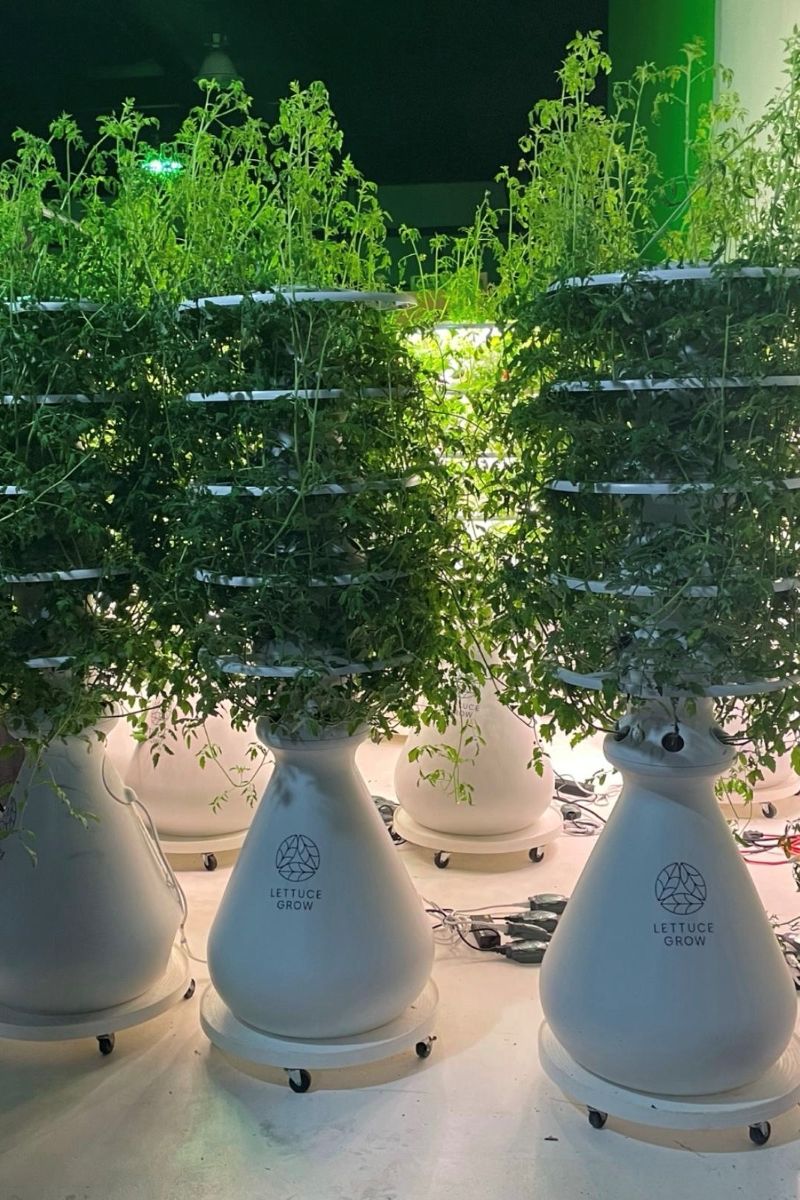
Determined to test the model himself, James began researching system designs and contacting manufacturers. Lettuce Grow, a vertical farming company, donated several hydroponic towers, allowing him to expand his experimental setup.
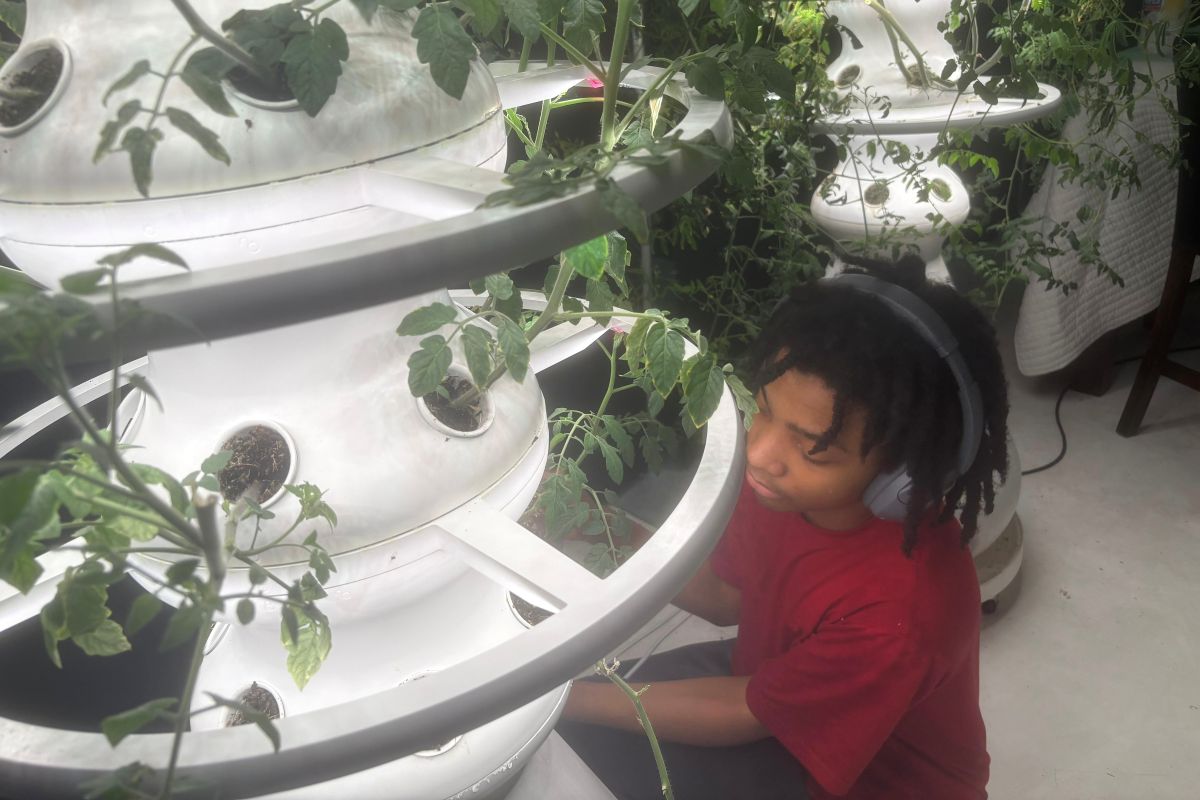
Today, he operates 24 hydroponic farmstands inside a compact indoor facility in Atlanta. The footprint is small compared to traditional agriculture — no acres of land, no heavy machinery, and no soil — yet the crop variety is extensive. He grows leafy greens, fruits, rice, cacao, coffee and fibre crops, including cotton.
LED lighting cycles are calibrated by species and run on timed intervals tailored to plant growth. Unlike horizontal nutrient film technique (NFT) systems, his vertical drip towers deliver nutrient solution from the top downward, using gravity to improve efficiency.
After five years of experimentation, James has tested multiple system configurations, studying how different designs address specific agricultural challenges in controlled environments. “All different. All unique,” he says. “All tackling some different type of issue.”
Reinventing “soil” for soil-free agriculture
One of James’s most significant projects is developing a biodegradable growing substrate — a soil alternative designed specifically for vertical hydroponic systems.
Traditional soil cannot effectively anchor plants in vertical towers and would wash through the structure. Hydroponic growers typically rely on materials such as coconut coir or rockwool to stabilise roots while allowing water and nutrients to circulate.
“It's meant to be firm and sturdy, able to hold the seed, keep it there, and let it grow,¨explains James.
He is refining a substrate that holds seeds securely while optimising nutrient retention and plant stability in controlled environments. James has secured a provisional patent for the design and is continuing to test it for performance.
“I’m trying to understand what a plant really needs, so the plant is comfortable in its climate and not overly reliant on outside sources,” he says.
His research includes collaborations with the U.S. Department of Agriculture, the University of Georgia, and Fort Valley State University, focusing on nutrient optimisation, lighting efficiency, and substrate performance. For James, hydroponics is both a cultivation method and a research platform for future food systems.
An educational mission
James began experimenting with hydroponics around age 10, but a classroom workshop marked the moment his work evolved beyond a personal project.
While guiding elementary school students through assembling and planting hydroponic towers, he noticed how quickly they engaged with the technology.
“Midway, I felt something in my heart,” he recalls. “Seeing young children so interested and building it from the ground up with such ease and such precision.”
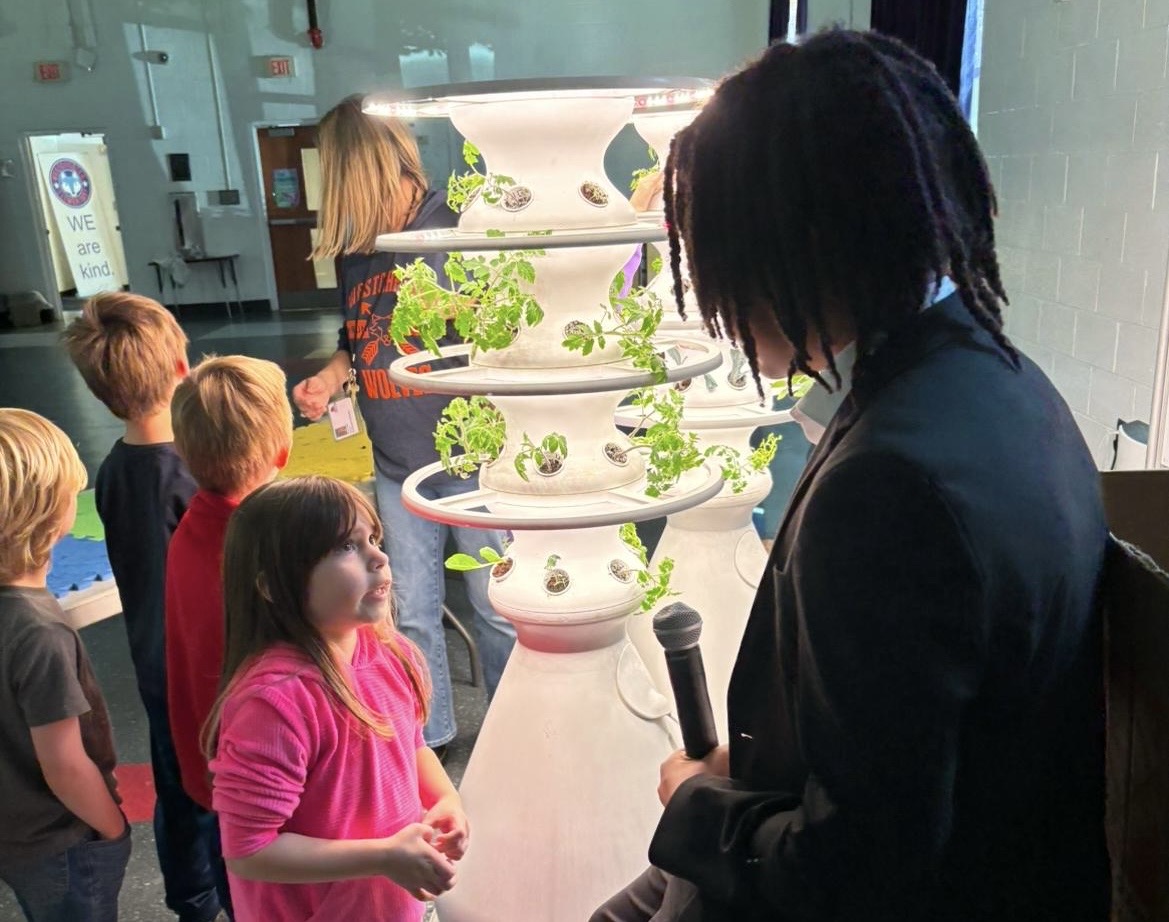
Workshops have since become central to his outreach. He partners with schools, colleges and community groups, teaching participants how hydroponic systems function, how nutrients circulate and how crops grow in controlled environments. Students plant seeds, assemble systems and monitor growth cycles firsthand.
“I want society as a whole to recognise it for what it is,” he says. “Technology.”
Extending the model to Liberia
Although based in the United States, Liberia remains central to James’s work. Through installations, training sessions and partnerships with local collaborators like Climate Smart Solutions, he estimates that his initiatives have helped more than 900 families gain access to locally grown food.
“I see what they need, what crops they want,” he says. “I’m glad I’m able to give them the knowledge so they can sustain themselves.”
One experience remains particularly vivid. After a delivery miscommunication left a single mother and her son without promised water, local partners intervened to ensure immediate delivery. The child later sent a note of thanks — a moment that reinforced James’s belief in resilient, localised food systems.
“We’re bonding over a root cause,” he says. “They need sustainability.”
Confronting skepticism in a traditional industry
Working in a field largely dominated by adults has not come without skepticism.
“It won’t ever be easy. People don’t think you have the same knowledge and wisdom. Pride and egos are strong in humans,” James reflects.
He recalls a conversation with a conventional farmer who insisted soil is indispensable to agriculture. Rather than positioning hydroponics as a replacement, James frames it as a complementary system suited for urban environments, climate-controlled production and regions facing land or supply limitations. “I don’t look at the world as swords versus sticks,” he says.
“Why can’t hydroponics and traditional farming work hand in hand?” he asks.
Criticism has become fuel for innovation. “I take my biggest haters and turn them into my biggest motivators. If hydroponics ends up working, and everybody has it in the end, I’ll look back and think, wow, I did this—even with these bad actors whispering in my ear. Some people are just scared of innovation.”
James advises aspiring farmers and young innovators: “Don’t try to fit into groups that don’t recognise you. Be something different. Setbacks and discrimination are phases. You have to go through the cons to get to the pros.”
Persistence, he says, is as crucial as technical skill. “Don’t give up.”
Food security, traceability, and trust
At the core of James’s philosophy is transparency in food production.
“If you go to a grocery store and see lettuce, do you know where it came from? What it endured?” he says.
Indoor hydroponic systems allow growers to control climate, water use and nutrient delivery while reducing reliance on pesticides. The result is greater traceability and trust — particularly for families growing their own food in homes, schools or community spaces.
Youth agricultural loan programs and community support have helped him expand equipment and research capacity. His next goal is a 4,500-square-foot facility, a major scale-up that would allow for broader experimentation and production.
Recognition and support
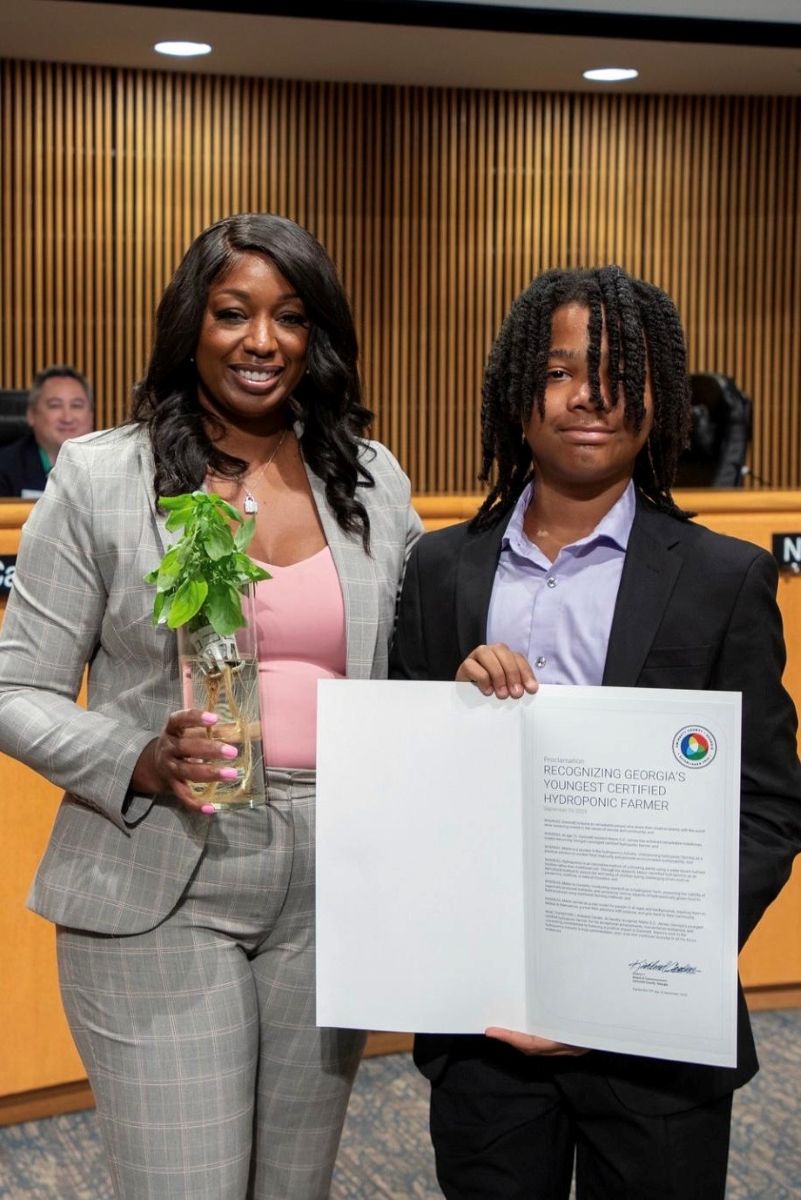
James’s work has earned public recognition, including a city council proclamation naming him Georgia’s youngest hydroponic farmer. “It was shocking,” he says. “I thought surely there were people before me.”
Behind his work stands a close support system, along with a growing digital audience that follows his progress on Instagram and TikTok and helps connect him with schools and community organisations.
“My family, my lovely grandmother, my mother—they’re my main support system,” he says. “They bear with me every day.”
The vision: Hydroponics everywhere
Ask James what the future looks like, and he doesn’t hesitate. “Hydroponics everywhere,” he says. “And everybody knows how to use it.”
He envisions traditional farming continuing outdoors while hydroponic systems operate indoors in classrooms, homes and urban communities. In that vision, families grow their own produce, schools integrate agricultural technology into education, and communities are less vulnerable to supply-chain disruptions.
For James, the ultimate goal is a food system that is traceable, sustainable and accessible — grown not only in fields, but in homes, schools and cities.
And each morning, before most teenagers wake, he is already working toward it.