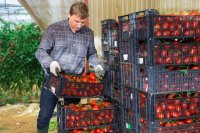


Food traceability is the ability to track and trace food products and their ingredients forward through distribution and backward to their source at every stage of the supply chain. It means that at any point between harvest and consumption, a food item can be linked to a specific farm, field, lot, processing facility, shipping date, and destination.
Traceability is not just a regulatory checkbox. When the 2024 US cucumber Salmonella outbreak sickened 551 people, the delay between the first illness in March and the recall in May was partly caused by difficulty tracing contaminated product through a complex supply chain (U.S. PIRG, 2025). Effective traceability narrows the scope of recalls, reduces the time contaminated products stay on shelves, and protects producers whose products are not involved. For farmers, it also serves as proof that their operation followed correct procedures if a downstream contamination event is investigated.
What does food traceability mean?
Food traceability means maintaining documented records that allow any food product to be followed from its origin to its final point of sale, and back again. The Codex Alimentarius defines it as the ability to follow the movement of a food through specified stages of production, processing, and distribution.
In practice, traceability requires each participant in the supply chain to record what they received, from whom, what they did with it, and to whom they sent it. This creates an unbroken chain of documentation linking a finished product on a retail shelf to the specific field where a crop was harvested or the facility where an animal was processed. When contamination is detected, investigators follow this chain to identify the source, determine which lots are affected, and remove only those products rather than issuing a blanket recall across an entire category.
Why is food traceability required?
Traceability is required because it makes food recalls faster, more targeted, and less costly. Without lot-level records, a contamination event affecting a single batch can force the recall of an entire product line or an entire season's production, causing losses far beyond what is necessary.
The economic argument is significant. The EU's Rapid Alert System for Food and Feed (RASFF) processed 5,250 notifications in 2024, a 12% increase over 2023 (European Commission, 2025). Each notification triggers product investigations that depend on traceability records to determine scope. In the US, the FDA estimates that approximately 48 million foodborne illness cases occur annually. Faster tracing means fewer people exposed to contaminated products between the first illness report and the recall announcement. The FDA's FSMA Food Traceability Rule was developed specifically to close this time gap for the highest-risk foods. Information on recent food safety recall trends illustrates how traceability gaps contribute to prolonged outbreaks.
What are Critical Tracking Events and Key Data Elements?
Critical Tracking Events (CTEs) are the specific points in the supply chain where traceability records must be created. Key Data Elements (KDEs) are the individual pieces of information that must be recorded at each CTE. Together, CTEs and KDEs form the standardized language of food traceability under the FDA's FSMA Section 204 rule.
The main CTEs defined by FSMA 204 are growing (for farms), receiving, transformation (any processing that changes the food, such as cutting, cooking, or mixing), creation of a new product, and shipping. At each CTE, producers must record KDEs including the traceability lot code, product description, quantity and unit of measure, location identifiers, dates, and reference documents such as bills of lading or purchase orders.
For example, a leafy greens farm must record the specific field or growing area (identified by name and geographic coordinates), the date of harvest, the quantity harvested, the traceability lot code assigned, and the immediate receiver to whom the product was shipped. This level of detail allows investigators to trace a contaminated bag of spinach back to the exact field and harvest date within hours rather than weeks.
What do regulations require from farmers and producers?
The two major regulatory frameworks for food traceability are the EU General Food Law and the US FSMA Food Traceability Rule. Both require documented records, but they differ in scope and specificity.
EU requirements: Regulation (EC) No 178/2002 requires all food businesses, including primary producers, to identify their immediate suppliers and immediate customers. This "one step back, one step forward" principle applies to every food product, not just high-risk items. The EU has also launched TraceMap, an AI-powered platform connecting RASFF data with trade databases to accelerate tracing during contamination events (European Commission, 2026). Wikifarmer's guide to EU food recall systems explains how these mechanisms work in practice.
US requirements: The FSMA Food Traceability Rule (Section 204) applies to high-risk foods on the Food Traceability List (FTL). Covered businesses must record CTEs and KDEs, maintain records for at least 24 months, and provide traceability data to the FDA within 24 hours of a request in an electronic sortable format. The original compliance date was January 2026, but Congress directed the FDA not to enforce the rule before July 20, 2028 (FDA, 2025). Farms growing FTL foods must also maintain a traceability plan with a farm map showing field names and geographic coordinates. Maintaining food safety compliance requires understanding which rules apply to your specific operation.
What technologies enable food traceability?
Traceability systems range from paper-based logbooks to fully digital platforms using barcodes, RFID tags, QR codes, and blockchain. The right choice depends on the size of the operation, the complexity of the supply chain, and regulatory requirements.
Barcodes and QR codes are the most common technology. GS1 standards, including the Global Trade Item Number (GTIN) combined with lot codes, provide a universal identification system recognized by regulators and trading partners worldwide. Scanning a barcode at each CTE automatically creates a timestamped digital record.
RFID tags allow automated scanning without line-of-sight and can record temperature data during food supply chain storage and transportation, adding cold chain verification to the traceability record.
Blockchain creates a tamper-proof, shared ledger that no single participant can alter. This is valuable for international supply chains where multiple jurisdictions are involved. Wikifarmer covers how blockchain and training enhance transparency across the food chain, and how IoT devices are enhancing farm management and food safety through real-time environmental monitoring. Data analysis is also reshaping how food traceability in food supply chains functions at scale.
What does a traceability plan look like on a farm?
A traceability plan on a farm is a written document describing how the operation tracks food from field to first buyer. Under FSMA 204, farms growing FTL foods must maintain a plan that includes a description of procedures used to maintain required records, a method for identifying FTL foods handled, procedures for assigning traceability lot codes, a point of contact, and a farm map.
The farm map is a practical requirement that most growers can meet with a simple diagram showing field names, boundaries, and geographic coordinates. At harvest, the grower assigns a traceability lot code and records the date, quantity, field identifier, and the name and address of the first receiver.
For small farms, a spreadsheet with columns for date, field, crop, lot code, quantity, and buyer can satisfy the requirement. Larger operations typically use farm management software that generates lot codes automatically. Regardless of scale, the system must allow the producer to retrieve all records for a specific lot within 24 hours. Running mock traces quarterly, picking a random lot and reconstructing its full history within four hours, is a practical way to test the system before it is needed in a real emergency.
Frequently asked questions
What foods are on the FDA Food Traceability List? The FTL includes leafy greens, melons, tomatoes, peppers, cucumbers, fresh herbs, sprouts, tropical tree fruits, fresh-cut fruits and vegetables, shell eggs, nut butter, soft and semi-soft cheeses, finfish, crustaceans, mollusks, smoked seafood, and ready-to-eat deli salads.
When does the FSMA Food Traceability Rule take effect? The original compliance date was January 20, 2026. Congress directed the FDA not to enforce the rule before July 20, 2028, giving businesses additional time to implement the requirements.
Does the EU require lot-level traceability? The EU General Food Law requires "one step back, one step forward" traceability for all food products. Some sectors, such as beef (Regulation (EC) No 1760/2000), have additional lot-level requirements. Individual retailers and certification schemes may also require lot-level tracking beyond the legal minimum.
Can small farms comply with paper records? Yes. The FSMA Food Traceability Rule does not require electronic recordkeeping or specific technologies. Paper records are acceptable as long as they can be provided in an electronic sortable spreadsheet format within 24 hours of an FDA request.
References
- FDA. (2025). FSMA Final Rule on Requirements for Additional Traceability Records for Certain Foods. FDA.
- FDA. (2025). FDA Proposes to Extend Compliance Date for Food Traceability Rule. FDA.
- European Commission. (2025). RASFF Annual Report 2024. DG SANTE.
- U.S. PIRG Education Fund. (2025). Food for Thought 2025. U.S. PIRG.
- GS1 US. (2025). FSMA and GS1 Standards. GS1 US.