What would you do if, after two years of planning, research, and cultivation, you were told you had 30 days to destroy your cotton?
Not harvest it.
Not relocate it.
Destroy it.
I quickly learned I was not the first to feel the invisible but enduring authority of King Cotton. That order, absolute and non-negotiable, became the moment an ancient crop collided head-on with modern control.
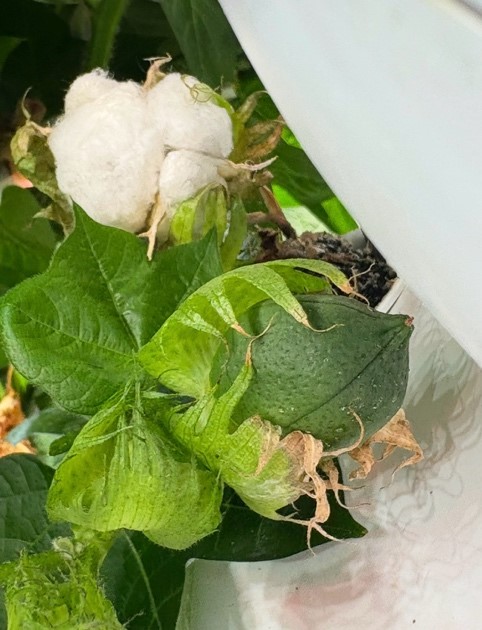
Photo courtesy of Malon E.D. James
Cotton is usually framed as fabric. Shirts, towels, and sheets folded into everyday life. But that narrow view ignores what cotton is becoming. In the 21st century, cotton is being reimagined as a biodegradable circuit substrate, a scaffold for regenerative medicine, a responsive material that can glow or change color, and even a bio-based filter capable of purifying water.
This is not a new invention. It is an 8,000-year-old fruit finally being allowed to speak in the language of technology and sustainability.
First domesticated in the Indus Valley and South America, cotton has clothed civilizations, fueled empires, and shaped economies, often at tremendous human cost. Today, its evolution continues far from the open field, inside controlled hydroponic systems and high-tech labs from Atlanta to India to Brazil. Here, researchers are asking an uncomfortable question.
What happens when cotton no longer depends on soil, or the systems that have historically governed it?
That question does not go unanswered for long. Because in Georgia, cotton still has guardians, and when innovation strays too far from tradition, the boll weevil is never the only thing watching.
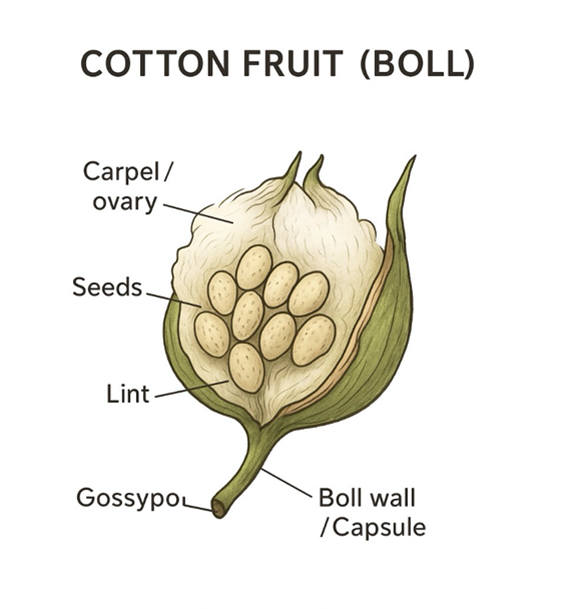
Hibiscus: From hydroponic peas to okra to cotton
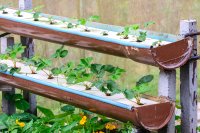
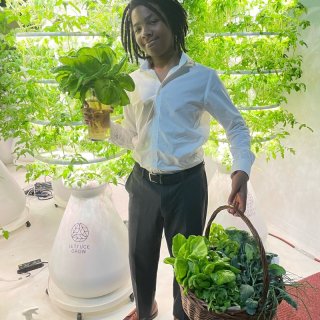
My path to hydroponic cotton did not begin with cotton at all. It began with a fascination for growing plants entirely in water. Roots suspended in carefully balanced nutrient solutions, freed from soil and the assumptions that come with it.
Early success with other members of the broader hibiscus lineage, including peas (Pisum sativum) and okra (Abelmoschus esculentus), gave me the confidence to attempt something far more ambitious.
What made that leap less reckless than it sounds is botany itself. Okra, ornamental hibiscus (Hibiscus rosa-sinensis), and cotton (Gossypium spp.) all belong to the Malvaceae family. Understanding how these plants absorb nutrients, manage stress, and respond to controlled environments in hydroponic systems offered a natural progression toward cotton. An ancient crop, yes, but one that responds predictably to modern inputs when its needs are precisely met.
 and okra (Abelmoschus esculentus).jfif)
Photos courtesy of Malon E.D. James
A shady past
Mention hydroponic cotton and the reaction is almost always the same. Surprise. Not only because cotton is rarely associated with controlled-environment agriculture, but because the crop itself carries a long and complicated history in both the United States and the wider world.
For generations, cotton has been tied to grueling labor, relentless sun, and cycles of exploitation that left little room for choice or escape. Slavery underwrote the early U.S. economy. While the federal government directly collected millions through constitutionally authorized slave import taxes, it profited far more indirectly as enslaved people, valued at roughly $3 to $4 billion by 1860, formed the single largest asset in the nation and powered cotton into the backbone of U.S. GDP.
By 1860, enslaved people represented the largest financial asset in the entire U.S. economy, exceeding railroads, factories, and banks.
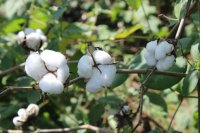
That history became personal earlier this year during a visit to my grandmother’s niece, Ave’, and her husband, Robert, in Swainsboro, Georgia. Fields of cotton stretched endlessly across the landscape. I picked a few bolls and shared a brief social media post, but what stayed with me far longer were Robert’s stories.
As a young man, he worked those fields from sunup to sundown. The labor demanded everything from the body and offered very little in return. He made a deliberate decision to study harder so he would never have to return. That choice frustrated his father, who had known nothing but life tied to the land. In leaving the fields, Robert was attempting something radical. Ending a family legacy of sharecropping through education.
Those conversations reinforced my conviction that innovation is not just about efficiency. It is about relief.
Controlled systems can reduce exposure to heat, pests, and crop loss, offering farmers a level of stability and physical safety that previous generations never experienced. In traditional fields, a single outbreak, whether boll weevils, two-spotted flies, or other mobile pests, can devastate not only one farm, but entire neighboring regions.
Why hydroponic cotton?
Like apples, grapes, carrots, and tomatoes, cotton was never meant to be singular in appearance. Archaeological evidence shows that Indigenous peoples in Peru cultivated cotton in natural shades of brown, tan, and red as early as 5000 to 3000 BCE. These varieties were prized because they required no dye. Their color was embedded directly into the fiber.
Hydroponic systems reopen the door to this lost diversity.
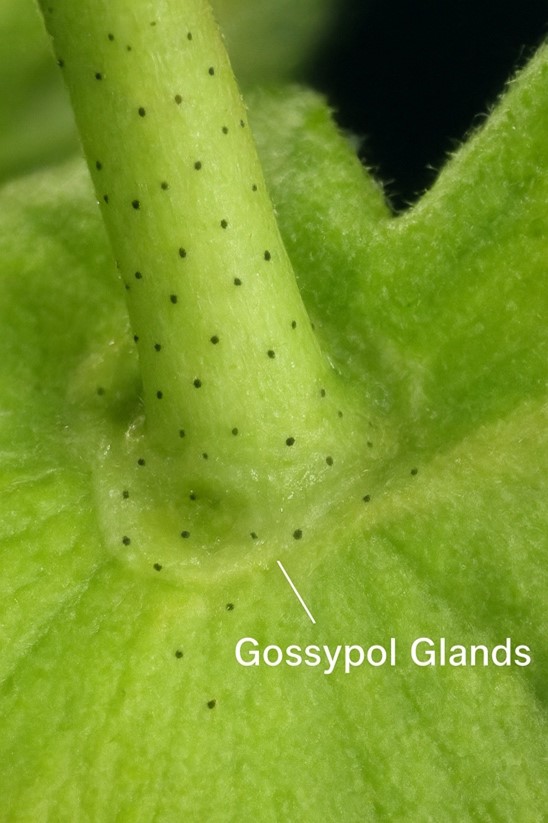
Photos courtesy of Malon E.D. James
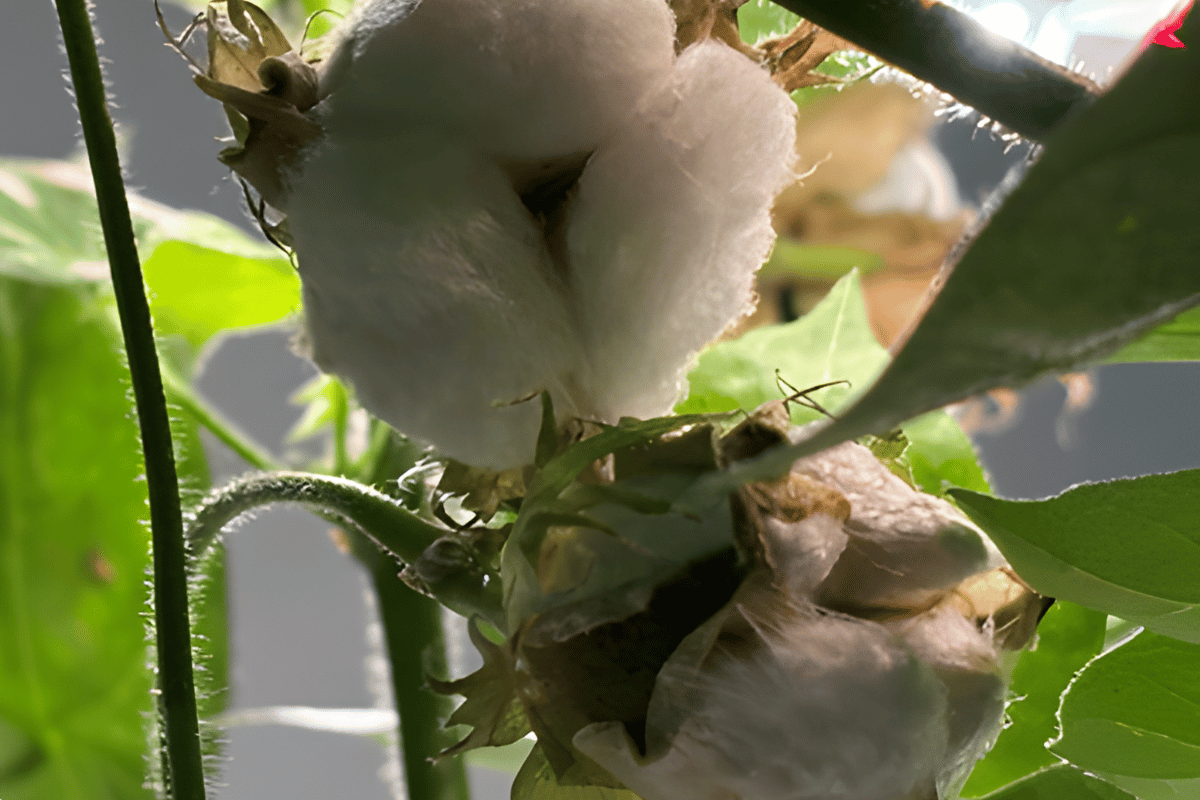
By tightly controlling nutrients, water, and environmental conditions, cotton can be grown more efficiently and sustainably than in conventional soil systems. While the specifics of my methods remain proprietary, the advantages are difficult to ignore:
- reduced exposure to pests and disease
- elimination of many environmental stresses common in soil cultivation
- dramatically improved water efficiency
- potential for higher yields and superior fiber quality
Innovation, biosecurity, and pest management
Inside a biosecure facility, cotton exists in an entirely different reality. Pests like the infamous boll weevil, or any other mobile insect, have virtually no pathway inside. Short of intentional human intervention, there is no plausible route for infestation.
This level of isolation fundamentally changes how pest management is approached. The focus shifts from reactive chemical control to proactive system design.
And yet, as I would soon learn, removing pests from the equation does not mean removing authority. In cotton, innovation has never existed in a vacuum. Even when the fields are gone, the rules, and the institutions built around them, have a way of finding you.
An unexpected pleasure
As children, many of us learned that summer sweetness could be found in unlikely places. Pulling nectar from wild honeysuckle flowers for a fleeting taste of sugar.
Cotton offers a similar, often overlooked delight.
Beyond its bolls and fiber, the cotton plant produces extrafloral nectar. Tiny beads of sweetness secreted from glands along its leaves, stems, and the bracts surrounding each boll.
In open fields, this nectar serves a quiet purpose. It attracts beneficial insects such as ants, lady beetles, and parasitic wasps that help shield the plant from hungry pests. It is a subtle partnership between plant and environment, one that has evolved over thousands of years.
Inside a hydroponic, biosecure system, that relationship changes. With no natural pathway for pests like the boll weevil to enter, these defenders are no longer necessary. The plant is free to redirect its energy inward, toward growth, resilience, and fiber quality.
Just before its long-standing guardians reenter the story.
Combating cotton pests: Regulation, resistance, and reinvention
When the boll weevil crossed into the United States from Mexico in the late 1800s, it tore through Southern cotton fields with ruthless efficiency. Entire regional economies collapsed under its advance.
In places like Coffee County, Alabama, farmers were forced to adapt or fail. Many turned to peanuts. The pivot proved so successful that Enterprise, Alabama erected the world’s only monument to an agricultural pest in 1919. The statue stands as a reminder that catastrophe can catalyze innovation.
More than a century later, cotton finds itself at a similar inflection point.
Hydroponic, biosecure cultivation removes the boll weevil entirely from the equation. No pesticides. No field exposure. No regional pest risk. What was once a vulnerability becomes an opportunity, one that promises cleaner fiber, greater water efficiency, and production systems unbound from the very pest that once defined the crop.
A strongly entrenched challenge
Innovation rarely moves without friction. I was unprepared for how deeply it would cut.
The directive came swiftly. The Georgia Boll Weevil Eradication Foundation ordered me to destroy my hydroponic cotton crop within 30 days. Not quarantine it. Not study it further. Destroy it.
Standing in a lab where no boll weevil had ever been, and none had been seen in Georgia for over a decade, I felt the full weight of history bearing down. As if the past itself had reached forward to erase the future I was trying to grow.
The order felt surreal. There has never been a documented boll weevil sighting in mid-Georgia, where my lab is located, not even during the height of the Great Infestation. More than that, no boll weevil has been detected anywhere in the state for over a decade, a status formally affirmed in recent years.
And yet, my sealed, soil-free, biosecure cotton was treated as an existential threat.
The devastation was immediate and personal. Two years of work stood to be erased, not by disease or failure, but by fear of a pest that had not been seen.
I remember thinking there was only one response available to me. Learn everything.
If cotton was powerful enough to provoke this reaction, then I needed to understand not just the plant, but the history, the trauma, and the institutions built to protect it.
Members of UGA Extension were the ones who helped me trace the lines of authority. Patient, pragmatic, and deeply rooted in Georgia agriculture, they pointed me toward the Georgia Boll Weevil Eradication Foundation and revealed something I had not fully grasped.
A single land-grant system has carried much of the responsibility for cotton research, policy, and protection across the state. Cotton here is not just a crop. It is a system, a legacy, and a guarded trust.
My project was never a field operation, nor a risk to neighboring farms. It was a controlled-environment experiment designed to imagine what cotton could become when freed from soil, weather, and pests altogether.
This moment exposed a deeper truth. Systems created to defend agriculture are often calibrated for yesterday’s threats. They can struggle to recognize safety when innovation no longer looks familiar.
Elsewhere, that recognition is already taking shape. Researchers in Spain, Hong Kong, and India are advancing hydroponic and controlled-environment cotton with far fewer constraints. Ironically, the same force that once defeated the boll weevil, innovation, was now being asked to step aside.
History offers a reminder of what happens when innovation is allowed to lead.
In the 1960s, USDA scientist Dr. Edward F. Knipling transformed boll weevil control through grandlure, a synthesized pheromone that enabled precise monitoring and targeted response. His work became the backbone of the Boll Weevil Eradication Program, one of the most successful pest management efforts in agricultural history.
That spirit ultimately resurfaced.
A Live Plant License from the Georgia Department of Agriculture formally recognized my Fulton County controlled-environment cotton operation as compliant, inspectable, and legitimate.
What began as an order to destroy ended as an invitation to proceed, with oversight, accountability, and dialogue.
In the end, clarity replaced conflict. The Georgia Boll Weevil Eradication Foundation did not push the issue further. Together, the institutions did what cotton has always demanded of those who steward it. Honor the past without preventing the future from taking root.
Cotton, technology, and high-value applications
My work in hydroponic, biosecure cotton is more than innovation. It is a blueprint for a sustainable future.
Cotton already plays a critical role far beyond textiles.
Most currency notes worldwide contain a minimum of 75 percent cotton. Cotton fibers make banknotes far more durable than wood-pulp paper. They resist tearing, tolerate moisture, and support advanced security features.
Cotton fibers can be blended with linen or integrated with security threads for added strength. Cotton-based notes also hold watermarks, embedded fibers, and anti-counterfeit features more effectively than wood-pulp paper.
Security fibers are a core anti-counterfeiting measure embedded into banknotes, certificates, and official documents. They are designed to be visible under normal or special conditions, making forgery significantly more difficult.
Medical and health applications
Cotton also plays a growing role in medicine and biotechnology:
- Advanced wound dressings and surgical textiles
- Cotton-derived cellulose scaffolds used in tissue engineering
- Emerging applications in regenerative medicine and stem cell research
Controlled-environment cotton offers purity, traceability, and consistency that these applications increasingly demand.
Looking forward
By eliminating pests and optimizing growth indoors, hydroponic cotton can produce high-quality fiber while reducing labor hardship, environmental strain, and systemic risk.
This approach does not attempt to erase cotton’s history. It acknowledges it.
By making cotton cultivation more accessible, resilient, and sustainable, we contribute to broader resource security and demonstrate that thoughtful innovation can protect both people and the planet.
Cotton has survived for 8,000 years by adapting. Allowing it to evolve again may be the most responsible stewardship it has ever known.