

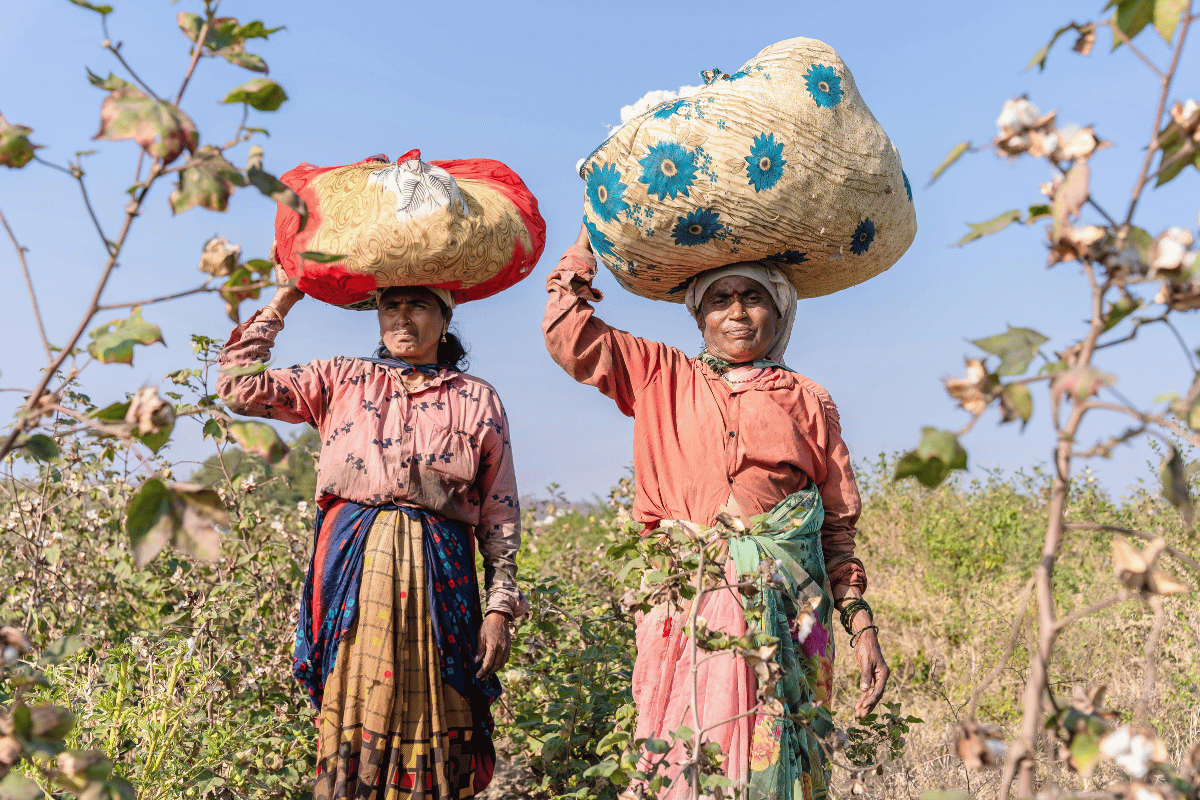
In 43 of 49 countries with agricultural data, men are more likely than women to own or hold secure rights to land, and in nearly half of those countries the gap exceeds 20 percentage points. The figures come from the 2026 FAO, ILC and CIRAD report The Status of Land Tenure and Governance and FAO's Suite of Gender Indicators, released the same month. Together they set out a gap that is wide, persistent, and only loosely connected to whether a country has laws protecting women's land rights on paper.
Secure land rights matter because they sit underneath almost everything else a farmer can do. Land that a producer controls with confidence can be invested in, used as collateral for credit, and farmed with a longer horizon than land that might be lost. FAO links secure tenure to higher investment, greater technology adoption and better incomes, which is why the gap between women and men in land rights carries through into the gaps in productivity and earnings seen across agrifood systems.
How wide the ownership gap runs
Across 108 countries in 2024, 48% of men and 40% of women reported being sole or joint owners of their home, and ownership fell for both between 2020 and 2024, by seven percentage points for women and three for men. Rural residents are more likely than urban ones to report ownership, but women stay behind men in both settings.
Agricultural land shows a sharper divide. Beyond the 43-of-49 headline, the share of land women own outright is far smaller than men's in many places. In some African countries women solely own about 3% of household land against 28% for men. Joint ownership softens the picture where sole ownership by women is rare. In the countries assessed, mostly in sub-Saharan Africa, the share of household land held jointly by women and men ranges from 18% in Malawi, where women also own a meaningful share independently, to 58% in Ethiopia. Joint title is often the practical route to any secure claim at all for women in those settings.
Documentation follows the same line. Drawing on SDG indicator 1.4.2 data from 51 countries, women are consistently less likely than men to hold legally documented ownership, with sub-Saharan Africa showing particularly low rates for everyone. A formal document is a step toward security, but on its own it does not guarantee it.
Tenure feels least secure when it is tested
A woman who owns land is more likely than a male owner to fear losing it if her circumstances change. Asked about hypothetical situations such as divorce or the death of a spouse, female landowners report tenure insecurity at higher rates than men, and the gap is most pronounced across sub-Saharan Africa, Southern Asia and South-eastern and Western Asia. The disparity tends to shrink, and sometimes close, as economies develop.
Who feels least secure also varies within the female population. Rural women and women in larger households face greater insecurity in the event of divorce or widowhood. Younger women aged 15 to 34 feel less secure than older women. Women with secondary or higher education worry less about losing their main property or farmland, which tracks with greater awareness of their rights, stronger bargaining power and more economic autonomy. Tenure security depends on more than holding a title. It rests on being able to defend that title when circumstances change.
Strong laws do not automatically close the gap
Among 91 countries reporting on SDG indicator 5.a.2, 49% have adopted no or only limited legal measures aligned with the indicator's benchmarks for protecting women's land rights, and nearly half meet only two or fewer of its six legal proxies. The specific gaps are concrete. Some 38% of reporting countries do not guarantee equal inheritance rights for women and men where there is no will, which leaves room for customary or religious norms to override gender-neutral provisions. Only about a third require jointly owned land to be registered in both spouses' names, and that share drops to 25% in sub-Saharan Africa and 8% in Western Asia. Mandatory quotas for women's participation in land administration exist in just 26 of the 91 countries, 15 of them in sub-Saharan Africa.
Regional patterns run through the legal data. Equal inheritance rights are common in Europe, Latin America and the Caribbean, and Asia, but rare in Western Asia and sub-Saharan Africa. Spousal consent for transactions involving matrimonial property is frequent, especially in Europe, while Western Asia lags behind across most measures.
The harder finding is that legal protection and real outcomes line up only weakly. Stronger legal frameworks are associated with lower perceived tenure insecurity, yet they do not automatically narrow the gap in actual ownership. Part of the reason is sequencing: countries often pass these reforms precisely because existing inequality is severe, so the law arrives into a setting already stacked against women. Limited literacy, poor access to justice and weak local governance then blunt the new rules, especially in rural areas, leaving women without the information or resources to claim what the law grants them.
Customary law is where much of it is decided
Of 45 countries that explicitly recognise customary law or customary land tenure, only 25 have provisions stating that non-discrimination or gender equality takes precedence when customary practice conflicts with it. In sub-Saharan Africa, 16 of 28 reporting countries both recognise customary law and guarantee gender equality within customary communities, often through recent land reforms. In Latin America, 7 of 18 protect gender equality, usually through constitutional provisions rather than dedicated land law.
Where customary systems govern access, women's rights are frequently the weakest. Reform here moves slowly because it intersects with family law, which is bound up with cultural and religious norms. Constitutional equality provisions have advanced faster than the changes to family and customary law that determine most of what happens to a woman's land in practice.
Closing the gap pays for itself
The case for acting is economic as much as moral. FAO data shows women already face higher rates of food insecurity, and research it cites estimates that closing gaps between women and men in farm productivity and wages could add about USD 1 trillion to global GDP while reducing the number of food-insecure people by 45 million. Secure land rights are one of the levers behind those gains, because a woman who can invest in land she controls produces and earns more from it.
What the two 2026 reports show, read together, is that the problem has moved. Recognition of women's equal right to land is now widespread in principle and written into many constitutions. The unfinished work is in implementation: inheritance rules, joint registration, access to justice, and customary systems that still decide most rural land claims. The same pattern that runs through the wider inequality in who controls the world's farmland runs through the gap between women and men, and the women already farming without secure title to their land are the ones who carry its cost.
Sources
- FAO, ILC and CIRAD. The Status of Land Tenure and Governance. Rome and Paris, 2026.
- FAO. Gender indicators 2000–2024 – June 2026 update. FAOSTAT Analytical Briefs, No. 128. Rome, 2026.
- FAO. FAOSTAT: Suite of Gender Indicators. Accessed June 2026.