
The world drinks and eats more dairy every year, and that growth carries a waste problem with it. In 2024, total milk consumption reached 985 million tonnes and, for the first time in three years, global dairy consumption grew faster than milk output, rising 2.5%, its strongest increase since 2021. Per capita consumption climbed to about 120.7 kg of milk equivalent. Milk production is projected to keep growing at roughly 2% a year over the coming decade, mostly through higher yields per animal, and most of that milk is cow milk (about 81%), followed by buffalo milk (around 16%), with goat, sheep, and camel milk making up the rest.
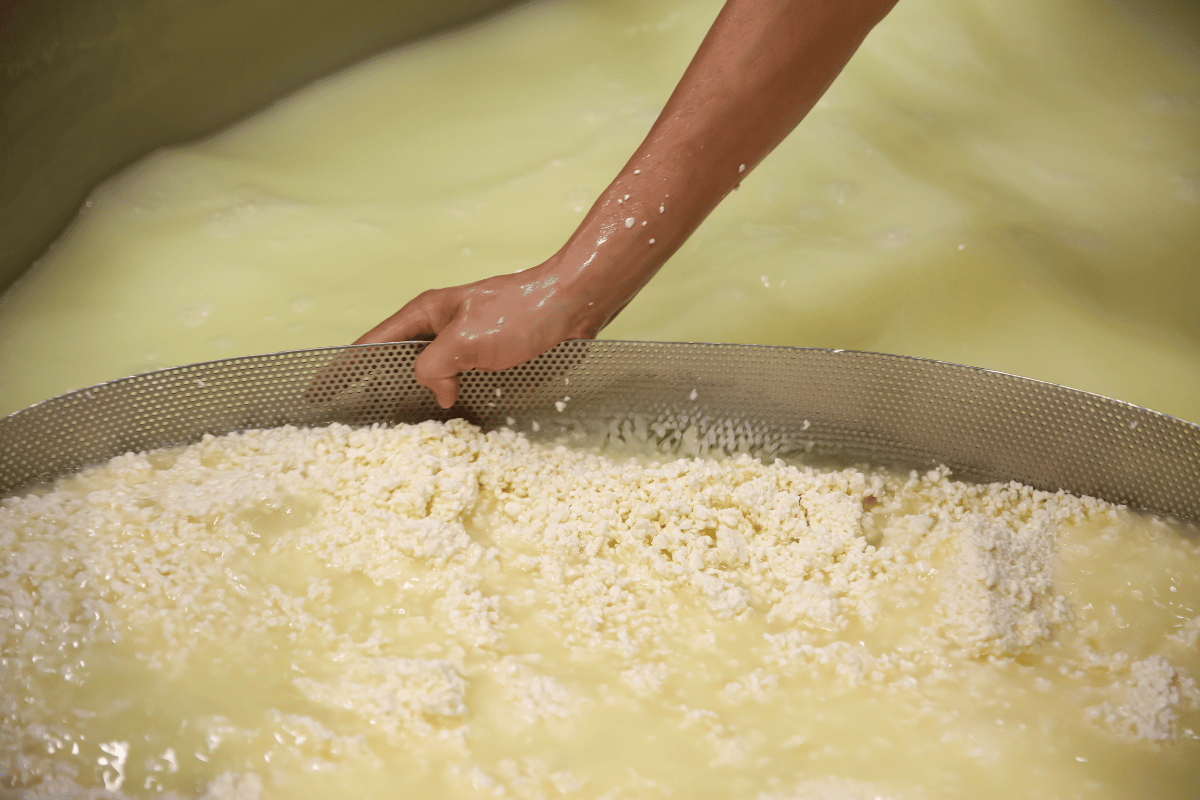
More milk and more cheese mean more whey, the liquid left behind when milk is coagulated during cheesemaking. Whey has long been treated as a waste stream, but it is far too valuable to pour away. Handled well, it becomes a food ingredient in its own right, and turning it from effluent into product is one of the clearest opportunities in modern dairy processing.
Why whey was treated as waste, and why that has changed
Whey is the liquid by-product of milk coagulation in cheese production. As cheese output expanded, dairies were left with large volumes of it, and its high organic load, a biochemical oxygen demand (BOD) of roughly 35 to 45 kg per cubic metre and a chemical oxygen demand (COD) of about 60 to 70 kg per cubic metre, made it a serious effluent problem rather than an asset. For a long time it was simply discarded.
That view has shifted as processors have learned to upcycle whey into products that people actually consume, from whey cheeses and spreads to soups, porridges, and beverages. The most common route is to dry it, using roller drying, spray drying, or a combination of spray and rotary drum systems. Drying is energy and capital intensive, though, and heat brings its own problems. Lactose is hygroscopic, so it readily absorbs moisture, and whey proteins can denature during thermal processing, which reduces the solubility and functional quality of the finished powder. The challenge, then, is to convert liquid whey into a stable protein product while protecting the protein's functional properties along the way. Doing that well is what lets whey move beyond animal feed into food, nutraceutical, and pharmaceutical uses.
How whey protein is produced
Cheesemaking is a lopsided process from a volume point of view. Roughly 10 litres of milk yield about 1 kg of cheese and 9 litres of whey, so whey is by far the larger stream. It comes in two main forms. Sweet whey is produced when milk is coagulated with an enzyme such as rennet. Acid whey is produced when milk is precipitated under acidic conditions, at around pH 4.6.
Whey protein itself is a mix of globular proteins. The main components are beta-lactoglobulin and alpha-lactalbumin, alongside smaller amounts of bovine serum albumin, immunoglobulins, and the glycomacropeptide released during cheesemaking, plus minor bioactive components such as lactoferrin and lactoperoxidase. The balance of these components is what gives a given whey protein its particular nutritional and functional character, and it varies with the type of cheese and the processing history.
Turning liquid whey into a concentrated protein ingredient involves a sequence of steps that shape the final product. First the whey is clarified, separated, and pasteurised, removing residual casein fines and fat. The protein is then separated from lactose using membrane filtration, the workhorse technology of modern whey recovery. Filtration can raise the protein content from around 11% in ordinary whey powder to more than 90% in a whey protein isolate. As protein content rises, mineral content is reduced through demineralisation, lowering ash content below 7%, the threshold that allows whey protein to be used in sensitive applications such as infant formula and baby food. Because heat and handling can damage the protein at any stage, quality has to be monitored throughout, from raw whey to finished powder.
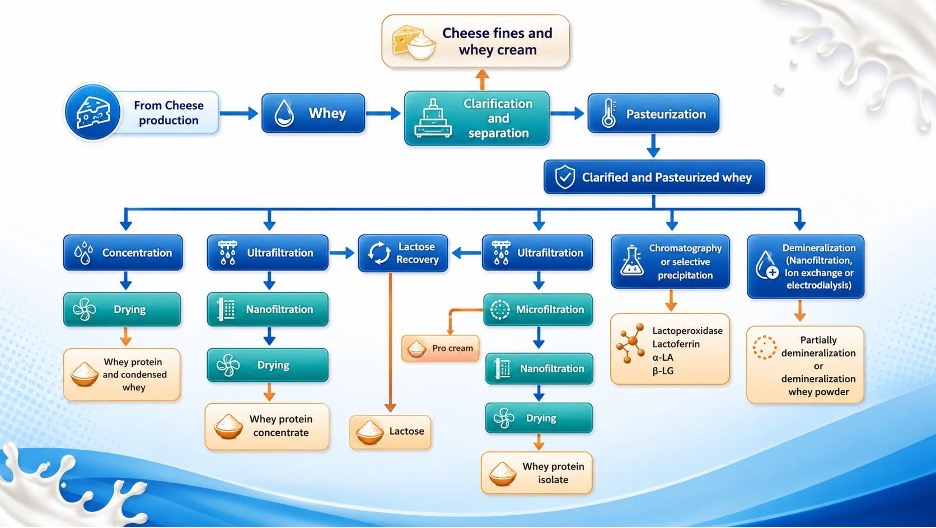
Figure1: Whey Protein Processing
The main whey protein products and what they are used for
The particular combination of steps determines which product comes out at the end. The main types are whey powder, whey protein concentrate (WPC), whey protein isolate (WPI), and the hydrolysed versions of each, in which the protein is partially broken down into smaller peptides. They differ mainly in protein content and in how much lactose and fat they retain.
| Product | Protein (%) | Lactose (%) | Fat (%) |
| Whey powder | 11 to 14.5 | 63 to 75 | 1 to 1.5 |
| Whey protein concentrate (WPC) | 25 to 89 (most often 80) | 4 to 52 | 1 to 9 |
| Whey protein isolate (WPI) | 90 to 95 | 0.5 to 1 | 0.5 to 1 |
| Hydrolysed whey protein concentrate | Above 80 | Below 8 | Below 10 |
| Hydrolysed whey protein isolate | Above 90 | 0.5 to 1 | 0.5 to 1 |
Figures are typical ranges on a dry basis. WPC protein content varies with the degree of concentration, and is most often around 80%.
WPC and WPI are widely used as functional ingredients in meat and dairy products, thanks to their ability to hold water, form gels, emulsify, and foam. Beta-lactoglobulin is the main protein behind these properties. It carries a reactive sulfhydryl group that forms sulfhydryl-disulfide bonds with other proteins, and those bonds shape the structure and texture of coagulated milk gels such as yogurt and cheese.
Both WPC and WPI hold GRAS (Generally Recognized as Safe) status with the US Food and Drug Administration under 21 CFR 184.1979c, provided they are made from pasteurised milk under good manufacturing practice. Used within those conditions, they can be added safely to a wide range of foods, which is part of why demand for them keeps growing. Whey powders are now among the higher-value products carrying dairy export growth in major producing regions.
The health value of whey's bioactive peptides
Whey protein is a rich source of bioactive peptides, short protein fragments that can influence the body beyond basic nutrition. Research links them to benefits across the cardiovascular, digestive, immune, and nervous systems, and whey protein has been associated with antimicrobial, antioxidant, anti-inflammatory, and blood-pressure and cholesterol-lowering effects. Beta-lactoglobulin and alpha-lactalbumin can act as antimicrobials and immunomodulators, and bovine serum albumin supplies essential amino acids.
These properties make whey protein attractive as a nutraceutical, well beyond its role as a food ingredient. Realising them in a finished product is the harder part, since the benefits depend on preserving the peptides through processing and, in some cases, on delivery systems that carry them intact to where they act. Getting the rheology, the bioactivity, and the stability right at every step of processing and formulation is the current frontier for the industry, and it is what will decide how far whey travels from a cheese-plant by-product toward a premium functional ingredient.
Sources
van Heerden, B. (2025). The World Dairy Situation Report 2025. International Dairy Federation, Bulletin 537/2025.
OECD/FAO (2025). OECD-FAO Agricultural Outlook 2025-2034, dairy and dairy products. OECD Publishing, Paris.
US FDA. 21 CFR 184.1979c, whey protein concentrate. Code of Federal Regulations.
Guo, M. (2019). Whey Protein Production, Chemistry, Functionality, and Applications. John Wiley & Sons.
Onwulata, C. I., and Huth, P. J. (2008). Whey Processing, Functionality and Health Benefits. Blackwell Publishing and the Institute of Food Technologists.