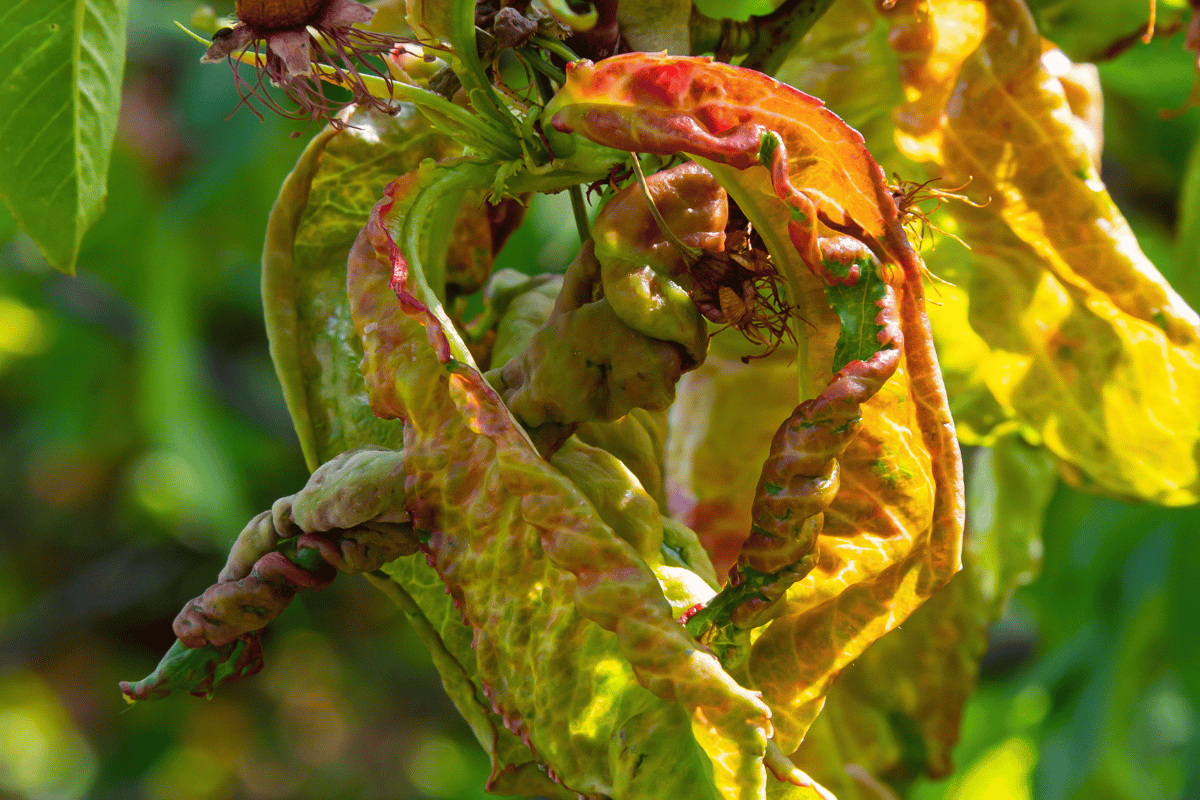
On stone fruit, the peaches, nectarines, apricots, plums, and cherries, the unsettled, cool weather of recent weeks is working against the grower. It keeps the growth soft and draws in aphids, holds the humidity that feeds brown rot, and finds the insects in full activity. The plant-protection bulletins issued by the Greek Ministry of Rural Development and Food for Central Greece and for Central and Western Macedonia show that the risk this period comes from several directions at once.
The most pressing part is the moth complex, the peach twig borer, the oriental fruit moth, and the summer fruit tortrix, all entering their second flight. Below, we bring together what each region's bulletin shows, starting there.
Peach twig borer, oriental fruit moth and summer fruit tortrix on peaches
The peach twig borer (Anarsia lineatella) and the oriental fruit moth (Grapholitha molesta) attack peaches, nectarines and apricots, while in Macedonia the summer fruit tortrix (Adoxophyes orana) joins them. All three are moths whose larvae bore into shoots and fruit. Once a larva enters the fruit, the damage is irreversible. A well-timed spray handles all three together, and it usually keeps aphids and thrips in check as well.
The right timing comes from the pheromone traps. Growers check them twice a week and work out the daily average of catches. Before each treatment, it helps to scout for egg-laying and for damage on the fruit and the soft growth.
| Region | Status | Indicative spray window |
|---|---|---|
| Central and Western Macedonia (Thessaloniki) Bulletin 4 June |
Second flight of the summer fruit tortrix and the peach twig borer, egg-laying 5-7 June, hatching 9-12 June | 7-9 June with products active on the eggs, 11-13 June with products for the young larvae. Also covers the oriental fruit moth |
| Central Greece (Volos) Bulletin 5 June |
Rising adult activity of the peach twig borer and the oriental fruit moth | Within 4-5 days of a rising catch trend, with a single product for both insects |
On plum, the plum fruit moth (Grapholita funebrana) is handled the same way. The decision to spray is based on each orchard's trap catches and fruit sampling, not on the calendar.
The dates are indicative, and every orchard is a separate case. Monitor your own traps, follow the most recent local bulletin, and, where needed, consult your agronomist. Within biological and integrated pest management, there are also macroorganism-based products for the same insects.
Mediterranean fruit fly and cherry fruit fly
As the early varieties start to color, the risk from the Mediterranean fruit fly begins, an extremely polyphagous insect that turns destructive from the onset of ripening through to harvest. Protection starts with a color change and is applied either with cover sprays or bait sprays. Near homes and for the sake of the environment, the bait sprays are preferred, though they only work when applied area-wide. For a bait spray, hydrolyzed protein is added at 2%, and about a glassful of the mix is sprayed onto the inner, upper part of the canopy, on the foliage rather than the fruit, on every second or third tree. In contrast, every tree on the perimeter is sprayed.
On late cherries, the problem is the cherry fruit fly. The spray follows the trap catches, and because the harvest interval is short, the choice of insecticide requires particular care to avoid residues on the fruit.
Aphids on the soft growth
The unsettled, rainy weather keeps the growth soft, and that is ideal food for aphids. Where the young growth on cherry, peach, nectarine, or plum shows infestation, treatment with an approved insecticide is advised. In many cases, the spray for the peach twig borer and the oriental fruit moth covers the aphids at the same time.
Brown rot and the wet weather
The unsettled weather, with showers, wind, and cool temperatures, favors brown rot, caused by Monilia. Susceptibility grows as the fruit nears ripening and after hail or strong winds that injure it. In orchards with a history of the disease, an approved fungicide is advised straight away, and protection should remain continuous until the weather becomes settled. On cherries, it helps to stop irrigation a few days before harvest so the fruit does not split; cracks let the fungus in easily.
How to choose and apply the products
On all stone fruit the big caution this time of year is the interval to harvest, which on several varieties is now short. We use only products approved for the crop and for the specific pest or disease, from the official database of the Greek Ministry of Rural Development and Food. We read the label carefully for dosage, tank-mix compatibility, the risk of phytotoxicity, and above all, the pre-harvest interval, so that no residues are left. Where possible, we rotate modes of action to avoid resistance.
On Farmclick, you can find approved plant-protection products for stone fruit from suppliers across Greece.
| Stone fruit plant protection on Farmclick Browse approved insecticides and fungicides from suppliers across Greece. |
The dates and recommendations above come from each region's bulletin and hold as a general trend. Conditions vary from orchard to orchard, depending on the species, variety, microclimate and infestation history, so final decisions should rest on your own pheromone traps, on field scouting and on the most recent local bulletin.
For serious or uncertain infestations, consult an agronomist. Where possible, favour cultural measures and low-impact solutions, and use only approved products, following the label instructions and the operator-safety measures.
Sources
All figures come from the plant-protection bulletins of the Greek Ministry of Rural Development and Food:
- Regional Plant Protection Centre of Volos, Central Greece, stone fruit bulletin No8, insect pests (5 June 2026).
- Regional Plant Protection Centre of Volos, Central Greece, stone fruit bulletin No9, diseases (5 June 2026).
- Regional Plant Protection Centre of Thessaloniki, peach bulletin No35 (4 June 2026).