In 2025, Syria had one of its driest years in decades and harvested a fraction of its normal wheat crop. A year later, the Euphrates rose so fast that farmers along its banks lost fields at the very moment they were meant to harvest. The two events differ in cause and in scale, but together they show how little room Syrian farmers have to absorb extreme weather. This article reviews what the main humanitarian and statistical sources reported, separates well-supported figures from rough estimates, and ends with practical steps for farmers working flood-prone land.
Syria's 2025 wheat harvest collapsed in a severe drought
The Food and Agriculture Organization (FAO) described the 2024/25 season as one of the worst droughts in nearly 40 years and estimated the 2025 wheat harvest at 0.9 to 1.1 million tonnes, among the lowest ever recorded in Syria. Before 2011, Syria produced an average of about 4.1 million tonnes a year, so the 2025 crop was roughly 75% smaller. Annual consumption is about four million tonnes, which left a projected wheat shortage of 2.73 million tonnes. The causes of the 2025 collapse are covered in more detail in why Syria's wheat harvest fell 60% in 2025.
Rain returned in the 2025/26 season. In August 2026, Syria's state Grain Establishment reported that it had received about 2.7 million tonnes of wheat from farmers, above the 2.55 million tonnes it treats as the national requirement for subsidised flour and bread, and said no imports would be needed. Some analysts caution that this is not the same as full self-sufficiency, because rain-fed production remains exposed to weather and because the requirement figure is lower than pre-war consumption. The 2.7 million tonnes is also a procurement total, not a final production estimate.
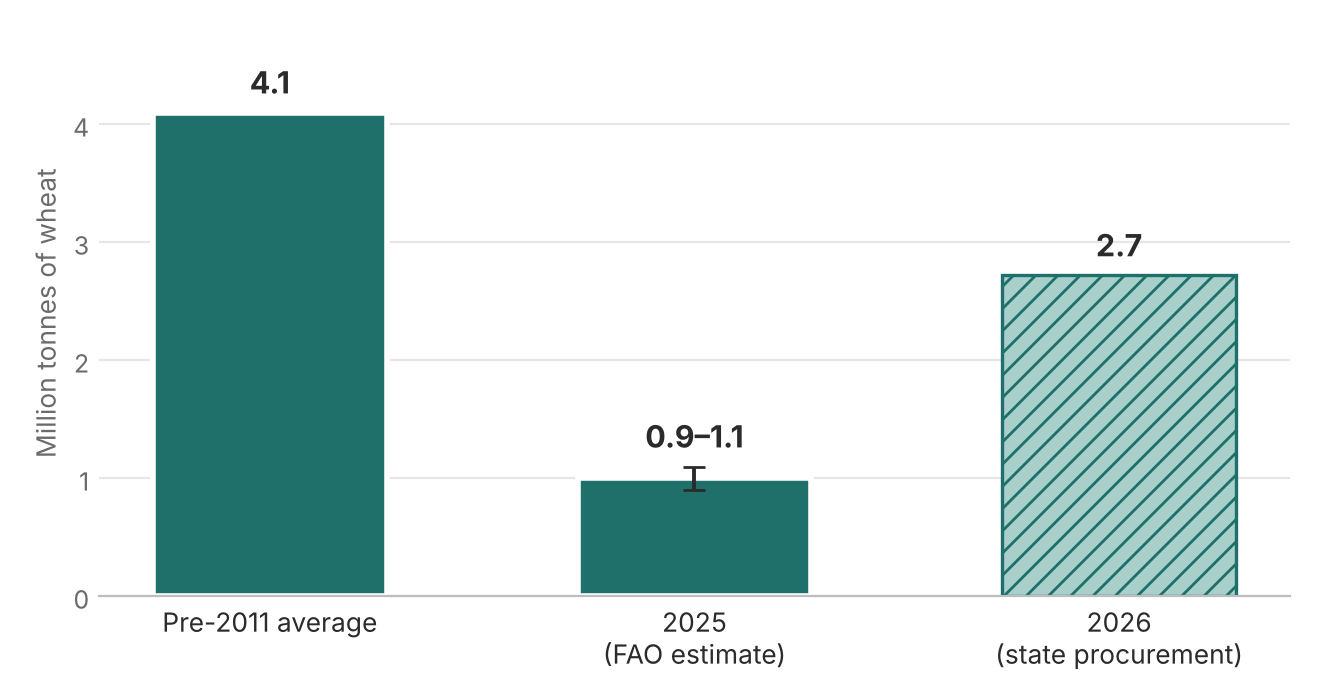
Syrian wheat, million tonnes. Pre-2011 average and 2025 (FAO estimate, range 0.9 to 1.1) compared with 2026 wheat received by the state Grain Establishment (about 2.7). The 2026 bar is a procurement figure, not a final national production estimate. Sources: FAO (2025); World Grain (2026); SANA (2026). Chart: Murad Kara Mustafa
The Euphrates rose by more than four metres in places in May 2026
From 25 May 2026, the Euphrates rose rapidly across Raqqa and Deir ez-Zor governorates. Exceptional rainfall and high inflows from Türkiye had pushed the reservoirs behind the Euphrates (Tabqa) Dam above 97% of capacity, and Syrian authorities opened spillway gates for the first time in more than three decades. The International Federation of Red Cross and Red Crescent Societies (IFRC) reported inflows of roughly 2,200 cubic metres per second, while Syrian officials gave figures of 1,800 to 2,000. The UN Office for the Coordination of Humanitarian Affairs (OCHA) recorded a rise of more than four metres in places. Using Sentinel-2 satellite images, the World Food Programme (WFP) measured the river's surface growing from 60.9 km² on 13 May to 188.7 km² on 30 May.
Syria's energy minister said the warning from Türkiye came too late, and the emergency minister acknowledged that Syria had lacked an effective early-warning system for this kind of event.
Estimates of flooded farmland differ by source and method
Counts of flooded farmland differ because they use different methods. The table compares the main estimates. One dunam, the local land unit, is 1,000 m², or 0.1 hectare.
| Source | Area covered | Estimate | Method |
| WFP (via Copernicus) | Deir ez-Zor | 7,210 ha (8.2% of cultivated land) | Sentinel-2 satellite imagery |
| Assessments reported by FEWS NET | Deir ez-Zor and Raqqa | Up to about 17,000 ha | Damage assessments |
| Deir ez-Zor Emergency Response Committee | Deir ez-Zor | 20,534 dunams (about 2,050 ha) | Local field count |
| Local preliminary data | Raqqa | About 2,000 dunams (about 200 ha) of wheat and barley | Preliminary estimate |
Estimates of flooded farmland, May 2026. Sources: Copernicus/WFP; FEWS NET (June 2026); Enab Baladi (June 2026).
On people, OCHA reported about 27,000 affected and 9,625 displaced across the two governorates. Preliminary local data listed nine deaths in Deir ez-Zor, seven of them children. The energy minister said 78 drinking-water stations (16 in Raqqa and 62 in Deir ez-Zor) went out of service, and local reports counted about 120 agricultural pump engines damaged in Raqqa and hundreds more in Deir ez-Zor.
Oxfam found that most of the assessed farming households lost income
Between 31 May and 3 June, Oxfam interviewed 89 farming households in al-Tabni, Deir ez-Zor and Khasham in the western countryside of Deir ez-Zor. About 85% had lost all or part of their farm income. In the assessed areas, 85% of irrigation systems, individual and shared, were not working because pumps were under water and pipes were clogged with debris. By then 43% of households had sold livestock or productive assets, and 25% planned to borrow money to start farming again.
This was a rapid assessment of a small sample in one part of the governorate, so the percentages describe those communities and should not be applied to the whole Euphrates basin.
Why the damage was so large
Reports point to four conditions that turned high water into a farming disaster:
- Timing. The water arrived during the wheat and barley harvest, so crops that were days or weeks from collection were lost.
- Farming inside the flood zone. Syria's emergency ministry said most affected areas were farmland next to the river, river islands and informal or unlicensed buildings. A climate adviser quoted by Enab Baladi said the overlap of high flows with settlements and fields inside the flood zone doubled the damage.
- Little warning. Farmers told AFP they had not been told that the dams would open.
- Weak infrastructure and repeated shocks. The IFRC noted reduced resilience after conflict damage, economic decline, drought and earlier floods.
None of the sources reviewed here attributes this particular flood to climate change, and one wet season does not prove a trend. What the sequence does show is how exposed rain-dependent and poorly protected farming is to swings in either direction. The same year had other extreme-rain events: heavy rain from mid-March flooded northern Syria, and OCHA counted more than 19,000 people affected and over 3,400 shelters damaged in Aleppo and Idleb, plus more than 1,400 families displaced in Al-Hasakeh.
The flooded area was small compared with Syria's wheat area
The flood was severe for families on the riverbank, but it did not undo the national recovery. Even the highest estimate, about 17,000 hectares across both governorates, is roughly 1.2% of the 1.4 million hectares the Ministry of Agriculture says were planted to wheat nationally in 2026. The flooded land included crops other than wheat, so this is a comparison of scale, not an exact loss rate.
In August 2026, WFP counted 13.3 million food-insecure people out of 24.4 million, 7.1 million of them acutely, and it had halved emergency food aid in May because of funding shortfalls. The International Monetary Fund expects growth above 10% in 2026, helped by the agricultural rebound, but says poverty is still widespread and growth uneven. Agriculture employs about 16% of Syrian workers, according to the World Bank's estimate for 2025.
Practical guidance for farmers on flood-prone land
Most published post-flood guidance comes from other countries and focuses on produce safety and soil recovery. The steps below are widely used principles; waiting times and testing rules should be confirmed with the local agriculture directorate.
- Do not eat or sell produce that touched floodwater. Crops whose edible parts came into direct contact with floodwater should not be harvested for human consumption. Clean and sanitise tools, bins and equipment that touched flooded soil.
- Wait before replanting vegetables, and test the soil. Let the field dry enough to work safely and level uneven silt deposits. Growers' associations in the United States recommend waiting 30 to 60 days before replanting unless soil tests show the soil is safe.
- Resample the soil where water scoured the field or left silt. Results from before the flood may no longer apply. Waterlogged soil loses nitrogen through denitrification, so base the fertiliser plan on new tests.
- Drain standing water early and loosen compacted soil. Drain through channels or pumps; deep ploughing can break compact layers and improve aeration.
- Match the crop to the season that is left. Where a crop was lost, choose short-duration varieties that can mature before the season ends.
- Protect bare silt. Cover crops can help stabilise flooded soil and reduce erosion.
- Inspect pumps and pipes before restarting irrigation. Oxfam found that submerged pumps and debris in pipelines were why most assessed irrigation systems stopped working, so check motors and electrical parts and flush pipelines before switching on.
What the wider system needs
Farm-level steps cannot replace shared protection. The evidence above points to four gaps: an early-warning system with enough lead time for harvesting and evacuation; routine data-sharing with Türkiye on dam releases, since Syria's energy minister said the warning came late; clearer rules and support for farming and housing inside the flood zone; and credit and replanting support, because a quarter of the surveyed households planned to borrow to restart farming.
Syrian farmers need to prepare for both drought and flood
Syrian farmers faced the driest conditions in decades in one year and rising water in the next. The national wheat harvest recovered in 2026, but families on the riverbank paid for the flood with their income, their pumps and, for some, their livestock. Preparing for both extremes, with better warnings, protected irrigation equipment and access to credit, would protect harvests in dry years and wet ones.
Sources
- AFP. (2026, June 2). Euphrates flood deprives east Syria farmers of crops. Gulf News.
- California Department of Food and Agriculture, Produce Safety Program. Farm flooding fact sheet (summarising US FDA 2011 guidance).
- Copernicus Global Flood Awareness System. (2026, June 10). Flooding along the Euphrates River in Syria, May 2026 (citing the WFP satellite assessment).
- Enab Baladi. (2026, June 9). Euphrates flood raises questions over Syria's water and energy.
- FAO. (2025, September 4). The Syrian Arab Republic: Farmers struggle amid worst agricultural crisis in decades.
- FEWS NET. (2026, June). Syria Food Security Outlook, June 2026.
- IFRC. (2026). DREF Operation MDRSY019: Syrian Arab Republic Euphrates River Floods 2026.
- Khaleej Times. (2025, August 18). Historic drought, wheat shortage to test Syria's new leadership.
- OCHA. (2026, March 27). Syrian Arab Republic: Flash Update No. 1, Flooding in North and East Syria. ReliefWeb.
- OCHA, via UNFPA Arab States. (2026). Euphrates Floods in Raqqa and Deir-ez-Zor, Syria: Flash Update, 25 May to 6 June 2026.
- Oxfam. (2026). Syria: Rapid Needs Assessment, Euphrates River flood, flood-affected farmers, May to June 2026. Figures as reported by Welat TV.
- SANA. (2026, June 4). Syria launches wheat procurement season amid forecast of 2.5 million-ton harvest.
- SANA. (2026, August 8). Syria's wheat production surges to more than 3 million tons in 2026.
- Sugar Research Australia. FAQs: Managing flood cane.
- The Amargi. (2026). Flood reignites debate over who controls the Euphrates.
- The New Arab. (2026, June 11). Euphrates floods trigger new displacement for Syrian families.
- The New Arab. (2026, August 5). IMF projects 10% growth for Syria's economy in 2026.
- The Sentinel (Assam). Post-flood strategies for farmers in Charaideo, Sivasagar, Jorhat, Golaghat.
- The Syrian Observer. (2026, September 2). Syria's wheat production approaches three million tons: has the country achieved self-sufficiency?
- Western Growers. (2023, March 1). What are the best management practices on-farm after a flood?
- WFP, via Arab News. (2026, August 24). WFP says hunger worsening in Syria as aid cuts deepen crisis.
- World Bank, via TheGlobalEconomy.com. Syria: Employment in agriculture, % of total employment (2025).
- World Grain. (2026, August 13). Syrian wheat harvest reaches self-sufficiency.