Key takeaways
- Drip irrigation uses about 47% less water than traditional surface methods and delivers the highest water-use efficiency, 0.47 to 0.54 kg per cubic metre, for cotton in Syria.
- Sprinkler irrigation covered 88% of Syria's modern irrigation area in 2000, because it suits large cereal fields and costs less upfront for broadacre farming.
- Small farms of 1 to 5 hectares growing high-value crops see profit rise by up to about 111% with drip, while large farms of 10 hectares or more see 55 to 125% gains with sprinklers.
- The water source often matters more than the crop. Deep wells make drip far more profitable, while river water makes sprinklers competitive.
- Hidden costs, emitter clogging, wind drift, and the energy needed for pressure, can erase the efficiency gains if they are ignored.
Agriculture consumes roughly 85% of Syria's available freshwater, which makes the choice between drip and sprinkler irrigation a question of survival, well beyond technical preference. I have spent years watching Syrian farmers make this choice under drought, conflict, collapsing infrastructure, and groundwater tables that have fallen sharply over the past decade. The lessons are not confined to Syria. From Yemen to Sudan, from Jordan to the Sahel, farmers in dry regions face the same equation of more crops, less water, and no room for error.
This guide is built on field data, not on theory. It draws on FAO surveys, JICA demonstration projects, and my own observations across Syria's agricultural zones, and its aim is to help you decide which system fits your land, your crop, and your water reality.
How each system works
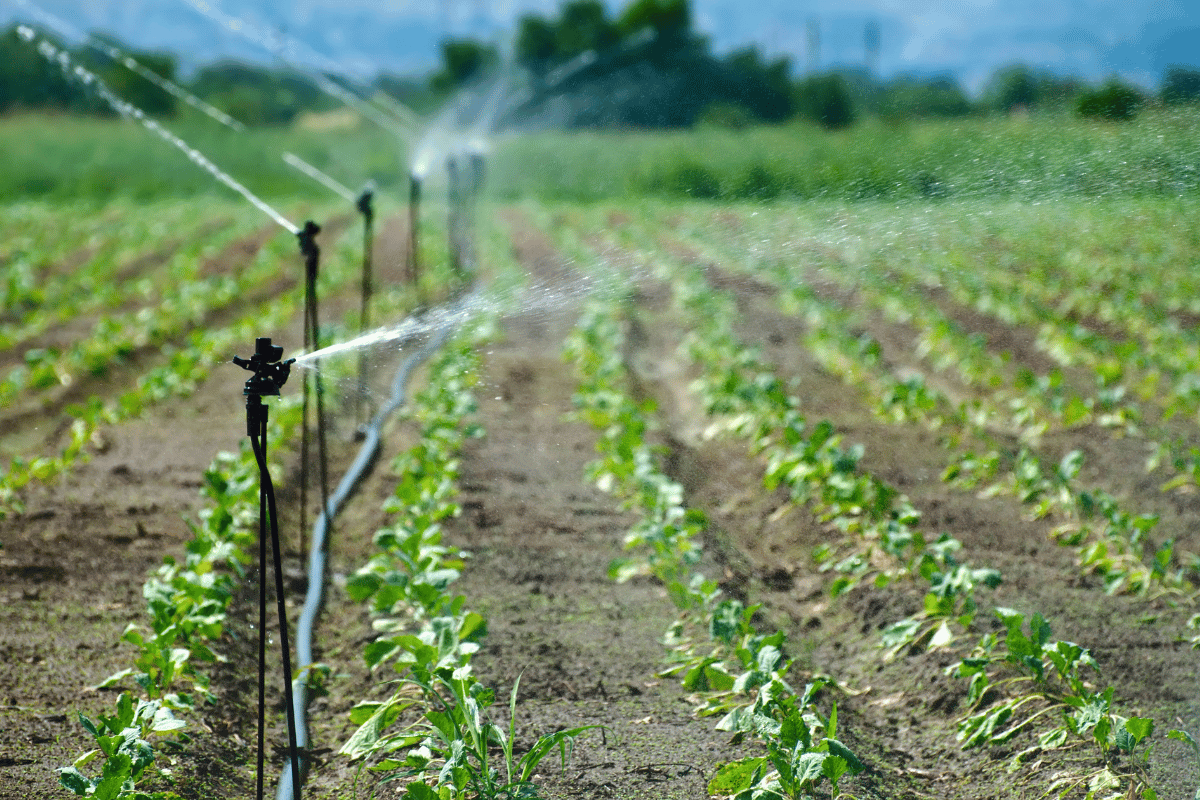
Sprinkler systems mimic rainfall, pressurising water through pipes and spraying it over the crop canopy through rotating or fixed nozzles. In Syria the most common types are centre-pivot systems for large cereal fields and portable sprinklers for smaller vegetable plots. Sprinklers work well on flat or gently sloping land, cover large areas quickly, and cool the canopy during Syria's summers, when temperatures regularly pass 40°C.
Drip irrigation delivers water straight to the root zone through a network of tubes and emitters, with no spray, no canopy wetting, and no drift. Surface drip is common for vegetables and orchards in Syria, while subsurface drip is gaining ground for water-intensive crops like cotton. The system needs precise pressure control and clean water, which is a real challenge where wells produce sandy or saline water, but where it is set up properly it works with remarkable efficiency.
What Syrian field data shows
In 2011, JICA conducted a controlled comparison across demonstration farms in Raqqa and Aleppo, measuring water-use efficiency and cotton yield per cubic metre of water applied.
.png)
The results were clear.
| Irrigation method | Water applied (m³/ha) | Water-use efficiency (kg/m³) |
| Traditional surface | 15,600 | 0.17 |
| Gated pipe (improved surface) | 9,920 | 0.36 to 0.41 |
| Drip tube | 8,190 | 0.47 to 0.54 |
Drip used 47% less water than traditional surface irrigation while producing the highest yield-to-water ratio. Gated pipe, a low-cost improvement to surface irrigation, offered a middle ground, cutting water use by about 36% with moderate efficiency gains.
.png)
A separate FAO analysis found that, against surface irrigation, drip systems saved 29% of water while sprinkler systems saved 22%. The gap is modest but consistent, with drip ahead on efficiency, especially for high-value, row-planted crops.
When sprinkler makes sense
Despite drip's efficiency advantage, sprinkler irrigation still dominates Syria's modern irrigation. In 2000, 88% of the modern irrigation area was under sprinklers and only 12% under drip, for practical reasons. Sprinkler is the better choice when you farm large, extensive fields of wheat, barley, or cotton on 10 hectares or more, when your crop benefits from evaporative cooling, when winds are manageable, when your water source is relatively clean, such as a river or large reservoir, and when you need lower upfront capital, since sprinkler systems are generally cheaper to install per hectare for broadacre farming.
In the northeastern Hasakah region, where farms average 14 hectares and grow wheat and cotton, sprinkler irrigation raised farm profits by 55 to 125% over surface methods depending on water source, and for deep-well irrigation the savings on pumping costs alone justified the switch.
When drip is the clear choice
Drip becomes the clear winner in situations that are increasingly common across Syria. Choose drip when you grow high-value, row-planted crops such as tomatoes, peppers, cucumbers, or fruit trees; when water comes from deep, energy-costly wells, so that volumetric savings translate straight into fuel and electricity savings; when your farm is small and intensive, of 1 to 5 hectares, where the FAO farm models showed drip roughly doubling the profit gain that sprinklers achieved; when salinity is a concern, since drip keeps soil moisture tension lower and reduces salt build-up at the root zone; and when labour is limited, because drip needs less field labour once installed.
.png)
In the coastal Lattakia region, where small farms of about 1.5 hectares grow tomatoes, potatoes, and citrus, drip raised profits by 67% on surface-water farms and by 111% on well-water farms. That difference is transformative for a smallholder.
The hidden costs that get overlooked
Drip irrigation clogs. In northwest Syria, most irrigation now comes from wells, many producing water with high sediment or iron content. Without proper filtration, whether sand media filters, cyclone separators, or at least screen filters, emitters clog within a season, and I have seen farmers abandon a drip system after one year because they skipped the filter.
Sprinkler irrigation loses water to the wind. In Syria's eastern steppe, wind speeds regularly exceed 15 km per hour during the growing season, and spray drift can waste 10 to 30% of applied water before it reaches the soil. The JICA demonstration farms in Daraa tested mini-sprinkler nets with cyclone filters to address this, but the problem is real.
Both systems need pressure. Syria's electricity grid is unreliable and generator fuel is expensive. A centre-pivot sprinkler needs consistent pressure, and a drip system with pressure-compensating emitters needs even more precision. Solar-powered pumps come up repeatedly in FAO and local council reports as a priority, but adoption is still limited by the upfront cost.
A practical decision framework
After years of working with Syrian farmers, the choice comes down to five questions.
| Question | If yes | If no |
| Is my farm smaller than 5 hectares? | Drip | Sprinkler or surface |
| Do I grow vegetables, fruits, or high-value crops? | Drip | Sprinkler |
| Is my water from a deep, costly well? | Drip | Either |
| Is wind a major factor in my region? | Drip, or avoid sprinklers | Sprinkler acceptable |
| Can I afford filtration and maintenance? | Drip | Sprinkler or gated pipe |
.png)
There is no universal winner. A wheat farmer in Hasakah with 20 hectares and river access should probably choose a centre-pivot sprinkler. A tomato farmer in Homs with 2 hectares and a deep well should almost certainly choose drip. A cotton farmer in Raqqa with saline soil and limited capital might begin with gated pipe as a stepping stone.
Syria's groundwater crisis as a wider warning
The figures from northwest Syria after 2011 should concern anyone working in dryland agriculture. The number of irrigation wells rose by 107%, from 8,173 to 16,932, as farmers drilled to compensate for failing surface-water infrastructure. Groundwater levels then fell by up to 62% in some districts, water extraction costs rose by around 85%, and 56% of farmers reported shrinking irrigated areas.
.png)
This is a dry-region problem, not only a Syrian one. When surface irrigation canals are damaged and governance weakens, farmers turn to the water source they still control, the aquifer beneath them, and over-pump it until it runs dry. Efficient irrigation is an economic necessity here. A farmer using drip on a deep well in Idlib pays less to pump, grows more per drop, and keeps the farm alive another season, while a farmer flood-irrigating the same well pays more, wastes more, and drills deeper until the well fails.
Frequently asked questions
Which irrigation system is best for small vegetable farms in dry regions?
Drip irrigation is almost always the best choice for small vegetable farms under 5 hectares in water-scarce regions. It delivers water straight to the root zone, reduces evaporation losses, and cuts pumping costs when water comes from deep wells. In Lattakia, drip raised profits by 67 to 111% on small farms growing tomatoes and citrus.
How much does it cost to install drip compared with sprinkler irrigation?
Sprinkler systems generally cost less upfront per hectare for large, flat fields. Drip costs more at the start because of the emitter network, filtration, and pressure-compensating components, but on small intensive farms and deep-well systems, the payback period is typically two to three seasons through water and energy savings.
Can I use drip irrigation with salty water?
Drip actually manages salinity better than sprinklers, because it keeps soil moisture tension lower and prevents salt from building up in the root zone. You do need proper filtration, sand media filters or cyclone separators, to stop sediment and dissolved minerals clogging the emitters.
What crops are unsuitable for drip irrigation?
Broadacre cereals like wheat and barley are generally unsuited to drip, because of the cost of installing emitters across large areas. They are better served by centre-pivot sprinklers or by improved surface methods, such as gated pipe. Drip pays off with row-planted, high-value crops.
How do I stop drip emitters clogging?
Clogging is the main reason drip systems fail. Install filtration matched to your water quality; screen filters for clean water; sand media filters for sediment; and cyclone separators for high iron content. Flush the system regularly and check emitter flow rates at the start of each season.
Start with your water source
Most farmers ask which system is best for a given crop. The more useful question is which system best fits your water source, your farm size, and your budget. Drip gives the highest water-use efficiency and the best returns on small, intensive farms. Sprinkler systems provide broader coverage, lower upfront costs on large fields, and useful crop cooling. Both need maintenance, pressure management, and realistic expectations. For farmers in Syria and across water-stressed regions, the aim is to match the right system to the right conditions before the water runs out.
Sources
Varela-Ortega, C., and Sagardoy, J. A. Irrigation water policies in Syria, current developments and future options. FAO.
FAO. Irrigation in the Middle East region in figures, AQUASTAT survey, Syria. FAO Water Reports.
Mohammed, S., et al. (2024). Irrigation water in northwest Syria, impact of the recent crisis and drought. Water, 16(21), 3101.
Fanack Water. Water use in Syria.