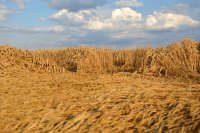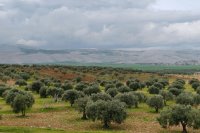
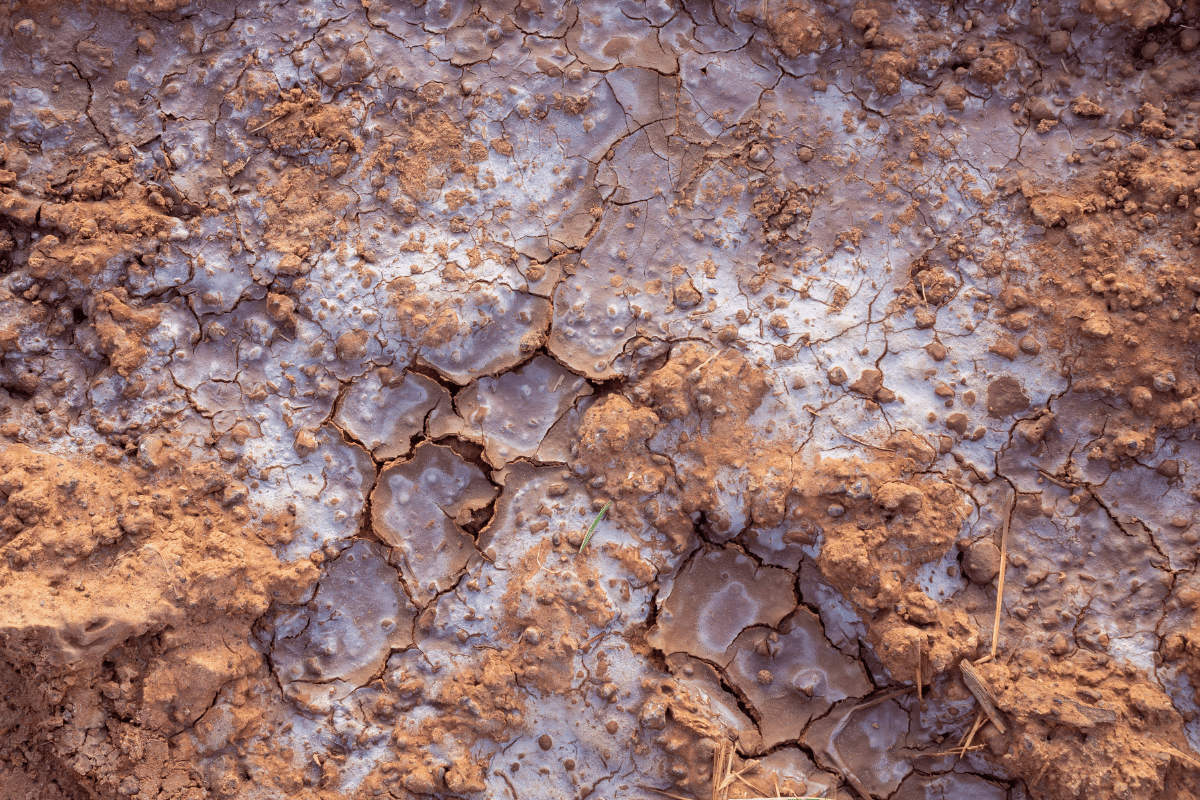
When food security and agricultural development are discussed, the soil itself often drops out of the conversation. Farmers in Syria tend to talk about what their land produces, wheat, olives, and potatoes, rather than what is happening beneath the surface. What is happening there is a genuine crisis, and it strikes at the foundation of everything grown above it.
Syrian soil suffers from several interlocking forms of degradation, but one process dominates: salinisation, along with the related problem of sodicity. Salt is no stranger to this landscape, yet its extent has grown over recent decades from a manageable constraint into a threat to agricultural production in a country whose economy has long rested on farming.
The scale of the problem
Salt-affected soil in Syria covers roughly 532,000 hectares, which is about 40% of the country's total irrigated area. That share is the striking part. Nearly half the land that receives irrigation water carries a salinity problem.
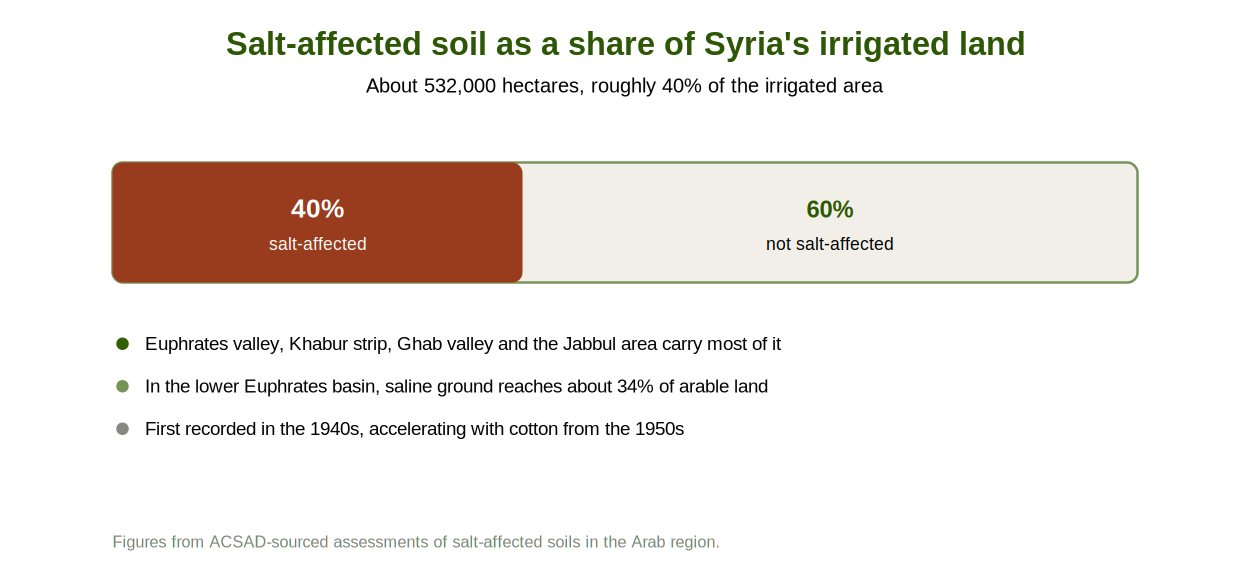
The affected areas concentrate where irrigation and poor drainage meet. The Euphrates valley is the largest, running from Halabiya in the west down to the Iraqi border, along with a strip following the Khabur river from Ras al-Ain south towards Deir ez-Zor. The Ghab valley in the west and the Jabbul area southeast of Aleppo are also badly affected. In the lower Euphrates basin specifically, saline areas have reached roughly 34% of arable land.
The history explains a good deal. Irrigation in the Euphrates valley goes back millennia, but salinisation was first recorded in the 1940s, when diesel pumps made large-scale irrigated agriculture possible. The process accelerated in the 1950s with the introduction of cotton, and a 1980 survey of newly irrigated land near Raqqa already found severe salinisation across about 24% of the area.
Field observation. During a visit to the Central Plains in 2023, thick white salt crusts had accumulated on the surface of wheat fields, with visibly stunted plants and early leaf chlorosis, the classic signs of sodium toxicity. Farmers reported yield declines of more than 40% compared with previous years, and some parcels had been abandoned after repeated crop failures.
Why is the soil turning saline
The causes are intertwined, but they cluster around four axes.
| Root cause | Direct impact | |
| Flood irrigation | Traditional surface irrigation that saturates the whole field | Rising groundwater table and salt accumulating at the surface |
| Irrigation water quality | Use of water with high salinity, above roughly 2 dS/m | Sodium and chloride ions are building up in the root zone |
| Lack of drainage | Drainage networks are insufficient, damaged, or clogged | High water table, evaporation at the surface, salt left behind |
| Sodic soils | Exchangeable sodium percentage above 15% | Structural collapse, loss of fertility, nutrients locked up |
What it costs
The economic damage is heavy. On moderately saline land, wheat productivity falls by something in the range of 30% to 50%, and where salinity is severe, cultivation stops altogether and land is abandoned or turned over to low-yielding grazing. Globally, salt-induced land degradation is estimated to cost around 27 billion US dollars a year in lost production, and the economics of the problem, along with the returns available from reclamation, are set out in detail by Qadir and colleagues.
The consequences reach past economics. Syria once exported wheat, cotton, and olive oil in quantity. With a large share of its best irrigated land now degraded, the country depends far more heavily on food imports, weakening its position and straining its budget.
Salinity is treatable
The encouraging part is that salinity responds to treatment. Most of what works does not depend on expensive imported technology, and most of it can be done with local resources and the direct involvement of farmers.
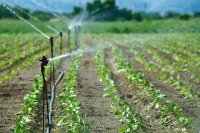
Drip irrigation instead of flood
Drip irrigation is more than a water-saving measure on saline land; it is part of the treatment. Flood irrigation covers the entire surface with water, which evaporates, leaving its salts behind. Drip delivers water at the root zone, which limits surface evaporation and keeps salts away from where roots take up water. Field trials report water savings of 30% to 50% and yield improvements of 20% to 40% on saline land when farmers switch. The obstacle is the upfront cost, which is where subsidies or cooperative financing make the difference.
Subsurface drainage to lower the water table
Surface drainage alone is not enough. Lowering the groundwater table requires closed subsurface drainage installed 1.5 to 2 metres below the surface, which removes excess water before it can evaporate and deposit its salt at the top of the profile. Egypt's drainage and soil improvement programmes in the Nile Delta, which have reclaimed hundreds of thousands of hectares of saline land, are the established model in the region. Syria's own experience points the same way: very saline land in the Euphrates valley has been reclaimed where deep drains were installed, and drainage remains the only route to recovering land already lost.
Gypsum for sodic soils
Where soil is sodic, meaning it carries a high proportion of exchangeable sodium, agricultural gypsum (CaSO₄·2H₂O) is the standard first treatment. Calcium from gypsum replaces the sodium held on clay particles, restoring structure and allowing the displaced sodium to be leached away. Gypsum occurs locally in Syria, in the Palmyra region and Homs governorate, at a fraction of the cost of imported fertiliser. Application rates have to be calculated from a soil analysis, because too much gypsum creates problems of its own.
Exchangeable sodium percentage, briefly. ESP is the share of sodium ions held on the soil's clay particles. Above about 15%, soil starts to lose its structure, becoming hard and closed to both roots and water. Gypsum works by replacing sodium with calcium, restoring the soil's workability and improving its physical and chemical behaviour.
Salt-tolerant crops where reclamation must wait
Not every affected hectare can be reclaimed at once, and in the meantime, tolerance buys time. Some wheat, barley, and potato cultivars handle more salt than conventional varieties, and barley is the reliable performer at the difficult end. Established salt-tolerance data indicate that above roughly 8 dS/m, productivity generally declines for most crops, and barley is often the only cereal that still yields, which matches what Syrian research stations report for local barley cultivars. Above about 16 dS/m, effectively nothing yields. Broader breeding work could broaden the range of tolerant crops beyond barley to include higher-value options.
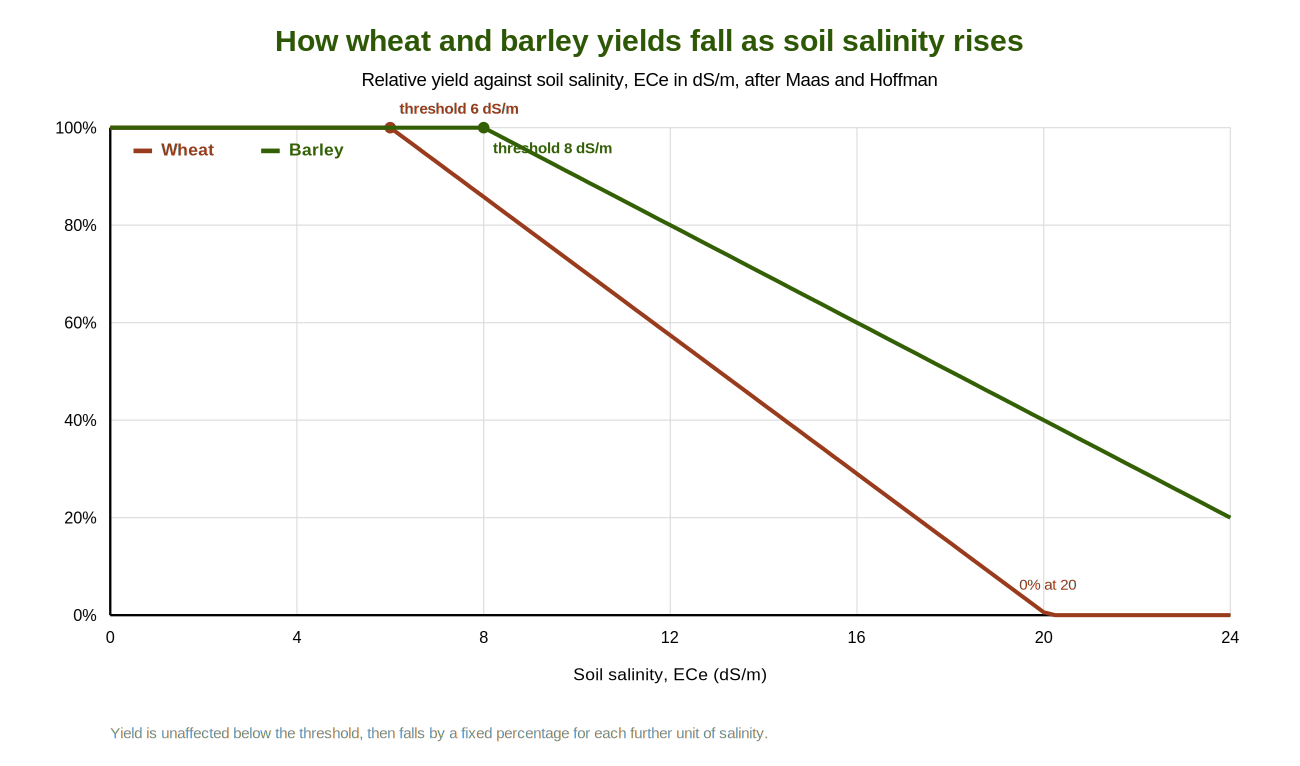
Wheat and barley yield against soil salinity, following the Maas and Hoffman threshold and slope model. Wheat is unaffected to about 6 dS/m and reaches zero near 20. Barley holds to about 8 dS/m and is still yielding at 24, which is why it remains the dependable crop on the worst ground.
Crop rotation to rebuild the soil
Rotation is as much a soil treatment as a tradition. Bringing nitrogen-fixing crops such as alfalfa, vetch, and faba bean into cereal rotations improves structure, adds organic matter, and reduces salt accumulation. Alfalfa is particularly useful, and it is already an important Syrian crop. Its roots reach beyond two metres, which helps break up compacted surface layers and improves infiltration, which leaching depends on.
The obstacles between science and the field
The solutions are well understood; applying them is harder. Agricultural infrastructure has been badly weakened over the past decade, with irrigation and drainage networks damaged, research stations closed, and much technical expertise lost to emigration. Equipment for drip systems and subsurface drainage is difficult and expensive to obtain.
There is also the question of extension. Many farmers work with practices inherited from their fathers, and adopting new techniques requires sustained, practical extension rather than printed leaflets. Any large transition also needs financial scaffolding, including affordable credit, functioning cooperatives, and some form of crop insurance to carry the risk of the changeover.
Soil takes decades to rebuild
Syrian soil, after drought, damage, and neglect, remains capable of recovery. The science is settled enough: drip irrigation, subsurface drainage, gypsum on sodic ground, tolerant cultivars, and rotations that feed the soil. What these require is sustained technical support at the field level and the direct participation of farmers in the decisions that affect their land.
The reason for urgency is simple. Soil does not renew itself on a useful timescale. A hectare that degrades needs decades to regain its fertility, so every season of delay converts a treatable problem into a permanent loss. Protecting it is a shared responsibility across researchers, policymakers, and the farmers who work it.
Sources
Qadir, M., et al. (2014). Economics of salt-induced land degradation and restoration. Natural Resources Forum, 38(4), 282-295.
Maas, E. V., and Hoffman, G. J. (1977). Crop salt tolerance, current assessment. Journal of the Irrigation and Drainage Division, 103(IR2), 115-134.
FAO and ITPS (2015). Status of the world's soil resources, main report. Rome.
Agricultural policy and environment in Syria, the cases of rangeland grazing and soil management. FAO.
Mustafa, K., et al. (2016). Salt accumulation in irrigated loamy soil, Lower Euphrates Valley, Syria. Water Science.