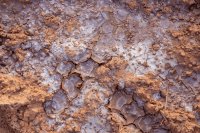
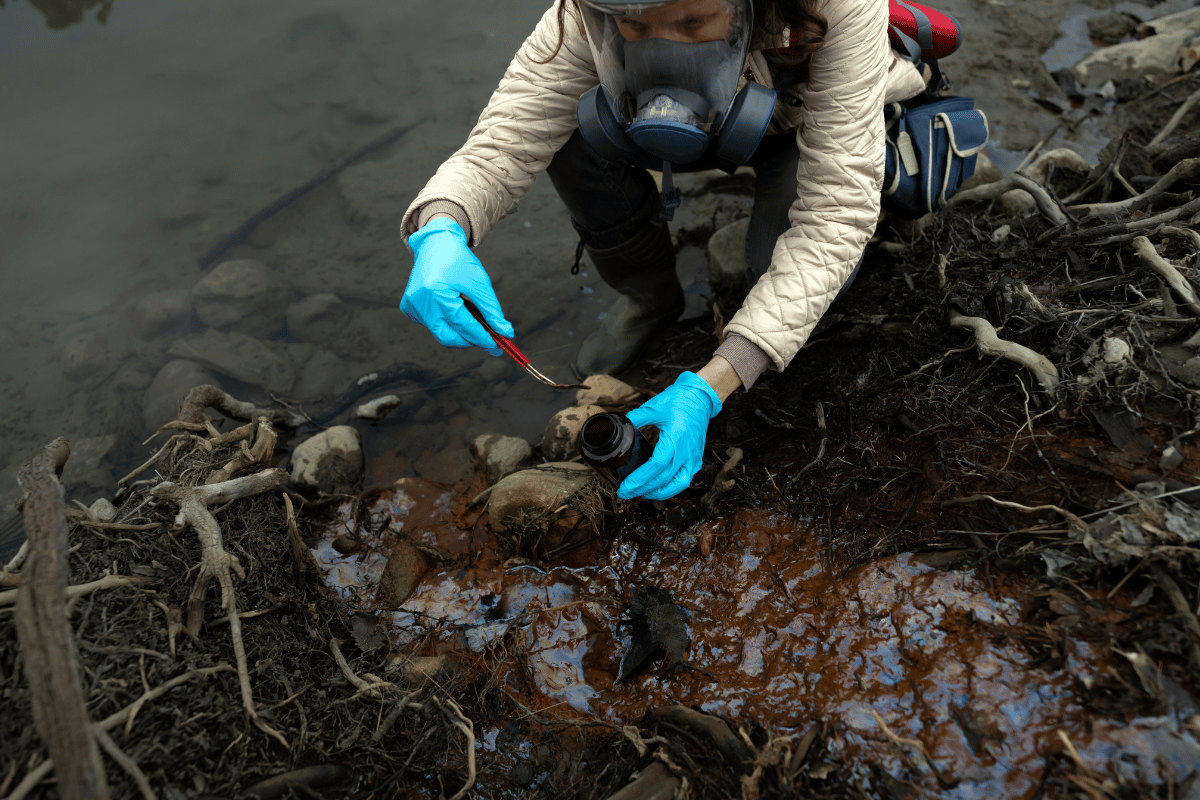
Oil fields in arid and semi-arid regions often sit on the same ground as historically productive farmland. Eastern Syria is a clear example, a region that was long one of the country's main grain-growing areas and that also holds most of its oil fields. Years of ageing infrastructure, small-scale improvised refining, and leaks from pipelines and disused wells have left oil waste seeping into farmland in places, and the soil on affected plots can no longer perform its basic functions. The damage runs far deeper than the black stain on the surface, and understanding it is the first step toward repairing it.
Petroleum contamination sets off chemical and biological changes in the soil that can persist for decades if nothing is done. This article looks at how petroleum derivatives reach and damage agricultural soil, drawing on peer-reviewed studies, and then at the bioremediation and physico-chemical methods that can bring that soil back to life. The science applies wherever oil production and agriculture share the same ground.
How oil reaches agricultural soil
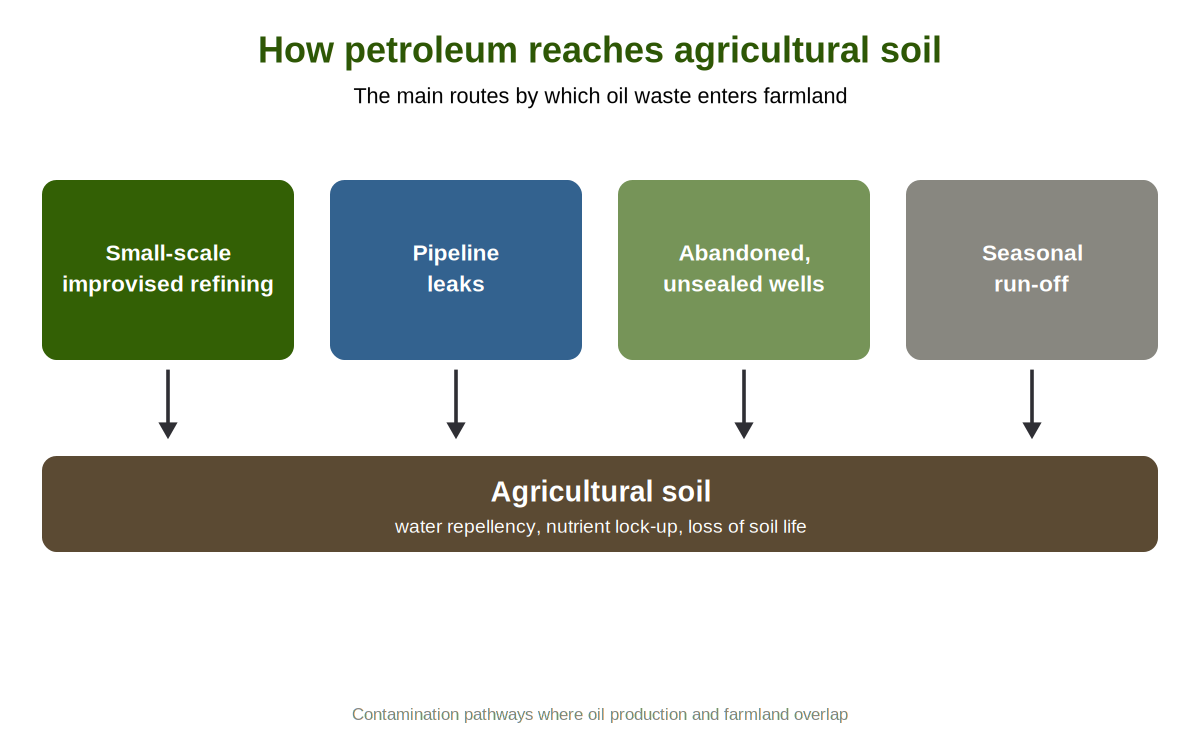
Where petroleum activity overlaps with farming, contamination arrives by several routes. Small-scale improvised refining is one of the most damaging: crude is heated in makeshift tanks, and a large share of it ends up as a thick, tar-like sludge that is dumped into open pits or seeps directly into the ground. Leaks from ageing or damaged pipelines add a steady, diffuse source, and wells that have been abandoned without proper sealing act as open conduits that let oil waste move down into deeper layers.
Weather then spreads what has already been spilled. In the wet season, run-off carries oil residues from refining sites and exposed wells into valleys, drainage lines, and rivers, moving contamination well beyond the original spill and onto farmland downstream. The result is that a problem which starts at a few points spreads across a much wider area over time.
What petroleum does to the soil
Oil contamination attacks the soil on three fronts at once, its physical structure, its chemistry, and its biology.
The most immediate change is physical. Petroleum coats soil particles with an oily film that turns them from water-attracting to water-repellent, so the soil sheds rainfall instead of absorbing it and plants can suffer drought stress even after rain. In the sandy soils common to dry regions the effect is pronounced, because their water-holding capacity is already low.
The chemistry shifts as well. Aromatic hydrocarbons tie up the major nutrients, nitrogen, phosphorus, and potassium, in forms that plants cannot easily take up, so a contaminated soil becomes effectively short of nutrients even where they are present. Heavy, sulfur-rich crude can push soil toward acidity, and as the pH falls, toxic metals such as aluminium and manganese become mobile and available to roots. Heavy crude also carries metals such as vanadium and nickel, which accumulate in the soil under continuous leakage. A study of soils around the Daura refinery in Baghdad found that concentrations of lead, cadmium, and hydrocarbons rose sharply closer to the pollution source, and that the hydrocarbons themselves helped mobilise heavy metals through the soil profile.
The biological damage may matter most, because the soil's living community is what makes it fertile. High hydrocarbon concentrations damage microbial cell membranes and suppress the microorganisms that drive the nitrogen cycle and the mycorrhizal fungi that help roots take up phosphorus and water. The effect depends on dose: research on the response of the soil microbial community to petroleum found that high concentrations reduced the soil's functional diversity, while low concentrations sometimes increased microbial diversity instead. As the community narrows, the soil loses much of its natural ability to cycle nutrients and hold off disease. The living side of that capacity is the community of soil microorganisms that healthy soil depends on, and the mycorrhizal fungi that extend the reach of plant roots.
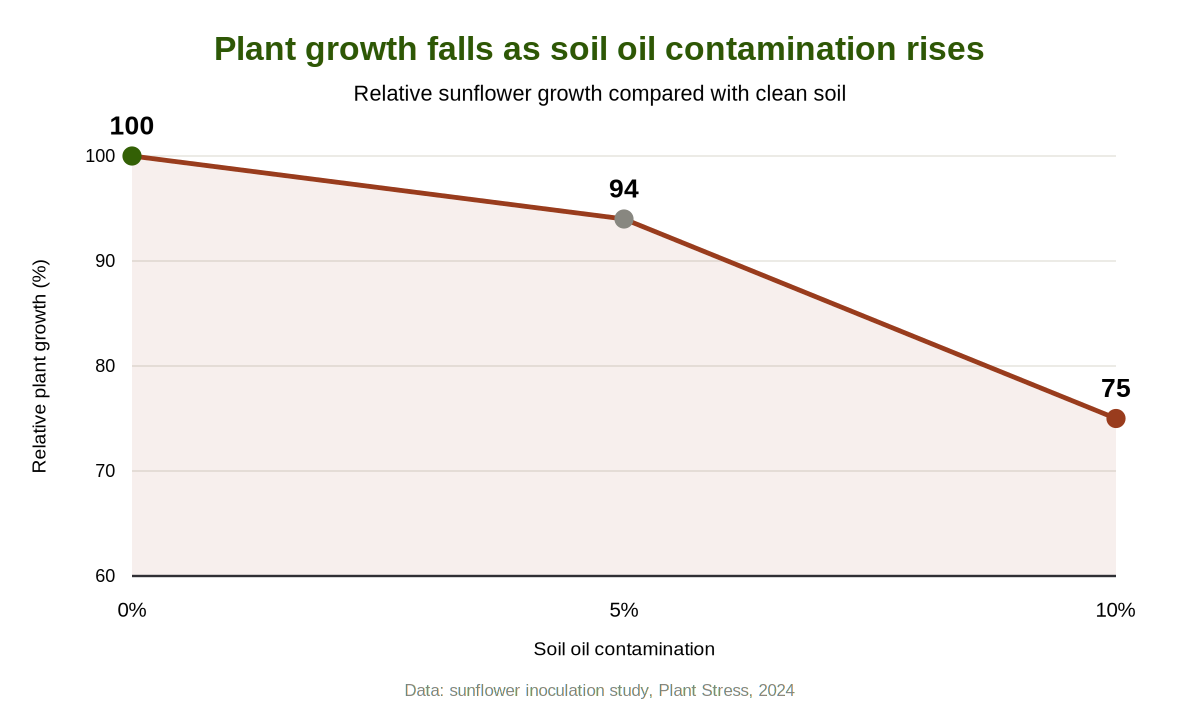
For the crop above ground, the combined result is poor establishment, stunted growth, and lower yield, with grain that tends to be smaller and of poorer quality. Because oil also interferes with the leaf surface and gas exchange, plants in contaminated soil struggle to grow even where moisture is present.
Why oil lingers for so long
The heavy fractions of petroleum are chemically stable and break down slowly. That breakdown is carried out mostly by soil microbes, and they need oxygen and nutrients to do it. In well-aerated soil with adequate nitrogen and phosphorus, degradation proceeds; in compacted, dry, or oxygen-poor soil it slows to a crawl. The light fraction of the oil evaporates within the first weeks, but the heavy fraction can persist for years, which is why an untreated spill remains a problem long after it stops being visible. In sandy soils especially, oil also moves gradually downward over time, so contamination left in place can eventually threaten the groundwater below.
How contaminated soil can be restored
Oil-contaminated soil can be brought back, and the most sustainable methods are biological. They are slower than digging the soil out, but they return the soil to a living state.
Phytoremediation uses plants to draw down contamination. Species such as sunflower (Helianthus annuus) tolerate hydrocarbons and support the root-zone activity that helps break oil down, and their performance improves when they are paired with helpful bacteria. In one study on heavy-metal-contaminated soil, sunflower inoculated with the bacteria Stutzerimonas stutzeri and Pseudomonas sundara grew taller, produced more biomass, took up more metal, and left the soil measurably lower in salts and heavy metals after harvest. The plants are grown, harvested, and disposed of safely, and the cycle is repeated over successive seasons.
Microbial bioremediation works with the soil's own hydrocarbon-degrading bacteria and fungi. Genera such as Pseudomonas, Bacillus, and Stenotrophomonas are among the most effective; a 2024 review reported individual strains of Stenotrophomonas acidaminiphila, Bacillus megaterium, and Pseudomonas aeruginosa degrading between about 87% and 92% of petroleum hydrocarbons under favourable conditions. Certain fungi, including oyster mushroom (Pleurotus ostreatus), secrete enzymes that break down the tougher polycyclic aromatic hydrocarbons. Two levers make these organisms more effective: biostimulation, which means supplying the oxygen and nutrients the microbes need, and bioaugmentation, which means adding effective strains where the native population has been depleted.
Aeration through tillage supports all of this by working oxygen into the soil, which is the single biggest constraint on how fast the microbes degrade the oil. Adding organic matter such as compost or manure at the same time feeds the microbial community and rebuilds soil structure. Even with these aids, biological restoration of moderately contaminated soil takes years, but it is durable, and it improves the soil while it works.
For the most heavily contaminated spots, biology alone is too slow, and physico-chemical methods come into play. Controlled thermal treatment can break down the bulk of the hydrocarbons in a heavily fouled surface layer, though it also destroys organic matter and leaves soil that must then be rehabilitated. Solvent washing extracts oil from concentrated pollution zones. Excavating the worst material and removing it to a lined, isolated site is the last resort for severe contamination. These methods are faster but far more expensive than the biological routes, and they leave the soil needing to be rebuilt, so they are best reserved for hotspots while biological methods handle the wider area.
<table style="border-collapse:collapse;width:100%;font-family:Arial,Helvetica,sans-serif;font-size:15px;"> <tr> <td style="background-color:#c0ceb2;color:#2e5705;font-weight:bold;padding:10px 12px;border:1px solid #769458;text-align:left;">Method</td> <td style="background-color:#c0ceb2;color:#2e5705;font-weight:bold;padding:10px 12px;border:1px solid #769458;text-align:left;">Relative cost</td> <td style="background-color:#c0ceb2;color:#2e5705;font-weight:bold;padding:10px 12px;border:1px solid #769458;text-align:left;">Typical time</td> <td style="background-color:#c0ceb2;color:#2e5705;font-weight:bold;padding:10px 12px;border:1px solid #769458;text-align:left;">Trade-off</td> </tr> <tr> <td style="color:#2f2f34;font-weight:bold;padding:10px 12px;border:1px solid #769458;text-align:left;">Bioremediation with organic matter</td> <td style="color:#336005;font-weight:bold;padding:10px 12px;border:1px solid #769458;text-align:left;">Lowest</td> <td style="color:#2f2f34;padding:10px 12px;border:1px solid #769458;text-align:left;">3 to 5 years</td> <td style="color:#2f2f34;padding:10px 12px;border:1px solid #769458;text-align:left;">Slow, but rebuilds living soil</td> </tr> <tr> <td style="background-color:#f7f7f7;color:#2f2f34;font-weight:bold;padding:10px 12px;border:1px solid #769458;text-align:left;">Aeration tillage with biostimulation</td> <td style="background-color:#f7f7f7;color:#2f2f34;padding:10px 12px;border:1px solid #769458;text-align:left;">Low</td> <td style="background-color:#f7f7f7;color:#2f2f34;padding:10px 12px;border:1px solid #769458;text-align:left;">2 to 4 years</td> <td style="background-color:#f7f7f7;color:#2f2f34;padding:10px 12px;border:1px solid #769458;text-align:left;">Speeds up natural breakdown</td> </tr> <tr> <td style="color:#2f2f34;font-weight:bold;padding:10px 12px;border:1px solid #769458;text-align:left;">Phytoremediation with sunflower</td> <td style="color:#2f2f34;padding:10px 12px;border:1px solid #769458;text-align:left;">Moderate</td> <td style="color:#2f2f34;padding:10px 12px;border:1px solid #769458;text-align:left;">1 to 2 years per cycle</td> <td style="color:#2f2f34;padding:10px 12px;border:1px solid #769458;text-align:left;">Preserves soil, needs several cycles</td> </tr> <tr> <td style="background-color:#f7f7f7;color:#2f2f34;font-weight:bold;padding:10px 12px;border:1px solid #769458;text-align:left;">Controlled thermal treatment</td> <td style="background-color:#f7f7f7;color:#2f2f34;padding:10px 12px;border:1px solid #769458;text-align:left;">High</td> <td style="background-color:#f7f7f7;color:#2f2f34;padding:10px 12px;border:1px solid #769458;text-align:left;">Immediate</td> <td style="background-color:#f7f7f7;color:#993C1D;font-weight:bold;padding:10px 12px;border:1px solid #769458;text-align:left;">Destroys organic matter</td> </tr> <tr> <td style="color:#2f2f34;font-weight:bold;padding:10px 12px;border:1px solid #769458;text-align:left;">Excavation and landfill</td> <td style="color:#993C1D;font-weight:bold;padding:10px 12px;border:1px solid #769458;text-align:left;">Highest</td> <td style="color:#2f2f34;padding:10px 12px;border:1px solid #769458;text-align:left;">Immediate</td> <td style="color:#993C1D;font-weight:bold;padding:10px 12px;border:1px solid #769458;text-align:left;">Removes the soil entirely</td> </tr> </table>
Protecting groundwater while the soil heals
Where contamination is ongoing or severe, the water beneath the field is at risk as hydrocarbons move slowly downward, especially through sandy profiles. Practical safeguards include barriers of compacted clay in deep trenches to slow downward movement, reactive barriers of materials such as zero-valent iron or activated carbon that break down or trap hydrocarbons before they travel further, and monitoring wells that give early warning of any leakage toward the water table. For the worst-affected ground, removing the most heavily contaminated surface layer first lets the biological methods do the rest.
Why bioremediation is usually the right first choice
Bioremediation stands out because it returns the soil to a living state without destroying its structure. Oil-degrading microbes convert hydrocarbons into carbon dioxide, water, and new microbial biomass, and that biomass becomes part of the soil's organic matter. The process is slow, typically three to five years for moderately contaminated soil, but it rebuilds the soil's biology, so it does more than strip out toxins and leave dead ground behind. That is the core idea of soil regeneration, and it is why biological methods are the sensible backbone of any recovery plan, with the faster physico-chemical methods kept for the hotspots that need them.
The takeaway for farmers and land managers
Petroleum contamination is a serious injury to a soil, but it is rarely a permanent one. The priority is to stop the source, protect the groundwater, and then give the soil's own biology what it needs to recover, which means oxygen, nutrients, organic matter, and the right plants. For any region where farmland and oil sit side by side, that combination offers a realistic path from damaged ground back to productive land, and it rewards patience more than any quick fix.
Sources
Petroleum contamination and heavy metals in soils near the Daura refinery. Agricultural Science Digest, 2024.
Response of the soil microbial community to petroleum hydrocarbon contamination. PMC.
Phytoremediation of heavy metals from industrially contaminated soil using sunflower (Helianthus annuus L.) by inoculation of two indigenous bacteria. Plant Stress, 2024.
Microbial bioremediation of soils contaminated with petroleum hydrocarbons. Discover Soil, Springer, 2024.
Remediation of soil polluted with petroleum hydrocarbons and its reuse for agriculture. Science of the Total Environment, 2022.