A practical guide to EU and US strawberry standards for growers and traders
Strawberries (Fragaria spp.) are among the world's most beloved and traded soft fruits, prized for their vibrant color, delicate sweetness, and nutritional richness. Yet beyond flavor, the global strawberry trade hinges on strict quality standards that determine whether fruit can access domestic or international markets.
Understanding these standards is essential for farmers, exporters, and importers—especially those targeting the EU or U.S. markets, where inspection systems are rigorous and non-compliance can mean rejection at the border.
This article synthesizes the latest UNECE, Codex, EU, and USDA strawberry standards, focusing on quality classes, maturity, sizing, packaging, and export requirements, helping you meet buyer expectations and strengthen your market position.
If you'd like to explore practical cultivation techniques, orchard management tips, and postharvest best practices, visit our dedicated section: Strawberry Cultivation and Management Guides
Key quality criteria for fresh strawberries
Quality strawberries are characterized by an attractive appearance, firmness, and freedom from defects. Buyers and standards agencies look for the following criteria:
- Shape and uniformity: Berries should be well-formed (typically conical or heart-shaped, depending on variety) and fairly uniform in shape and size in each package. Very irregular or deformed fruits are considered lower quality.
- Color and ripeness: Fruit color should be bright and glossy red appropriate to the variety, with minimal green or white areas. A small white or green patch at the tip (the “shoulder” near the calyx) is acceptable only if it’s very limited in size (e.g., <10% of the surface for Class I). Strawberries are non-climacteric, meaning they do not ripen further after harvest, so they should be picked when mostly red for best flavor.
- Firmness: Berries must be firm and plump, not soft or mushy. Firmness indicates freshness and helps the fruit withstand handling. Overripe or very soft strawberries are prone to bruising and decay, and are usually rejected for high-quality grades.
- Cleanliness and fresh appearance: Strawberries should be clean, free of visible soil or foreign matter, and fresh in appearance (they should not be washed, as washing can introduce moisture and spoilage). The skin should have a natural sheen with no abnormal external moisture (e.g. condensation in the package).
- Calyx (cap) condition: Quality standards require the green cap (calyx) to be intact, fresh and green on each berry. Dry, brown, or missing calyxes are signs of reduced freshness. In the US No.1 grade, strawberries without caps are a defect.
- Freedom from defects and decay: Premium-grade strawberries must be free from rot, mold, or significant defects. There should be no bruises or only very slight superficial pressure marks on higher grades. They must also be practically free of pests and damage from insects or disease (no holes, feeding marks, etc.). Even slight decay or mold will disqualify fruit from top quality classes.
In summary, top-quality strawberries are intact, sound, clean, fresh-looking, and uniformly well-colored, with only the slightest allowable cosmetic defects. They should look appealing and appetizing, as visual quality greatly influences market value.
If you're looking to source or sell high-quality strawberries directly, explore our global trading platform: Buy and sell strawberries on Wikifarmer Marketplace.
Maturity and ripeness
Strawberries reach their best flavor and quality only when they are fully mature. Since they are non-climacteric fruits, they stop developing sugars and color once picked. This means harvesting too early leads to bland flavor and pale color that cannot be improved after picking.
Unlike bananas or mangoes, strawberries must be harvested at their peak. Growers evaluate maturity by several key indicators:
- Surface color: The most reliable sign of ripeness. Berries are typically harvested when at least three-quarters of their surface is red. U.S. No.1 grade requires a minimum of 75% red coloration, while top programs often target fully red berries for superior taste. Green or half-white fruits lack sweetness, while dark, dull berries may already be overripe.
- Sugar content (Brix): Sweetness usually begins around 7 °Brix, but most buyers prefer levels of 8 °Brix or higher. Modern varieties like Calinda and Sonata often achieve 8–9 °Brix, offering better flavor than traditional cultivars such as Elsanta. Farmers often use handheld refractometers to check Brix in the field before harvest.
- Flavor balance: Ideal berries combine sweetness with moderate acidity (roughly 7% sugars and below 0.8% titratable acidity). When fully red, acids drop and aroma compounds intensify, giving the fruit its characteristic flavor.
- Firmness: Maturity also affects texture. A properly ripe strawberry feels full and resilient without being hard or soft. Overripe fruit yields to slight pressure and deteriorates quickly.
- Harvest timing: Picking during the cooler hours of the morning, after dew has dried, helps maintain firmness and extends shelf life. Afternoon harvesting often results in softer, more perishable fruit.
Harvest stages
- Phase 6 (¾ red): Suitable for longer storage or distant markets
- Phase 7 (fully red): Best for immediate sale and fresh consumption
- Phase 8 (dark red or dull): Only for processing use
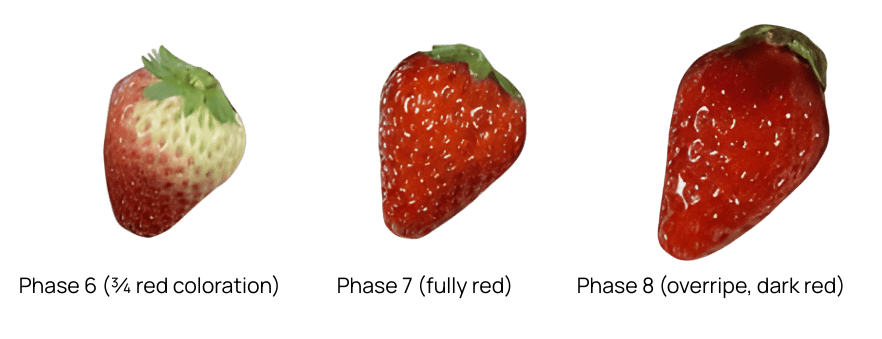
Fully red, sweet, and firm berries with fresh green caps represent the perfect harvest point. Careful timing ensures both flavor and durability, directly influencing the market quality of the fruit.
EU vs. US maturity standards
|
Region |
Maturity Indicators |
Color Requirements |
|
EU (UNECE/543/2011) |
Sufficiently developed, satisfactory ripeness; variety-dependent |
No specific minimum; white patch limits apply by class |
|
USA |
Not overripe or undeveloped; firm |
U.S. No. 1: ≥ 75% pink/red surface U.S. No. 2: ≥ 50% pink/red surface |
The U.S. explicitly defines color thresholds for each grade, while EU standards focus on maturity, shape development, and permissible white patches per class.
Strawberry classification systems
Both EU and U.S. systems classify strawberries into quality grades, though terminology and criteria differ slightly.
EU and UNECE quality classes
|
Class |
Description |
Allowed Surface Defects |
|
Extra Class |
Superior quality; bright in appearance; characteristic of variety; free from soil |
Only very slight superficial defects; no white patches allowed |
|
Class I |
Good quality; characteristic of variety; practically free from soil |
• Slight defect in shape • Small white patch ≤ 1/10 of surface • Slight superficial pressure marks |
|
Class II |
Marketable quality; suitable for consumption |
• Defects in shape • White patch ≤ 1/5 of surface • Slight dry bruising not likely to spread • Slight traces of soil |
Uniformity requirements:
- Extra Class: Strawberries (except wood strawberries) must be particularly uniform and regular with respect to ripeness, color, and size
- Class I: May be less uniform in size
- Class II: Reasonable quality; must retain essential characteristics
U.S. quality grades
|
Grade |
Key U.S. defect definitions:
- Damage: Any defect materially detracting from appearance, edibility, or shipping quality
- Serious damage: Soft berries, badly deformed, badly bruised, decayed/leaky, badly caked with dirt, or < 50% pink/red (for No. 2)
- Overripe: Dead ripe, becoming soft; unfit for shipment
- Undeveloped: Button berries or abnormal shape due to frost, poor pollination, or insect injury
Strawberry sizing systems explained
Size is determined by the maximum diameter of the equatorial section (the widest point measured perpendicular to stem-apex axis).
EU minimum size
|
Class |
Minimum Diameter |
Size Tolerance |
|
Extra Class |
25 mm |
10% may not meet minimum size |
|
Class I |
18 mm |
10% may not meet minimum size |
|
Class II |
18 mm |
10% may not meet minimum size |
U.S. minimum size and count designations
|
Grade |
|
U.S. No. 1 |
|
U.S. Combination |
|
U.S. No. 2 |
Note: The U.S. does not mandate size uniformity within packages, providing flexibility. However, uniformity within a package improves marketability—weight variation should ideally not exceed ±10%.
Common defects affecting grading
Understanding defects is crucial for compliance and quality control.
Visual defects and permissible limits
|
Defect Type |
|
White/green patches |
|
Pressure marks |
|
Shape defects |
|
Soil traces |
|
Calyx condition |
Disease and physiological defects
- Bruising or physical damage: From rough handling or mechanical injury
- Sunburn: Exposure to direct sunlight causing tissue damage; reduces value by up to 40% after 4 hours at 30°C (86°F)
- Anthracnose (fungal): Dark lesions that render fruit unsaleable
- Botrytis (gray mold): Even slight signs lead to rejection; mold spores spread rapidly
- Powdery mildew: White fungal coating
- Insect damage (thrips): Surface scarring or internal damage
- Overripe/soft berries: Leaky, unfit for shipping

Packaging standards and best practices
Proper packaging protects delicate strawberries during transport while meeting regulatory and buyer expectations.
Standard packaging formats
Retail packages (consumer-ready):
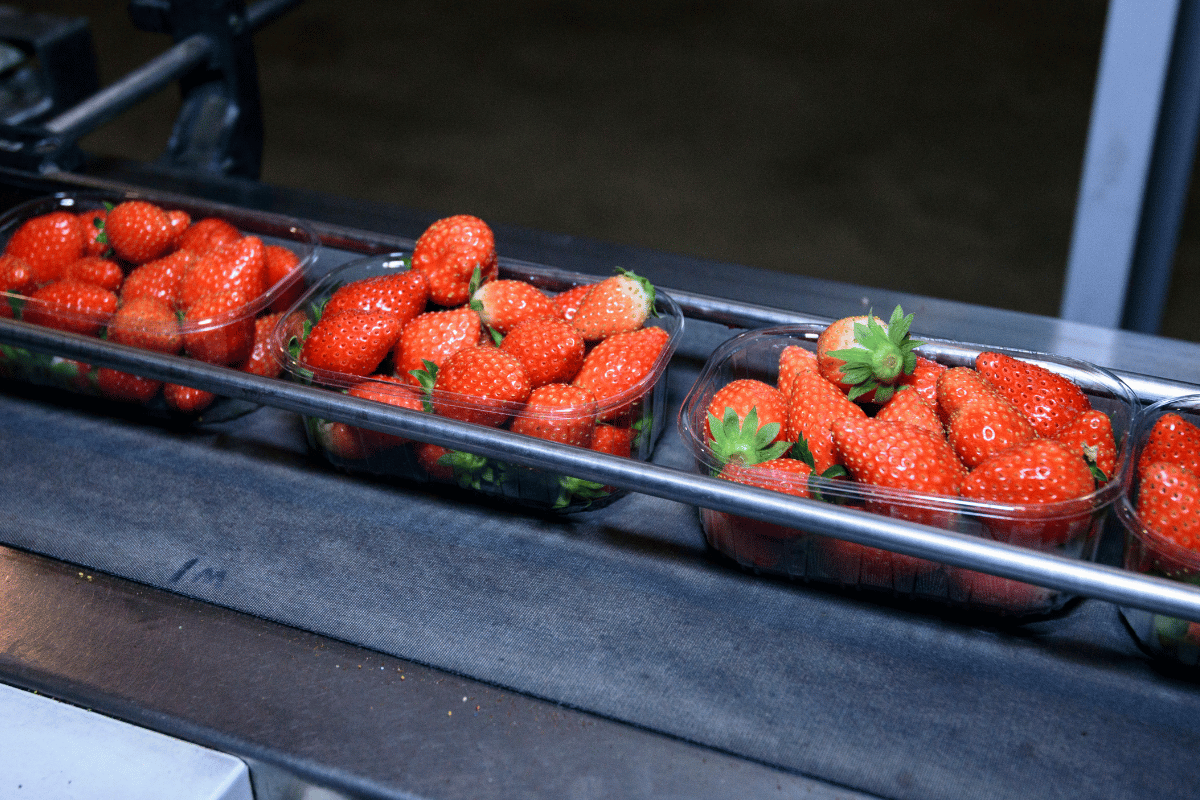
- Clamshells: 125g, 150g, 250g, 500g – transparent plastic with ventilation holes
- Top-seal trays: Cardboard or pulp base with plastic film lid; increasingly popular for sustainability
- Flow-packs: Sealed plastic bags with perforations for gas exchange
- Punnets: Small baskets (250g–500g) with or without lids
Wholesale/transport packages:
- Single-layer boxes: Arrange strawberries in one layer; each fruit visible when opened
- Volume-filled cartons: Stack strawberries without strict layering
- Maximum net content: 5 kg per package (EU standard)
- Material: Cardboard, wood, or moulded paperboard pulp
Pack tightness considerations:
- Very tight: Causes bruising in ripe fruit; should be avoided
- Tight: No fruit movement; optimal for transport
- Fairly tight: Slight movement permitted (within 1 inch / ~2.5 cm of container top)
- Slack: Free movement; must be specified and minimized
Packaging materials requirements
Materials must be:
- Clean and food-grade quality – new or recycled materials; free of foreign matter and odor
- Non-toxic – printing/labeling with non-toxic ink or glue
- Protective – avoid external or internal damage to produce
- Permeable – allow gas exchange to prevent moisture accumulation
Stickers and labels:
- Individually affixed stickers must not leave glue traces or cause skin defects when removed
- Laser-printed information on fruit should not cause flesh or skin defects
Labeling requirements
Each package must display specific information to ensure traceability and consumer transparency.
Mandatory label information
A. Identification:
- Packer and/or dispatcher/exporter: Name and physical address (street/city/region/postal code)
- If different from country of origin, include the country
- Alternatively: officially recognized code mark (preceded by ISO 3166 country code if not country of origin)
B. Nature of Produce:
- "Strawberries" if contents not visible from outside
- Name of variety (optional but recommended)
C. Origin:
- Country of origin (full or commonly used name; acronyms like "USA" permitted)
- Optionally: district, regional, or local place name
D. Commercial Specifications:
- Class (Extra, I, or II)
Pre-packages (consumer retail)
Must comply with:
- Codex General Standard for Labelling of Prepackaged Foods
- EU Regulation No. 1169/2011 (for EU markets)
Includes additional requirements: net quantity, date of minimum durability, storage instructions, allergen information (if applicable).
Export considerations: Meeting phytosanitary requirements
Phytosanitary compliance is non-negotiable for strawberry exports.
EU requirements
Since December 2019 (Regulation EU 2019/2072), strawberries imported into the EU require a phytosanitary certificate stating one of the following:
- Fruit originates in a country recognized as free from Tephritidae (fruit flies)
- Fruit originates in an area established as free from Tephritidae
- No signs of Tephritidae observed at the place of production and surrounding area since the beginning of the last vegetation cycle; official inspections monthly during the 3 months before harvest and on harvested fruit; traceability information indicated on certificates
- Product has been subjected to effective treatment to ensure freedom from Tephritidae; treatment data indicated on certificates
Challenge: If local plant health authorities are insufficiently equipped for phytosanitary control, export potential to Europe is affected.
Storage and cold chain management
Proper post-harvest handling is essential—strawberries are highly perishable.
Pre-cooling
Why pre-cooling matters:
- Strawberries are sensitive to high temperatures and lose water rapidly
- At 15°C (59°C): 0.5% mass loss within 2 hours
- At 30°C (86°C): 2.5% mass loss within 2 hours
- Direct sunlight exposure (4 hours at 30°C): 40% loss of commercial value
Pre-cooling methods:
- Forced-air cooling (cooling tunnels): Most effective; strong cold air circulated through packages
- Room cooling: Smaller quantities in conventional cold storage
- Hydro-cooling: Less common for strawberries (risk of moisture damage)
Timing: Cool within 2–3 hours of harvest to maximize shelf life.
Duration: 0.3–2 hours depending on fruit temperature, packaging, and cooling system.
Storage conditions
|
Condition |
|
Mature strawberries (Class I, harvested at ¾ red) |
|
Ripe strawberries (fully red) |
|
Controlled Atmosphere (CA) storage |
|
Critical minimum temperature |
Storage tips:
- Use small packaging to improve air circulation and cooling efficiency
- Shield from direct sunlight during harvest and transport
- Transport to cold storage within 2 hours of harvest
- Check packages visually for mold; discard moldy berries and adjacent ones to prevent spread
Final insights for growers and traders
A consolidated verification list helps ensure fruit is ready for premium buyers.
- Harvest with gloves or clean hands and avoid stacking fruit too deep.
- Keep picked fruit shaded at all times.
- Pre-cool within two hours.
- Maintain 0°C and high humidity during storage.
- Use clean packaging with good airflow.
- Sort out fruit with bruises, rot or soil contamination.
- Ensure uniformity within each package.
- Include clear labelling with origin and class.
- Check Brix levels for markets that require sweetness standard
Strawberry quality depends on careful work at every stage, from choosing the right variety to the way fruit is picked, cooled and presented. Growers who invest in firm, uniform berries and rapid cooling tend to achieve far lower postharvest losses and reach the premium classes that most markets demand. Traders benefit when lots are consistent, clearly labelled and packed in a way that protects fruit during long transport.
Sources
Entering the European market for strawberries
United States Standards for Grades of Strawberries
UNECE STANDARD FFV-57 concerning the marketing and commercial quality control of strawberries