
Puerto del Pico in Ávila received 352.0 mm of rain on 10 and 11 November, and Garganta la Olla in northern Cáceres 348.6 mm, according to station data from Spain's meteorological agency, AEMET. The storm came in the first weeks of the olive harvest, from Andalusia and Extremadura to the Alentejo in Portugal, at a time that matters directly to growers and mills. Forecasts in early November had pointed to heavy rain over Iberia's olive groves, and station readings now show where most of it fell.
How much rain fell in Spain and Portugal
AEMET had issued an orange rain warning for northern Cáceres and southern Ávila on 10 November and a red one on 11 November. On the second day alone, Garganta la Olla recorded 152.6 mm, Puerto del Pico 122.2 mm and Piornal 104.4 mm. In Andalusia's olive groves totals were much lower and uneven. The mountain stations of Cazalla de la Sierra (Seville) and Alájar (Huelva) recorded 86.2 mm and 83.0 mm on 11 November, Seville and Córdoba airports 42.6 mm and 31.2 mm, and in Jaén, Spain's largest olive-growing province, the city station had 23.0 mm. The median across stations was 65.6 mm in Cáceres, the highest in Spain, and 16.4 mm in Jaén.
Totals in the Alentejo also varied widely from station to station. Data from Portugal's meteorological institute, IPMA, for 11 November cover 21 of the 24 hours, without three morning hours, so the totals are minimums. Mora reached at least 77.8 mm and Portalegre 62.3 mm, while Beja, in the area of intensive olive groves, recorded 15.9 mm and Évora 16.0 mm. By 12 November IPMA had no orange or red warnings left for mainland Portugal.
The storm caught the groves early in the harvest
For the Alentejo, Portugal's agriculture ministry noted in the GPP crop condition report for September 2026 that the olive cycle was ahead of normal, harvesting had started early on some farms, and olive oil production was estimated at about 10% above the previous year.
In Spain the 2026/27 season opened on 1 October with the agriculture ministry's first official production estimate, which put olive oil at 1,602,596 tonnes, 23% above the previous season. The ministry described the figures as preliminary and said oil yield would depend on the weather of the following weeks and on how the fruit developed after the summer heat, which mainly affected rain-fed groves. The storm therefore arrived within the weeks that will set the final yield.
Rain at harvest puts oil quality at risk
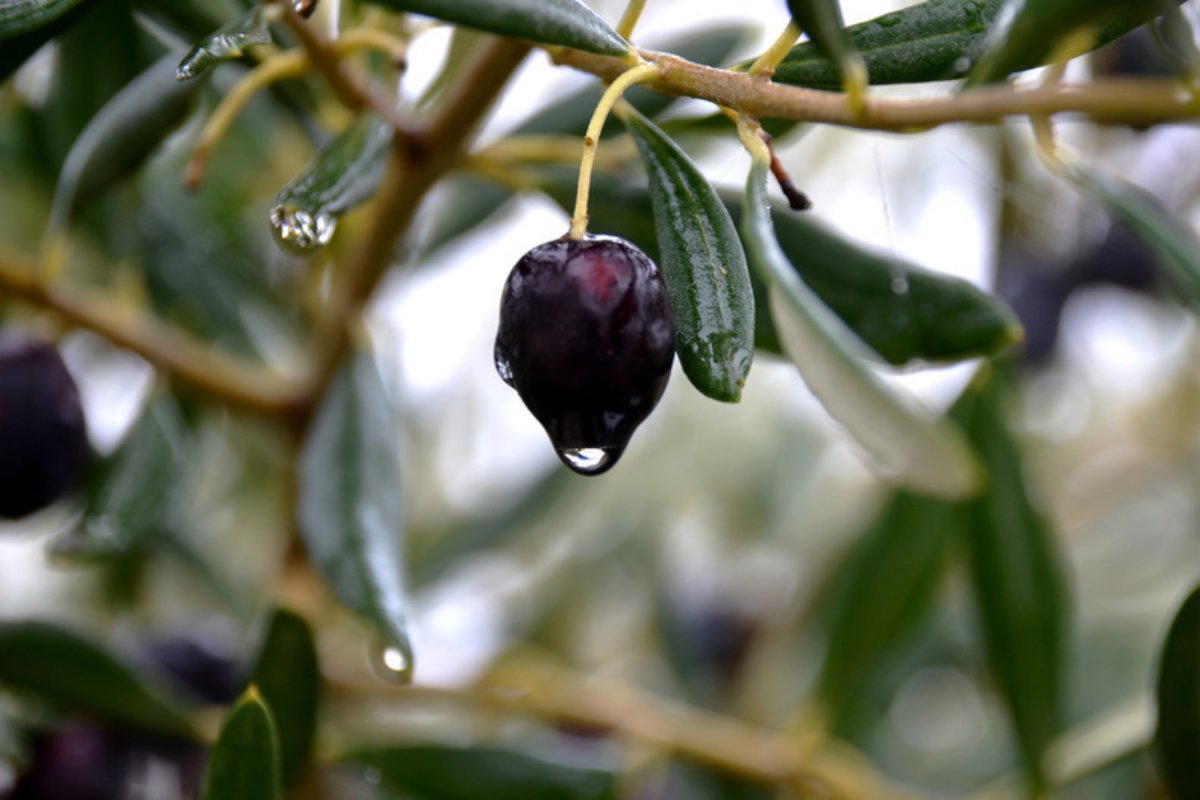
Prolonged wetness on ripe fruit favours olive anthracnose, a fungal disease caused by Colletotrichum species that develops mainly as the fruit matures, alongside autumn rains, and causes fruit rot, fruit drop and yield losses.
In a laboratory experiment with Portugal's two most widely grown cultivars, healthy fruit was artificially infected with anthracnose fungi. With C. nymphaeae and C. acutatum, oil acidity reached 5% in the more susceptible Galega Vulgar and 2% in Cobrançosa 14 days after infection. In Galega, fatty acid ethyl esters exceeded the extra virgin limit after 7 to 11 days, depending on the fungus, and total phenols fell with all the fungi tested. With the same two fungi, the musty sensory defect appeared before the chemical degradation, after 3 days in Galega and 7 days in Cobrançosa. The results come from controlled conditions, but they show how quickly oil from infected fruit can lose its grade, which bears directly on whether it qualifies as extra virgin.
Harvesting slows and the flow to the mills narrows
Where the soil became waterlogged, machinery cannot get into the groves and picking slows down, especially in intensive groves harvested with trunk shakers and self-propelled harvesters. Fruit knocked down by wind and rain is collected separately, because it gets dirty and deteriorates quickly. Wet and bruised fruit has to reach the mill and be crushed soon, since storing it in piles raises acidity and causes defects. In the busy weeks after a storm like this, the flow of fruit to the mills and their crushing capacity become the bottleneck of the chain.
It is still too early to call the olive oil price
Spain is the world's largest olive oil producer and Andalusia is its core, so what happens there during the harvest sets the reference for the whole Mediterranean market. Since the summer the market had been moving on lower prices ahead of a large 2026/27 crop, and the first official estimate in October put output 23% above last year. It is too early to attribute any price move to this rainfall, because the harvest runs into the winter and the final output will depend on how it goes. What can be followed with certainty are the official revisions of the production estimates by the Spanish agriculture ministry, the autonomous communities and Portugal's GPP, which will show whether and how far volume and quality were affected.
What growers should watch now
Ripe and infected fruit comes first in the harvest and is picked as soon as the ground allows, so that it does not stay wet on the tree. Fallen and bruised fruit is kept apart and taken to the mill quickly, without being stored in wet piles. Copper sprays are the standard preventive protection against anthracnose, using the products authorised in each country, once ground and weather conditions allow.
Growers with insurance cover, through Agroseguro in Spain or equivalent schemes, record the damage with photos and dates and follow the claim procedure set out in their policy. For official advice, the agricultural warnings issued by the Junta de Andalucía and by Portugal's regional agriculture directorates are the reference for each area, and as of 13 November no official damage assessment had been published by the competent authorities. Where the ground became waterlogged, autumn field work such as winter cereal sowing is also delayed for as long as machinery access stays difficult.
Frequently asked questions
How much rain fell on Iberia's olive groves?
The highest totals were in the uplands of Ávila and Cáceres, with 352.0 mm in two days at Puerto del Pico and 348.6 mm at Garganta la Olla. In the olive groves themselves, totals on 11 November were much lower and uneven, with a median of 16.4 mm in Jaén and up to 86.2 mm at Cazalla de la Sierra, while in the Alentejo they ranged from 15.9 mm at Beja to at least 77.8 mm at Mora.
Is this season's oil quality at risk?
The risk concerns fruit that stays wet and becomes infected with anthracnose, which raises acidity and causes sensory defects. How far quality is affected will show in the analyses of the new oil over the coming weeks.
What is olive anthracnose and why does it appear now?
It is a fungal disease caused by Colletotrichum species that develops mainly as the fruit matures, alongside autumn rains, and causes fruit rot and drop. Autumn, with rain falling on ripe fruit, is its typical season.
Should the harvest stop?
The harvest resumes as soon as the ground allows, with ripe and infected fruit first. The delay comes from machinery being unable to enter waterlogged groves.
Is there an official damage estimate?
As of 13 November no official estimate had been published by the Junta de Andalucía, the Spanish ministry or Portugal's GPP. The next revisions of the production estimates will show the real picture.
Will the olive oil price be affected?
It is too early to link the rain to the price. Since the summer the market had been moving on lower prices ahead of a large crop, and the final output will depend on how the harvest develops.
Important notes
The rainfall figures are observations from official AEMET and IPMA stations. The Portuguese totals for 11 November cover 21 of 24 hours and are minimums. The Spanish and Portuguese figures come from different station networks and should not be added together. For the management of each farm and for authorised products, consult an agronomist and the local official agricultural warnings.
Sources
- AEMET, station data (Hoy y últimos días)
- IPMA, hourly surface observations
- GPP, Estado das Culturas e Previsão de Colheitas, September 2026
- MAPA, first olive oil production estimate for 2026/27, 1 October 2026
- Peres F. et al., 2021, Olive Oils from Fruits Infected with Different Anthracnose Pathogens Show Sensory Defects Earlier Than Chemical Degradation, Agronomy 11(6), 1041
- Agroseguro