

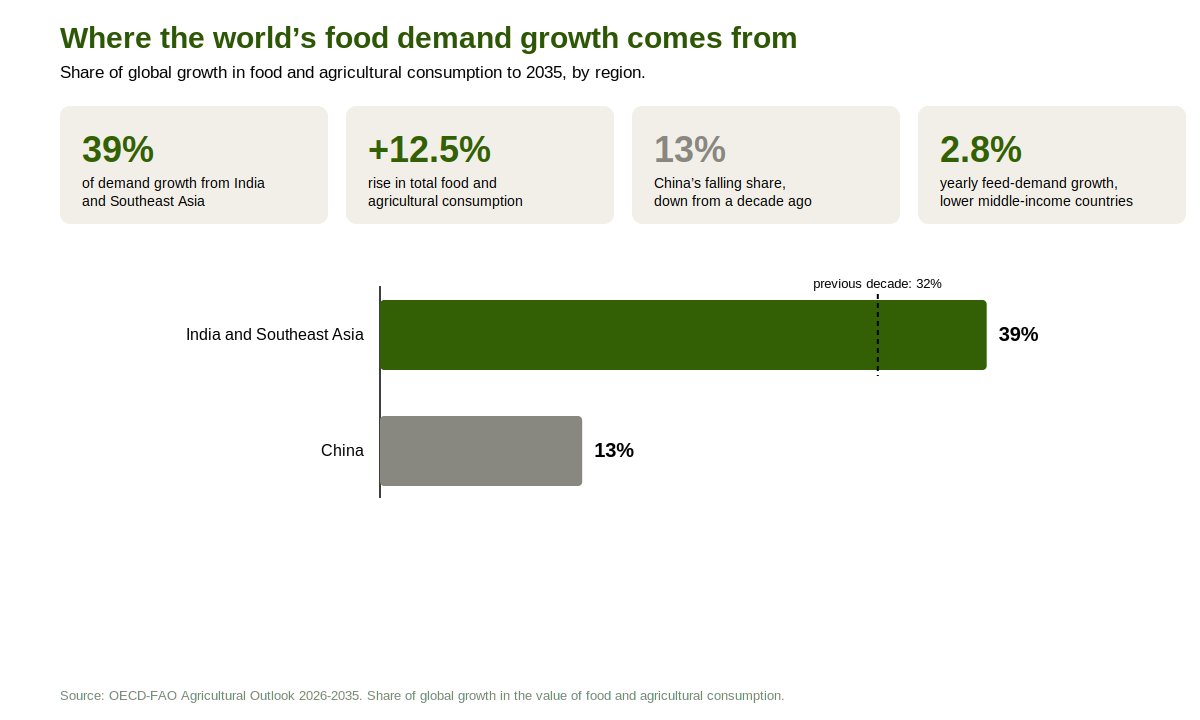
Southeast Asia, together with India, is set to generate an estimated 39% of global growth in food and agricultural consumption by 2035, up from 32% in the previous decade. The figure comes from the OECD-FAO Agricultural Outlook 2026-2035, the ten-year projection published jointly by the OECD and FAO, and it marks a clear shift in where the world's extra food will be eaten. For producers, exporters and feed suppliers, the answer to where demand is heading over the next decade points firmly toward South and Southeast Asia.
A shift in who eats the extra food
The total value of agricultural and fish consumption is projected to grow 12.5% over the coming decade, and almost all of that increase comes from middle- and low-income countries. Population growth expands the total number of mouths to feed, while rising incomes and rapid urbanisation change what those consumers buy. Lower middle-income countries, led by India and Southeast Asia, carry the largest single share of that growth.
China moves in the opposite direction. Its contribution to global consumption growth is expected to fall sharply to 13%, held down by a food demand that has already reached saturation on a per-capita basis and by a shrinking population. The centre of gravity in food demand is moving from East Asia toward South and Southeast Asia, and the decade to 2035 is when that shift becomes clear in the numbers.
Diets are moving beyond staples toward meat and fish
Rising incomes tend to change diets in a consistent direction, and Southeast Asia is following it. As living standards rise, consumers diversify away from a staple-heavy diet toward a higher share of livestock and fish products. The Outlook projects diets across low- and middle-income countries becoming more energy-rich and protein-rich over the decade, with the strongest changes in lower and upper middle-income countries and animal-source foods driving much of the change.
Fish is a central part of this shift, particularly across coastal and archipelagic Southeast Asia where it is already a dietary staple. Rising demand for fish products connects directly to the region's role in aquaculture, the farmed production that now supplies most of the fish people eat, covered in our overview of the most important cultivated aquaculture species. Meat demand rises alongside it, with the fastest gains in the same middle-income economies.
High-income countries sit outside this story. Their diets are expected to stay broadly unchanged over the decade, with meat consumption stable and plant-based alternatives still a small share of the total. Where meat consumption has dipped in wealthy countries, the Outlook attributes it mainly to price movements rather than a lasting change in preferences, though it notes that longer-term shifts could emerge as younger generations adopt different eating patterns.
The feed demand hidden inside the diet shift
Every extra kilogram of farmed meat or fish carries a demand for feed behind it, and this is where the diet shift reshapes crop markets. As domestic livestock and aquaculture production grows to meet rising demand, a larger share of staple crops and oilseeds is diverted from direct human consumption into animal feed.
Feed demand is projected to grow fastest in lower middle-income countries, at 2.8% per year over the decade, the direct consequence of their move toward animal-source diets. Food still accounts for the largest single use of agricultural commodities at roughly 42% of the total, so this is a shift in the balance rather than a reversal of it. For grain and oilseed producers, the implication is concrete. A meaningful part of future demand growth will come through animal feed rather than direct human consumption, driven by the meat and fish that consumers in Southeast Asia increasingly want to eat.
What the shift means for producers and exporters
Demand growth concentrated in South and Southeast Asia changes the map for anyone selling into global markets. Exporters of animal-source foods and of the feed grains and oilseeds behind them will find their fastest-growing customers in this region rather than in the saturated markets of East Asia and the high-income world.
The shift is uneven in a way that matters. Sub-Saharan Africa will also see strong demand growth, but driven by population increase rather than rising incomes, so its consumption stays dominated by staples and its feed demand grows only modestly. That contrast, between demand growing through diet upgrading in Southeast Asia and demand growing through population alone in sub-Saharan Africa, defines the two very different markets producers will be serving. The report ties both to the same underlying condition, since productivity growth and well-functioning trade are what stand between rising demand and rising food prices. Where supply keeps pace, the diet shift plays out as opportunity. Where it does not, the same demand growth turns into price pressure.
Sources
- OECD/FAO. (2026). OECD-FAO Agricultural Outlook 2026-2035. OECD Publishing, Paris and FAO, Rome.