
Roses are pruned once a year, in late winter while the plant is still dormant and before new growth takes off, which in most climates means January to March. It is the single most decisive job of the year for flowering, because roses bloom on the new growth that the pruning triggers. This guide covers exactly when to prune by climate and rose type; the tools; the rules of the cut; a step-by-step order of work; pruning by rose type; summer deadheading; and the question every gardener asks at some point: whether it is too late.
Why roses are pruned
Pruning renews the plant and encourages it to produce fresh, vigorous canes, where this year's flowers will form. It also opens the centre of the bush to light and air, which sharply reduces fungal disease. A rose left unpruned for years grows tall, leggy and spindly, with thick old wood, fewer and smaller blooms, and more disease, which is why "tall and spindly with no flowers" is almost always a pruning problem rather than a feeding one.
When to prune roses
The main pruning happens in late winter, while the rose is dormant, and once the danger of severe frost has passed, so the fresh cuts and the tender growth that follows are not exposed to hard freezes. In most regions, that means January to March, with the window shifting by climate:
- Mild and warm climates: from mid-January to February
- Cold and late-frost climates: February to March, and in the coldest gardens into early April
Autumn is not pruning season. A hard cut in October or November triggers soft new shoots that the first freeze kills, leaving the plant weakened for winter. The one big exception to the winter rule is the group of old garden roses and ramblers that flower only once a year on last year's wood. These are pruned straight after they finish flowering, in summer, because a winter prune would remove the very wood that carries the next display.
When and how to prune roses
Is it too late to prune
Rarely, and the leaves are the indicator. While the buds are only just breaking and the first leaves are unfolding, pruning is still safe, and the worst outcome is a first flush delayed by a couple of weeks. Once the plant has fully leafed out, a hard prune wastes the stored energy it has already spent on that foliage, so at that point the better move is to wait and prune lightly after the first round of flowering ends. Repeat-flowering shrub and bush roses are forgiving either way, and a late prune delays blooms without harming the plant.
Tools for the job
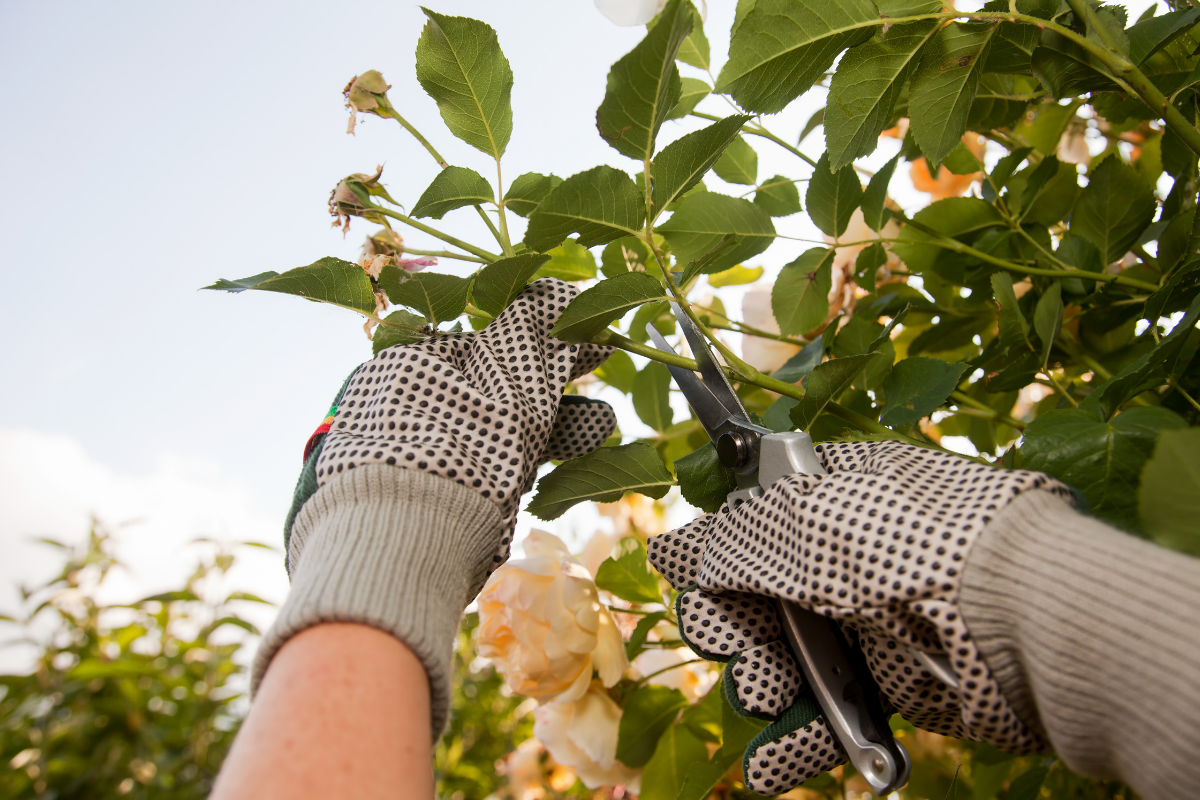
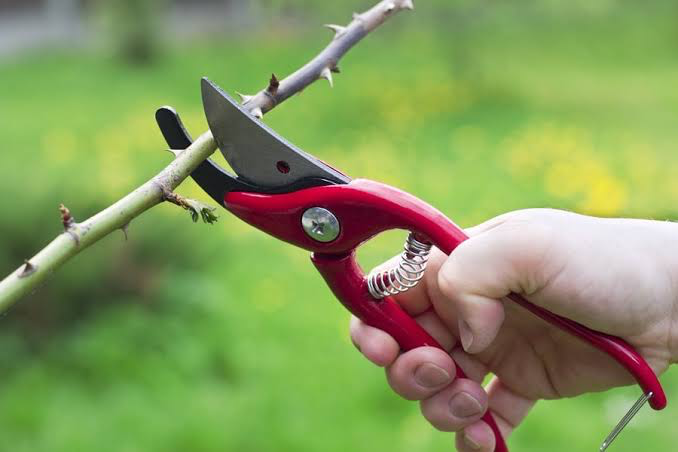
Sharp bypass secateurs handle live canes up to about 2 cm thick, long-handled loppers or a small pruning saw take the old, thick wood, and thornproof gloves with long sleeves protect your hands and forearms. Blades are cleaned and disinfected between plants because they carry disease from bush to bush, and a bucket or wheelbarrow for debris keeps cleanup quick.
The rules of the cut
A bud, the small swelling spaced along each cane, is where new growth breaks from, and every cut in rose pruning is made in relation to one:
- Cut about 5 mm above the bud: higher leaves a stub that dies back, closer risks destroying the bud itself
- Choose a bud that faces outward: the new shoot grows away from the centre, keeping the bush open, airy and less disease-prone
- Slope the cut at 45 degrees, angled away from the bud, so rainwater runs off the far side instead of sitting on the bud and inviting rot
- Cut back to healthy white pith: dead wood is brown and crispy inside, so if the centre of the cane shows brown, keep cutting lower until the inside is clean and white
- Apply the pencil rule: stems thinner than a pencil rarely carry a good bloom, so they come out entirely
- Remove suckers below the graft: most commercial roses are grafted onto wild rootstocks, and any shoot rising from below the graft union is wild growth that gets cut at its base
Step-by-step pruning
The order of work is simple. Start with the three Ds: remove dead, diseased, and damaged wood at its base. Then open the centre, cutting out anything that crosses, rubs against another cane or grows inward. Finally, shorten the remaining healthy canes by a third to a half, each cut made to an outward-facing bud, adjusting the height to the rose type as shown below. Stripping any remaining old leaves off the plant and off the ground finishes the job, since old foliage carries fungal spores.
All the debris, canes and leaves alike, go in the trash or the fire, never the compost, because black spot, rust and mildew spores survive composting. A fresh layer of mulch around the base then closes the season's file.
Pruning by rose type
| Rose type | Character | How it is pruned |
|---|---|---|
| Miniature | Up to 40 cm, masses of small blooms | Weak shoots out at the base, vigorous canes cut to 3 to 4 buds |
| Hybrid tea | The classic large-flowered bush, to about 70 cm | Canes cut hard to 2 to 3 buds, roughly 15 cm above the ground |
| Shrub and floribunda | Bushes of 1 to 1.5 m | Long canes shortened by about a third, lower shoots to 2 to 3 buds, weak growth out at the base |
| Groundcover | Long trailing stems | Pruned every 2 to 3 years, stems reduced to a third of their length |
| Standard (tree rose) | A head of growth on a tall clear stem | The head is shaped above the crown graft, long canes cut by a third, and standards tolerate harder pruning, down to canes of 15 to 20 cm |
| Climbing | Canes of 4 to 5 m on walls and pergolas | The main framework canes are kept and tied to their support, side flowering shoots are cut to 3 to 4 buds, and dead or weak canes come out at the base |
Two age-related exceptions apply. Newly planted climbers and standards are left unpruned in their first year and pruned only lightly for the first two years, until their framework builds. At the other end, an old, neglected rose takes renovation well, cut hard to three or four strong canes, each with about three buds, from which it rebuilds a clean structure.
Summer pruning and deadheading
Summer is not the season for hard cuts, which weaken the plant in the heat and expose the remaining canes to sunscald. Summer work is deadheading. Each spent bloom is cut back to an outward-facing bud just above the first leaf with five leaflets below the flower, at the same 45-degree angle, which stops the plant wasting energy on hips and pushes the next flush. Deadheading is also the moment to check the soft new shoots for aphids, which cluster on exactly this growth. During heatwaves, even light trimming waits until the stress passes, and repeat-flowering roses handled this way remain a backbone of the border among the flowers that bloom all year.
Frequently asked questions
What is the best month to prune roses?
January to March, while the rose is dormant and after the risk of hard frost has passed. Warm climates prune from mid-January, cold ones from February into March.
What are the three Ds of rose pruning
Dead, diseased, and damaged wood, which is always removed first, is cut back at the base or down to the healthy white pith. Clearing the three Ds alone solves most of a neglected rose's problems.
How far down should roses be pruned?
Healthy canes are shortened by a third to a half, always to an outward-facing bud. Hybrid teas take harder pruning, down to 2 to 3 buds about 15 cm above the ground, while shrub roses keep more height.
Is it too late to prune roses in spring?
Not while the leaves are only just opening, at worst, the first flush arrives a little later. Once the plant is in full leaf, wait and prune lightly after the first flowering instead.
Can roses be pruned in summer?
Only lightly. Summer pruning means deadheading spent blooms above the first five-leaflet leaf and removing the odd dead twig, never hard cuts in the heat. Once-flowering old roses and ramblers are the exception, pruned right after their single bloom.
Where do you cut when deadheading a rose?
Just above the first leaf with five leaflets below the spent flower, at a 45-degree angle to an outward-facing bud, so the plant reflowers quickly from the same stem.
Important notes
Every garden differs in climate and timing, so treat the windows above as a starting point and let the plant's dormancy and bud break guide the exact date. Dispose of all pruning debris in the trash rather than the compost, since fungal spores survive composting, and disinfect blades between plants.
References
- Royal Horticultural Society, Rose pruning: general tips.
- University of Illinois Extension, Pruning roses.