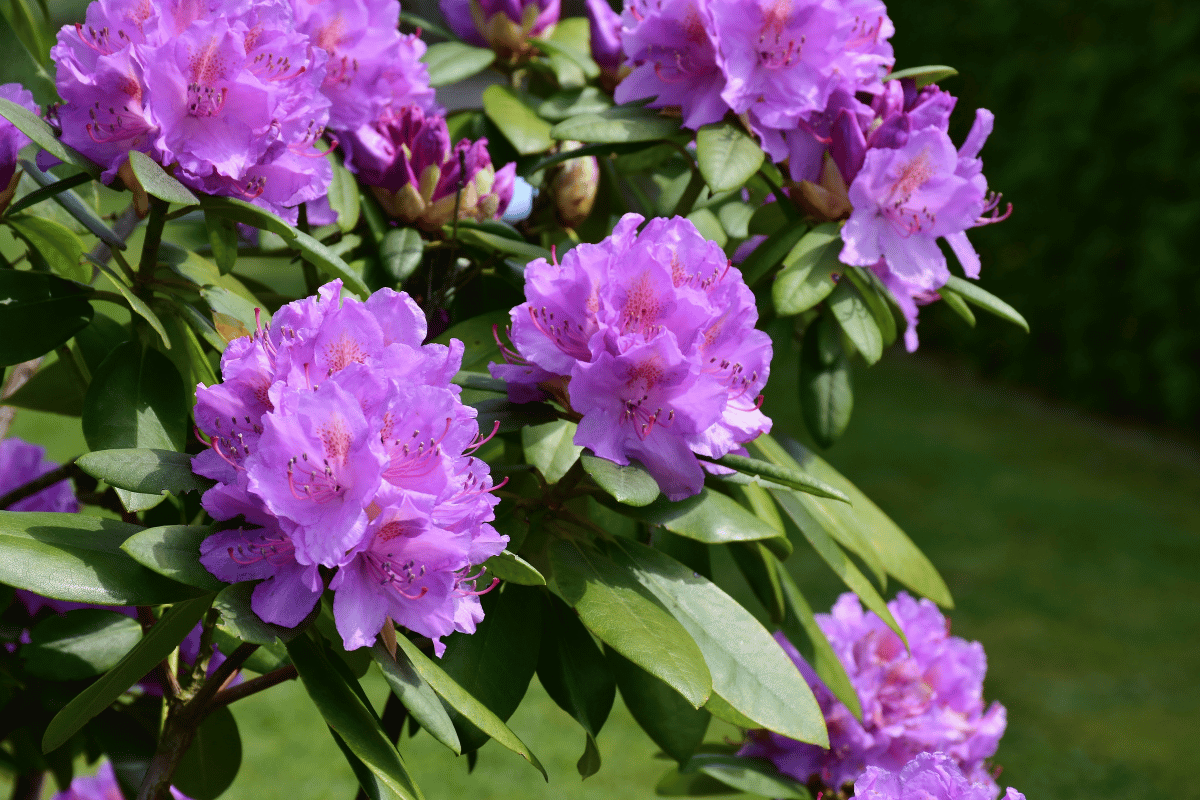
Rhododendrons are among the most spectacular flowering shrubs, carrying large trusses of bell-shaped flowers in spring, in shades of pink, purple, red, white and yellow. Most are evergreen, with glossy, leathery leaves that give structure all year, and in the right spot, they live for decades. They are woodland-edge plants at heart, and the key to growing them well comes down to one thing above all, acidic soil.
Rhododendron is a large genus in the heath family (Ericaceae), with over 900 species, including azaleas. This guide covers how to grow and care for rhododendrons, from the acidic soil they cannot do without to watering, pruning, and the toxicity every pet owner should know about.
What is a rhododendron and how does it differ from an azalea
Azaleas are part of the same genus as rhododendrons, so the two are closely related and need the same basic care, but gardeners separate them by a few practical differences. Rhododendrons are usually larger, evergreen shrubs with big, leathery leaves and bell-shaped flowers in full trusses. Azaleas tend to be smaller, are often deciduous, and carry smaller, funnel-shaped flowers, sometimes fragrant, in a wider range of vivid shades. Both share shallow roots and the same need for acidic, well-drained soil.
Acidic soil, the defining requirement
Rhododendrons are lime-hating plants that need acidic soil, ideally a pH between 4.5 and 6.0. This is the single most important factor in growing them. In neutral or alkaline soil, they cannot take up iron and other nutrients, and the leaves turn yellow between the veins while the veins stay green, a condition called chlorosis that eventually kills the plant.
Test your soil with a simple pH kit before planting. A good sign is whether acid-loving plants such as gardenia, hydrangea or blueberries already grow well in nearby gardens, since they need the same conditions. Rhododendrons want the opposite of lime-loving shrubs like the lilac, so the two are never planted in the same ground. On slightly alkaline soil, you can lower the pH with elemental sulphur or by digging in and mulching with acidic organic matter such as composted pine bark or pine needles, though the effect is gradual and needs repeating.
If your soil is genuinely alkaline or chalky, do not fight it. The reliable answer is to grow rhododendrons in containers of ericaceous (lime-free) compost, which is also the practical approach across much of Greece, where soils are often alkaline. Choose a pot at least 45 cm wide with drainage holes, and use ericaceous compost mixed with about 20% perlite or grit for drainage.
Planting and location
Rhododendrons do best in dappled or partial shade, sheltered from cold, drying winds. A spot at the edge of a tree canopy is ideal, but avoid deep shade directly under dense trees and sites hit by early-morning sun, which can damage frosted buds. In hotter regions, shade during the intense afternoon hours matters more, since too much sun and heat scorch the foliage.
These are shallow, surface-rooting shrubs, so how you plant matters. Set the plant so the top of the rootball sits at soil level or barely below, never deeper, as burying the base rots the plant. Dig in plenty of acidic organic matter, and after planting add a loose mulch of pine bark or pine needles to keep the roots cool and moist. Keep the mulch clear of the stem rather than piling it against the base.
Watering and feeding
Rhododendrons have shallow roots that dry out fast, so keep the soil consistently moist, especially in the first years and through late summer when next year's flower buds are forming. They will not tolerate waterlogging either, which suffocates the roots. Water with rainwater whenever you can, since tap water in hard-water areas is alkaline and raises the pH around the roots over time.
Feed sparingly. An annual application of an ericaceous fertiliser in spring, as growth begins, is enough. Too much fertiliser, especially nitrogen, burns the roots and drives leafy growth at the expense of flowers. Avoid lime and bone meal, both of which add unwanted calcium.
When do rhododendrons bloom
Most rhododendrons flower in spring, though across the genus the season stretches from late winter to early summer depending on the species and variety. Early types can open in March, later ones well into June. Each shrub flowers for a few weeks, and choosing early and late varieties together extends the display across much of spring.
How and when to prune rhododendrons
Rhododendrons need very little pruning. In most years the only jobs are removing dead or damaged wood and deadheading the spent flowers. Deadhead carefully, because next year's buds sit right behind the old flower head. Snap off the spent truss by bending it sideways until it breaks, without damaging the growth buds just below.
If you need to reduce a plant's size, prune right after flowering, before the new buds form. Pruning later, in mid to late summer, removes the buds that would have flowered the following year. Overgrown, leggy specimens can be renovated by cutting them back hard in late winter, which most rhododendrons tolerate, but they may not flower again for two or three years.
Common problems
- No flowers: usually from too much shade, pruning at the wrong time, drought stress the previous summer while buds were forming, or a plant that is still too young. Newly planted rhododendrons often take two to three years to flower reliably
- Yellowing leaves (chlorosis): leaves yellow between green veins, a sign the soil is not acidic enough. Improve acidity and water with rainwater
- Scorched, crispy leaf edges: from drought, cold winds or too much sun. Mulch well and keep the soil moist
- Wilting and dieback: often from planting too deep, waterlogging, or root rot in heavy wet soil. Check the depth and drainage
Do deer eat rhododendrons, and are they toxic
Rhododendrons are generally left alone by deer, which is a real advantage in rural gardens. The reason is the same one that makes them dangerous to pets. Every part of the plant, including the leaves, flowers, pollen and nectar, contains compounds called grayanotoxins.
All parts are toxic to dogs, cats, horses and people if eaten. In pets, ingestion causes drooling, vomiting, weakness and heart problems, and large amounts can be fatal to dogs. The nectar is toxic too, which is where the historical "mad honey" made by bees working rhododendron flowers comes from. Keep pets and livestock away from the plants and the prunings, and if an animal eats any part, contact your veterinarian promptly.
Frequently asked questions
What soil do rhododendrons need? Acidic soil, with a pH between about 4.5 and 6.0. In neutral or alkaline soil they suffer chlorosis and decline. On alkaline soil, grow them in containers of ericaceous compost.
Where should I plant a rhododendron? In dappled or partial shade, sheltered from cold winds, in moist but well-drained acidic soil. Plant shallowly, since the roots are near the surface, and mulch to keep them cool.
Why won't my rhododendron flower? Usually too much shade, pruning at the wrong time, drought stress the previous summer, or a plant that is still too young.
Are rhododendrons toxic to cats and dogs? Yes. Every part contains grayanotoxins and is toxic to cats, dogs, horses and people. Large amounts can be fatal to dogs, so keep pets away from the plant.
Do rhododendrons need acidic soil in pots too? Yes. In containers, use ericaceous (lime-free) compost and water with rainwater where possible, since hard tap water gradually raises the pH.
Important notes
Every garden and every plant is unique. Conditions vary significantly with your soil pH, region, shade and shelter. The guidance above is general and a starting point rather than a strict rule.
Given how toxic every part of the rhododendron is to pets, livestock and people, plant it where animals and children cannot reach it, and keep the prunings away from grazing animals. If an animal or person ingests any part, seek veterinary or medical help promptly.
If a plant shows persistent problems that don't respond to the basic practices, it's worth consulting a horticulturist or your local nursery. For pest and disease control, try non-chemical methods first. When a product is needed, use only approved ones and follow the label instructions.
References
- Royal Horticultural Society. How to grow rhododendrons.
- Royal Horticultural Society. Rhododendrons on alkaline soils.
- BBC Gardeners' World. How to grow rhododendrons.