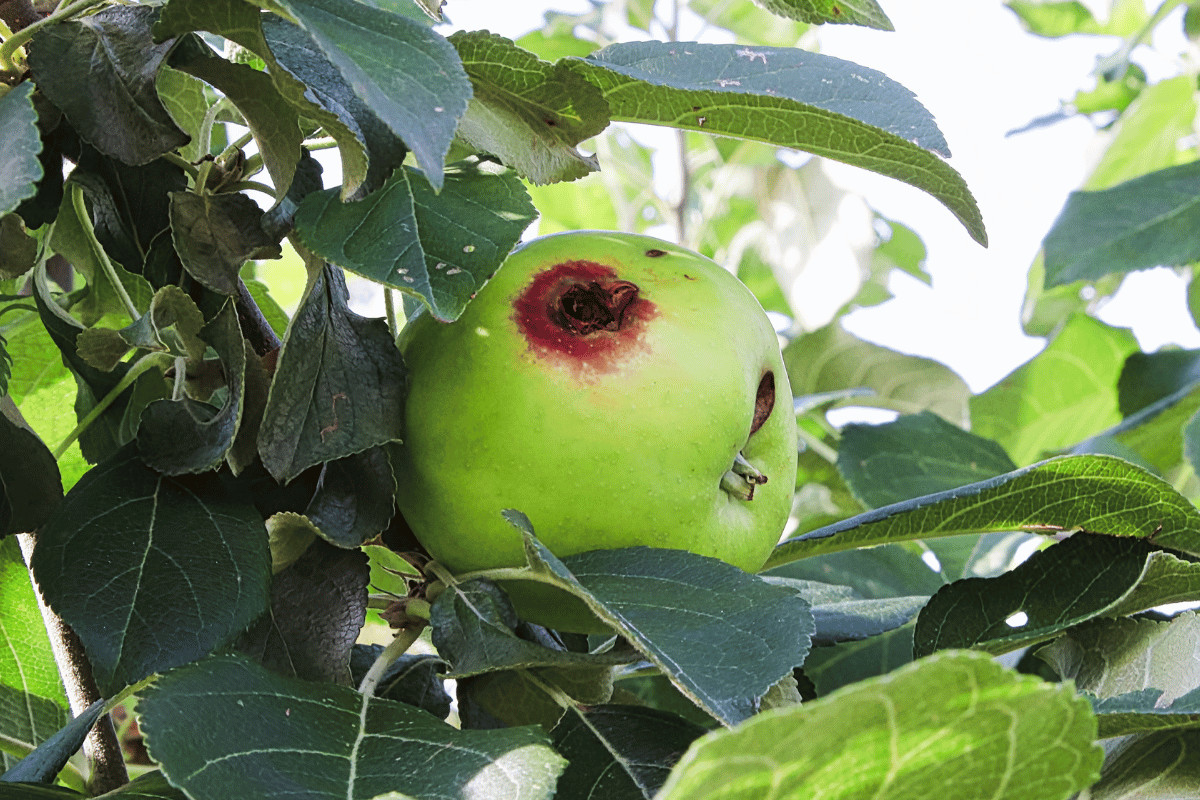
On pome fruit, apple and pear, and on walnut too, the pest that shapes the season is the codling moth. It is the insect behind the wormy apple, and June is when its activity peaks. The plant-protection bulletins issued by the Greek Ministry of Rural Development and Food show two different pictures depending on the region. In the mountainous areas of Crete, the first flight is still underway, while in Central and Western Macedonia, the second flight is already starting.
Below, we bring together what each region's bulletin shows and when treatment is advised.
Why the codling moth is the most serious pest of pome fruit
The codling moth (Cydia pomonella) attacks apple, pear, and walnut. The young larva bores through the skin and tunnels to the seeds, leaving behind galleries and frass that make the fruit unusable. Once the larvae are inside, the damage is irreversible, so treatment has to come early, while the eggs are hatching and before the larvae can enter.
The right timing comes from the pheromone traps and from calculating egg-laying and hatching against temperature. The same treatment also controls the leaf miners that attack pome fruit at this time of year.
| Region | Codling moth stage | Indicative spray window |
|---|---|---|
| Crete (Heraklion), mountainous areas Bulletin 3 June |
First flight underway, rising catches | Repeat sprays. On the Lasithi plateau, Livadi Krousonas and Damasta, 5-7 June |
| Central and Western Macedonia (Thessaloniki) Bulletin 9 June |
Second flight starting 6-8 June, egg-laying 11-13, hatching 16-18 June | 13-16 June with products active on the eggs, 17-20 June with products for the young larvae |
Because the flight runs for weeks, protection is not a single spray. It needs repeat treatments at intervals that depend on the product, and always good coverage of the fruit and foliage. The dates are indicative, and every orchard is a separate case, so please monitor your own traps, follow the most recent local bulletin, and, where needed, consult your agronomist. Within biological and integrated pest management, there are also macroorganism-based products for the codling moth.
Wood-boring moths on the trunk and the scaffold branches
In Macedonia, the bulletin also flags the wood-boring moths, the apple clearwing (Synanthedon myopaeformis), the goat moth (Cossus cossus), and the leopard moth (Zeuzera pyrina). Their larvae tunnel into the wood, weaken the trees, and leave them more open to rot. With the right product, they can be controlled alongside codling moth, as long as the spray is applied correctly. For the apple clearwing, it is directed at the trunk and the scaffold branches, for the goat moth at the collar and the trunk, and for the leopard moth at the shoot tips.
Apple scab and powdery mildew on the leaves and young fruit
In the mountainous areas of Crete, the bulletin adds two fungal diseases. Apple scab found favorable conditions this spring and is showing symptoms, more strongly on pears. Even with no rain in the forecast, frequent night dews are enough to keep the infection active, so in orchards with symptoms, protection should continue.
Powdery mildew appears on the soft growth of apple trees, and the young fruit, together with the new growth, are its most vulnerable targets. On susceptible varieties, protection is needed, and it can be done in the same spray as the scab.
How to choose and apply the products
We use only products approved for the crop, for the specific pest or disease, and for the current growth stage, from the official database of the Greek Ministry of Rural Development and Food. For codling moth, rotating products with different modes of action is especially important, as the insect develops resistance readily. We read the label carefully for dosage, tank-mix compatibility, and the pre-harvest interval, and we take all the protective measures.
On Farmclick, you can find approved plant-protection products for pome fruit from suppliers across Greece.
| Pome fruit plant protection on Farmclick Browse approved insecticides and fungicides from suppliers across Greece. |
The dates and recommendations above come from each region's bulletin and hold as a general trend. Conditions vary from orchard to orchard, depending on altitude, variety, microclimate and infestation history, so final decisions should rest on your own pheromone traps and the most recent local bulletin.
For serious or uncertain infestations, consult an agronomist. Where possible, favor cultural measures and low-impact solutions, and use only approved products, following the label instructions and the operator-safety measures.
Sources
All figures come from the plant-protection bulletins of the Greek Ministry of Rural Development and Food:
- Regional Plant Protection Centre of Heraklion, apple, pear and walnut bulletin No3, mountainous areas (3 June 2026).
- Regional Plant Protection Centre of Thessaloniki, apple codling moth bulletin No36 (9 June 2026).