
Canola Plant Physiology, Growth Stages, and Variety Selection Guide
Physiology and Characteristics of Canola Plants
Canola belongs to the Brassicaceae family and the Brassica napus species and is related to mustard, broccoli, cabbage, cauliflower, and turnip (1). It is an annual broadleaf species and can successfully be cultivated in the same regions as small grains, especially wheat. Depending on the cold hardness, canola has both winter and spring-type varieties. The winter canola is planted in the early fall and harvested in early summer, while the spring type is sown in early spring and harvested in early-mid fall (2).
Understanding the physiology of canola and its growth stages can help the farmer to make more informed and effective management decisions and increase his/her crop yield.
Briefly, the growth stages of a canola plant are the following:
- Germination and plant’s emergence (growth stage 0)
- Leaf development and rosette formation
- Stem elongation
- Inflorescence Emergence (growth stage 5)
- Flowering
- Development of seed
- Ripening
- Senescence of the plant (growth stage 9) (3)

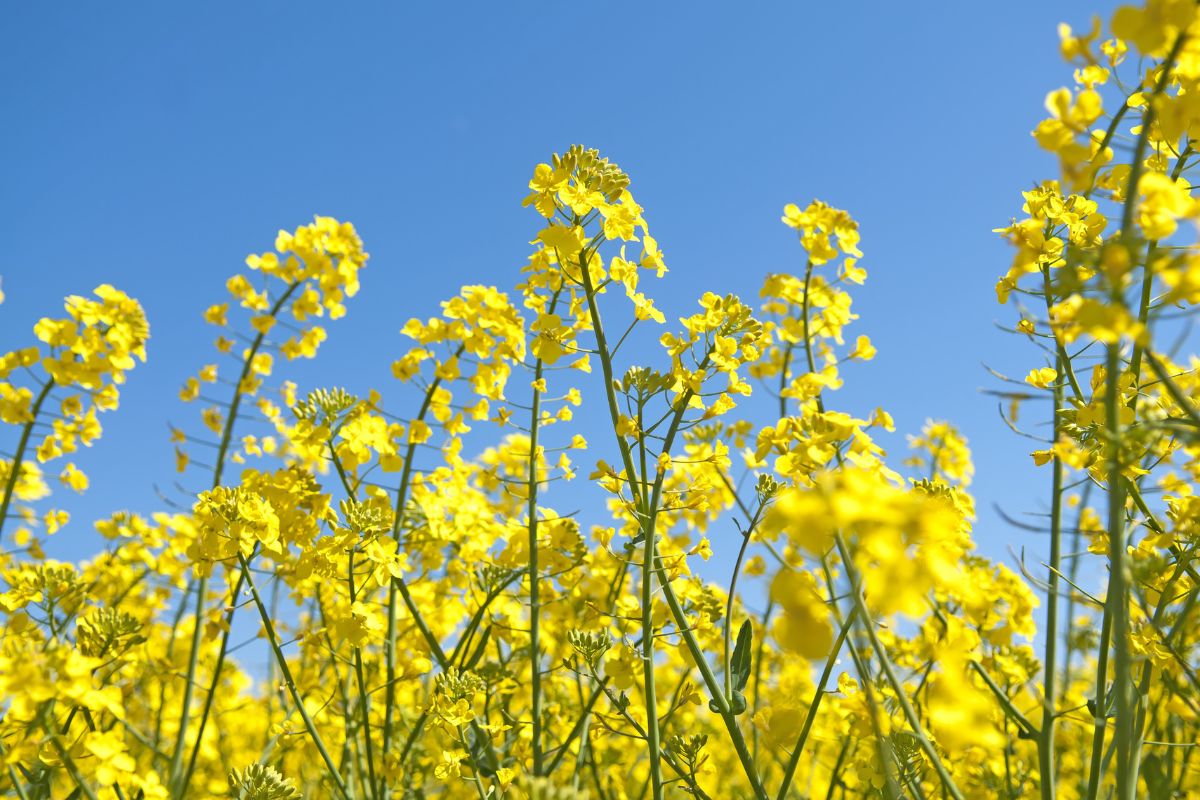
The Canola plant initially develops a thick rosette with 6 large, waxy, blue-green leaves close to the ground. It has a deep taproot (90-190 cm or 36-76 in) and a fibrous extensive root system. Depending on the temperature and the variety, the plant will develop from the crown a flowering stalk (stem), 3-5 feet tall (92-152 cm) with 5-7 branches (4). During spring, the plants produce the characteristic yellow flowers. The flowering of the main stem happens 40-80 days after sowing and can last 14 to 21 days. With the help of pollinators, the flowers will be fertilized and produce pods (60-100 per plant) with the seeds (up to 30 seeds per pod).
This is the most sensitive stage to water and nutrient stress (scarcity). Such conditions may lead to pods' abortion and a reduced number of seeds. The fully expanded seeds are generally more resistant to stresses. Depending on the variety and the environmental conditions, the plants need up to 120 days to grow and mature (1, 5) fully. The farmer may start harvesting when most seeds mature and have a moisture content below 30% (3). While a farmer can use all plant parts, one way or another, these tiny black spherical seeds, rich in oil, have the highest economic importance.
How to select the best canola variety
Like for every other crop, the farmer should select a variety with superior quality characteristics that fit the intended market demands, high yield potential, good pest, and disease resistance, and is well adapted to the region's local (environmental) conditions that will be cultivated. The plant's resistance to lodging, drought, heat, low soil pH, and pod shattering are other agronomical characteristics of interest for canola. Other traits to consider (commercial) are the oil content and quality. Keep an eye on the local variety trials, consult the relevant local authorities (institution or agronomists), and start by conducting your own small-scale field tests with 2-3 varieties of your choice to see which is the best for you.
For human consumption, the farmers should select a canola variety like the 'Double low,' the HO (high-oleic), and LL (low linolenic fatty acid) varieties (1). There are both winter and spring types of canola.
The winter canola is more cold-hardy (frost resistant), is planted in the early fall, overwinters, and harvested in early summer. Usually, winter canola has a 20-30% higher yield compared to spring canola but has chilling requirements to transit from the vegetative to the reproductive phase. Nowadays, there are very few commercially available winter varieties. Additionally, there are also some herbicide-resistant winter canola varieties. However, the Roundup Ready™ and Liberty™ cultivars that can tolerate glyphosate are GMO, while on the other hand, the Clearfield varieties, which are tolerant of Beyond herbicide, are not. The 'Wichita' and 'Plainsman' are 2 new varieties recommended for central-west states of America (2).
On the other hand, spring canola is sown in early spring and harvested in early-mid fall. All spring types belong to 2 types: the Argentine and the Polish. Their difference is that the cultivars of the first type have been developed from the species Brassica napus and the other from the Brassica rapa (3). Additionally, the Polish cultivars mature up to 3 weeks earlier, while the Argentina cultivars have higher yield potential (4). Of the two, the Argentina type is the most cultivated (especially in the U.S.). Some varieties of this type that are commonly used are the Andor, Global, Hyola 70, Topas, Tribute, and Westar. However, since canola is a cool-season plant, both types are sensitive to very high summer temperatures and drought (5).
The farmer can select between hybrids, synthetic hybrids, and open-pollinated varieties. Before choosing, the farmer should consider each type's advantages and disadvantages. Hybrids have a larger seed size, facilitating sowing. They may also have an advantage in emerging from less ideal seedbeds and having more vigorous fall growth. However, the higher hybrid seed cost is a significant drawback that farmers do not overlook.
References
- Canola Profile – Agmrc
- Growth Stages – Canolacouncil
- Canola Crop Guide (PDF) – Iowa State University Extension
- Rapeseed (Brassica napus): Processing, Utilization, and Genetic Improvement
- Oilseed Rape – Teagasc
- Canola Crop Guide (PDF) – Iowa State University Extension
- Canola (Rapeseed)
- South Dakota Canola Production (PDF) – Uscanola
- Canola Production: Common Questions — Oklahoma State University
Further reading
- History, Uses, and Nutritional value of oilseed rape (Canola)
- Canola Planting Guide: Soil Requirements, Seeding Rates, and Best Planting Time
- Plant Information and Variety Selection of Rapeseed
- Canola Irrigation and Water Needs
- Canola Fertilization Guide: Key Nutrients, Rates, and Application Timing
- Canola Pest and Disease Management
- Canola Weed Management
- Yield, Harvest, and Storage of Canola