The olive weevil, Rhynchites cribripennis, together with Otiorhynchus cribricollis, is behind the severe early fruit drop showing up this season in groves across Greece. The agricultural warning bulletins link the heavier attacks mainly to groves where the carpovorous generation of the olive moth was not treated in time. Below we look at the life cycle of the two beetles, the signs of attack, and when treatment is carried out.
The life cycle and the damage
Rhynchites cribripennis and Otiorhynchus cribricollis are small weevils that overwinter in the soil and emerge in large numbers after particular winter and spring weather. The adult rhynchites feeds on the flesh of the developing fruit and opens characteristic crater-shaped holes, while the females lay a single egg in the endocarp, where the larva feeds on the seed. The result is fruit drop, often with the stalk still attached, and a loss of crop.
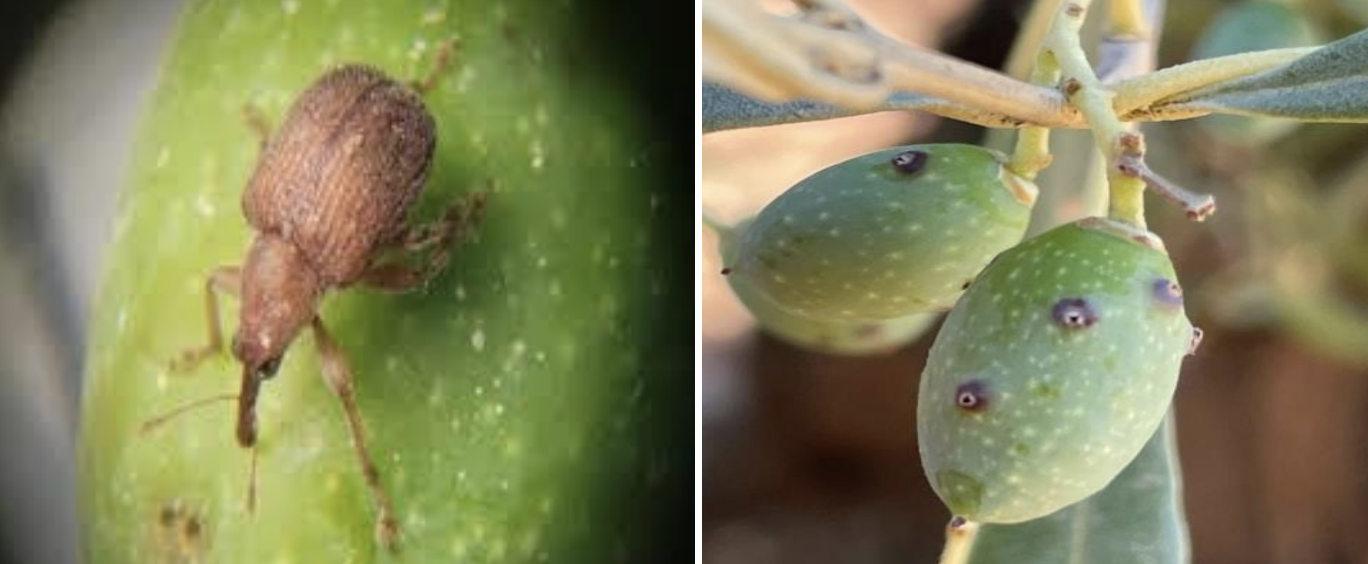
Olive weevil damage
Otiorhynchus climbs into the tree from the soil and, besides the damage to the fruit, produces saw-toothed notches along the leaf margins. Because it reaches the canopy on foot, the spray solution blocks its passage upward, covering the trunk and main branches. Groves with a light or moderate fruit load need more protection, since the damage is concentrated on fewer fruits.
When to treat
Control of the two weevils is combined with the treatment against the carpovorous generation of the olive moth, since the beetles become active right after fruit set. In groves without timely olive moth control the risk is higher, so regular inspections are advised, along with immediate treatment once fruit drop with the characteristic signs begins.
| Region | Situation | Recommendation |
|---|---|---|
| Crete Bulletin 22 June |
Severe fruit drop from rhynchites and otiorhynchus in early and mid-early zones | Immediate inspection and treatment where signs of attack appear |
| Lowland Chalkidiki and Thessaloniki Bulletin 19 June |
Olive moth carpovorous generation hatching 23-26 June | Treatment 23-27 June, which also covers rhynchites |
| Central Greece Bulletin 16 June |
Fruit attack by rhynchites in groves without timely treatment | Control combined with the carpovorous generation of the olive moth |
In groves with a history of severe attack over the past two years, monitoring starts early, from April until fruit set is complete, by tapping branches over a white surface in the early morning to assess the population.
The other pests of the season
The same bulletins record increased activity of the carpovorous generation of the olive moth, which remains the main target of the treatment. The jasmine moth attacks the tender growth and, in places, the green fruit, with more serious damage in nurseries and young trees. The olive bark midge is a secondary pest that causes dieback on thin twigs, with a characteristic reddish discolouration of the bark, and is managed by removing and destroying the affected twigs. Scale insects are controlled mainly through cultural measures, such as proper pruning and balanced nutrition.
How to choose and apply the products
Use only products approved for olive and for the specific pest, from the official ministry database, and follow the label for dose, method, and timing, as well as the interval until harvest. For otiorhynchus, covering the trunk and the main branches is decisive. Where olive growing fits into the wider farm plan is covered in our guide on commercial olive cultivation.
The dates above come from the bulletins of each region and hold as a general trend. The course of an attack differs from grove to grove, so final decisions rest on your own inspections and on the most recent local bulletin. For serious or doubtful attacks consult an agronomist, and use only approved products in line with the label and the operator safety measures.
Sources
All data come from the agricultural warning bulletins of the Greek Ministry of Rural Development and Food (ΥΠΑΑΤ):
- Regional Plant Protection Centre of Heraklion, olive plant protection bulletin No 9 (22 June 2026).
- Regional Plant Protection Centre of Volos, olive bulletin No 6 (16 June 2026).
- Regional Plant Protection Centre of Thessaloniki, olive moth bulletin No 40 (19 June 2026).