
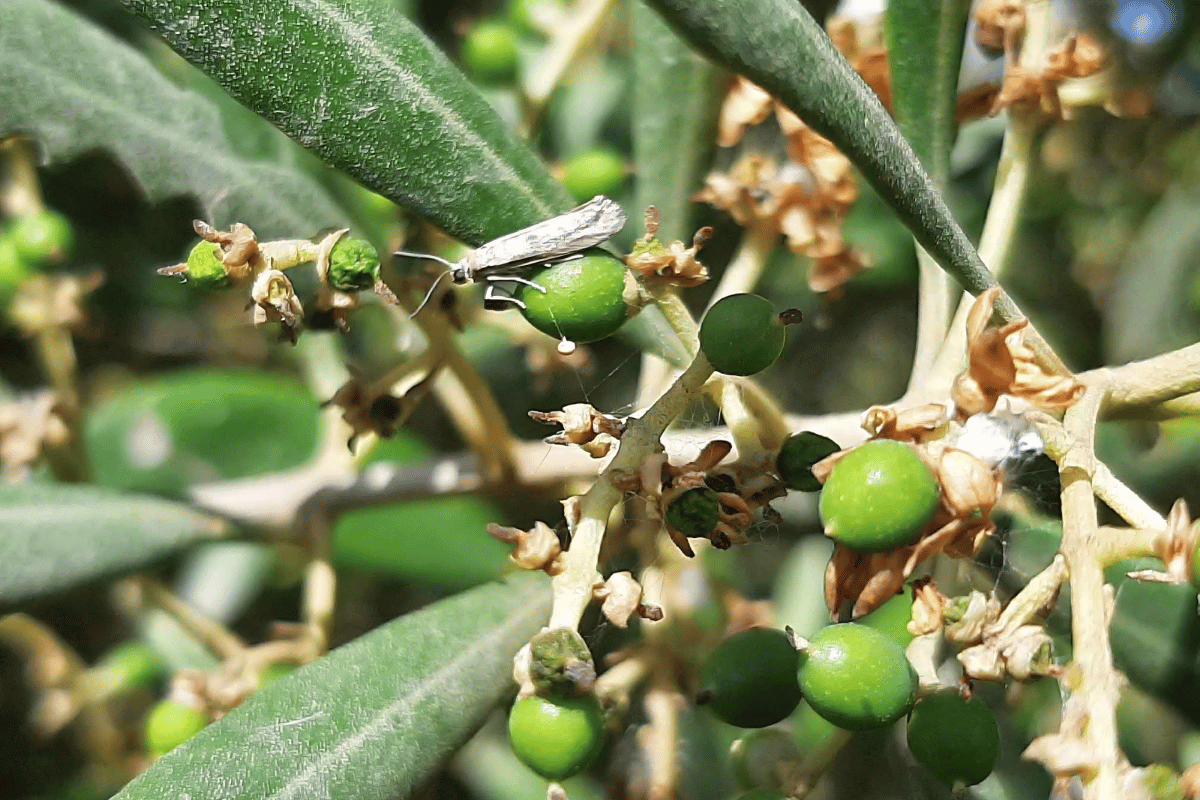
The olive moth is the most serious pest of the olive tree in summer, and of its three generations a year, the fruit generation is the one that decides the crop. Once the fruit set is complete and the young fruits reach the size of a wheat grain, the moth lays its eggs on them, and the larvae bore into the kernel, making the damage irreversible the moment they get inside. The June 2026 advisory bulletins in Greece indicate that the flight of the fruit generation is already underway and that egg hatching occurs in the second half of the month. Below, we examine the life cycle, the damage, and the optimal timing of intervention by region.
The life cycle and the damage of the fruit generation
The olive moth (Prays oleae) shifts host with each generation. Earlier in spring, it works on the flower clusters as the flowering generation, and now comes the fruit generation, which is the most damaging of the three. After hatching, the larva enters the small fruit under the calyx and feeds inside the kernel. Its entry and exit path near the base of the stalk causes fruit drop through summer and autumn, so every infested fruit is effectively lost.
Control is effective only while the young larvae are still on the surface of the fruit, before they manage to bore in. Timing is therefore everything, and it is set by the pheromone traps and by the temperature-based estimate of hatching.
Timing the spray by region
The dates below are from the current bulletins and vary by region and the crop's maturity. They work as a guide, while the local traps give the final picture in each grove.
| Region | Olive moth stage | Indicative spray window |
|---|---|---|
| Pieria and mountainous Halkidiki Bulletin of 10 June |
Fruit-generation flight 6-9 June, hatching 13-16 June | 13-16 June |
| Late areas of Crete (Heraklion) Bulletin of 11 June |
Flight since late May, hatching over the coming days | 12-15 June, with priority in groves of low to moderate fruit load |
Other pests are covered by the same treatment
The advantage of the olive moth spray is that, with correct timing, it clears the other pests of the season at the same time. The olive weevil (Rhynchites cribripennis) opens dry crater-shaped holes in the fruits, and its larvae live inside the kernel and cause early fruit drop. After fruit set, we monitor their numbers by shaking the branches over a white surface early in the morning, and when more than 3 to 4 adults per branch are found, the treatment is combined with that of the olive moth.
Otiorhynchus cribricollis, a small night-active weevil, causes notched feeding around the leaf margins and the drop of fruits or tender shoot tips. In groves with a history of infestation, we also spray the trunk and the lower stem. In northern Greece, the jasmine moth (Palpita unionalis) is a pest, damaging tender shoot tips mainly in nurseries, young trees, and trees after renewal pruning. At the same time, the same spray also covers its young larvae.
Choosing and applying the products
Use only products approved for olive and the specific pest in your country, and read the label carefully for the dose, method, and timing of application. Pay particular attention to the pre-harvest interval to ensure no residues remain, and, where feasible, rotate modes of action to avoid resistance.
The dates above are from the regional bulletins and reflect a general trend. Conditions change from grove to grove depending on the area, the earliness of the crop, and the history of infestations, so the final decisions rest on your own traps and on the most recent local bulletin. For serious or uncertain infestations, consult an agronomist and use only approved products in accordance with the label and operator protection measures.
Sources
All data come from the plant protection advisory bulletins of the Greek Ministry of Rural Development and Food (ΥΠΑΑΤ):
- Regional Plant Protection Centre of Thessaloniki, olive bulletin No37 (Pieria, mountainous Halkidiki) (10 June 2026).
- Regional Plant Protection Centre of Heraklion, olive bulletin No8 (late areas of Crete) (11 June 2026).