Lianolia dominates the Corfiot landscape with trees reaching 18 metres, a height that makes it the tallest olive variety grown in Greece, while centuries-old specimens exceed even that.
Height is not merely a feature of the scenery, however. Combined with a second trait of the fruit, it determines how the crop is gathered and, through that, the quality of the oil produced.
Strong fruit retention
In a comparison presented at a meeting organised by the Preveza regional agricultural authority with the participation of the Agricultural University of Athens and the University of Ioannina, the two varieties differ at three decisive points.
Lianolia fruit weighs on average 2.2 grams, meaning double the weight of Koroneiki fruit at 1.1 grams. Koroneiki shows weaker fruit retention, a trait leading to easier and earlier harvest, whereas Lianolia holds its fruit far more firmly, so picking demands greater detachment force and comes later, while it also shows more pronounced alternate bearing than Koroneiki.
Natural fruit drop produces lampante oil
An eighteen-metre tree carrying fruit that does not detach readily leads to one particular practice, and that practice explains why Corfiot oil lacks the recognition its history would justify.
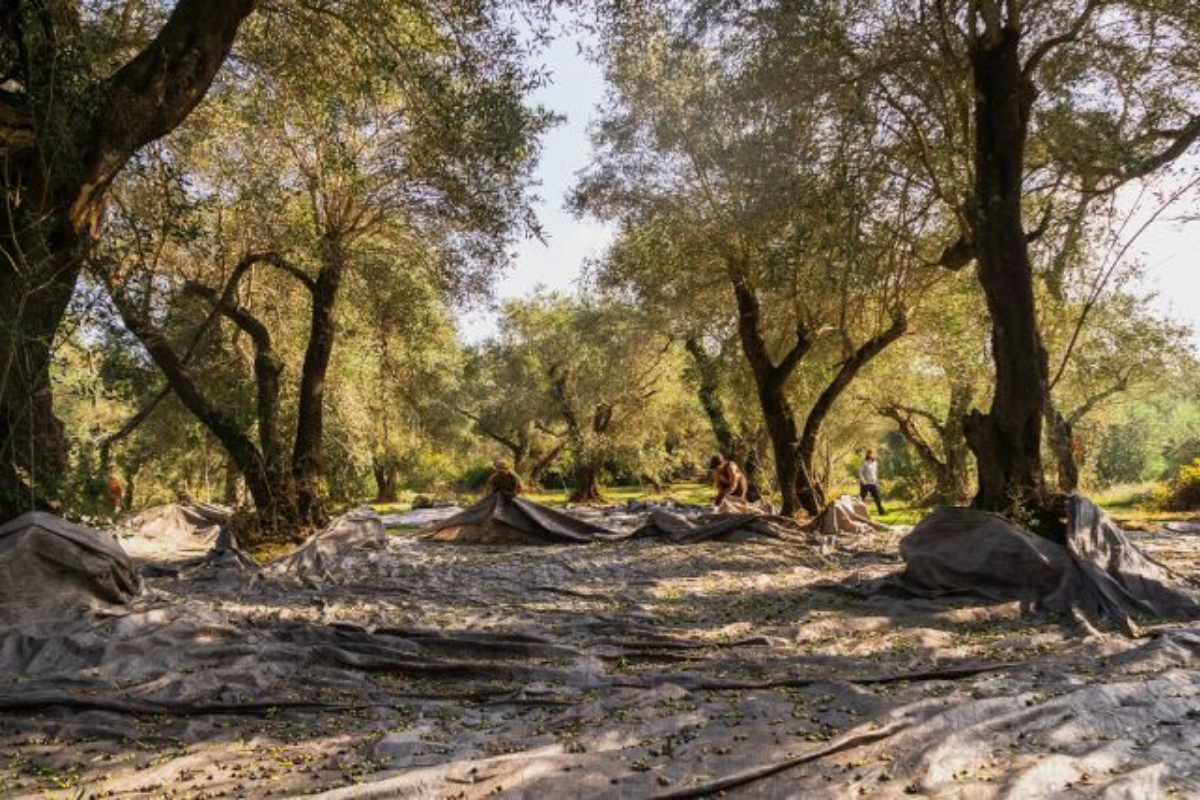
Rather than active harvesting, the fruit is left to fall naturally onto nets that stay on the ground, so gathering stretches over months and in some cases continues into June. The outcome is predictable. Fruit left for weeks or months on the ground, exposed to moisture and microorganisms, yields oil with high acidity, classified as lampante and not sold at retail without refining. That finding matters because it concerns management rather than the variety. The same planting material, harvested promptly and milled quickly, yields oil of excellent quality.
The tree and its requirements
Beyond its height, Lianolia is marked by a twisted trunk and branches that rise upward, a form that gives Corfiot groves their distinctive appearance.
Its most significant requirement is moisture, since it thrives in areas of high rainfall, which explains why it established itself and prevailed in Corfu and across the Ionian islands, while in dry positions without irrigation it struggles. On cold it shows greater tolerance than Koroneiki and withstands moderately low temperatures, without reaching the levels of Tsounati.
Where it is grown
The variety is cultivated in Corfu, across the rest of the Ionian islands and in Epirus, with Preveza and Parga forming significant zones. Its geographic spread has a historical explanation, since it established itself around three centuries ago and spread from Preveza as far as Corfu, a route that explains why the same variety carries both names.
Olive cultivation on the island is far older, with the first written reference found in the Odyssey, among the trees in the gardens of Alcinous.
The names and two dangerous confusions
The variety circulates as Lianolia Kerkyras or Lianolia Prevezas, and also as Nerolia, Ladolia, Dopia Pargas, Karfolia, Prevezana, Souvlolia and Stryftolia. Two designations, however, point to entirely different varieties and create real problems in the planting-stock trade.
Koutsourelia, grown in Aetolia-Acarnania, Achaia and Corinthia, also circulates as Lianolia chondri, Lianolia psili or Patrini. That is a different variety, with a tree reaching only 5 to 7 metres. Koroneiki is also referred to locally as Lianolia, despite being a completely different tree and fruit.
When buying planting stock or describing production, the full name Lianolia Kerkyras is the safe one.
When it is harvested
Ripening is late, a trait which, combined with strong fruit retention, places harvest later than for most Greek varieties.
The recommendation that follows is clear. Harvest is carried out actively and promptly, using rods and nets that are emptied frequently, rather than by leaving fruit on the ground. The extra effort demanded by tree height and fruit retention is precisely what separates extra virgin from lampante.
On Corfu, most growers lay nets in November and wait for the fruit to fall until June, while one family that now harvests its tall Lianolia trees with a trunk shaker set a world record for phenol content, as told in when and how olives are harvested in Greece. Maturity indices, yield per tree and the route to the mill are covered in the guide to harvesting olives.
Notes
Height and fruit weight figures come from Greek sources and represent typical values, which shift with tree age, management and site conditions. The observation on oil quality concerns the harvesting method rather than the genetic potential of the variety. Before establishing a new planting, consult a local agronomist and bear in mind that the moisture requirement and the eventual height of the tree bear directly on harvesting and pruning costs.