Kale (Brassica oleracea, Acephala Group) is a cool-season leafy vegetable in the cabbage family that does not form a head like cabbage. Instead, it forms a rosette of leaves around a strong central stem. In mild climates, it is sown from late summer into autumn, and in cold regions also in early spring. Seedlings are transplanted after 5 to 6 weeks, 40 to 50 cm apart, and the first leaves are picked about six weeks after transplanting. Because leaves are harvested gradually, from the outside in, a single plant keeps producing for months, and winter cold makes the leaves sweeter. This guide covers the main kale types; when and how to sow and transplant; watering and feeding; the growth stages; how to harvest without stopping production; and how to grow kale in pots and indoors.
What kale is
According to the Royal Botanic Gardens, Kew, kale belongs to the Acephala cultivar group of Brassica oleracea, together with collards, and is among the vegetables of the family most similar to wild cabbage. The same group also includes ornamental varieties with coloured leaves and fodder varieties grown for livestock.
So-called "Chinese kale", or gai lan, is a different vegetable. It belongs to the Alboglabra Group of the same species, with glossy leaves, thick stems and small broccoli-like flower shoots, which is why it is also called Chinese broccoli.
Kale varieties
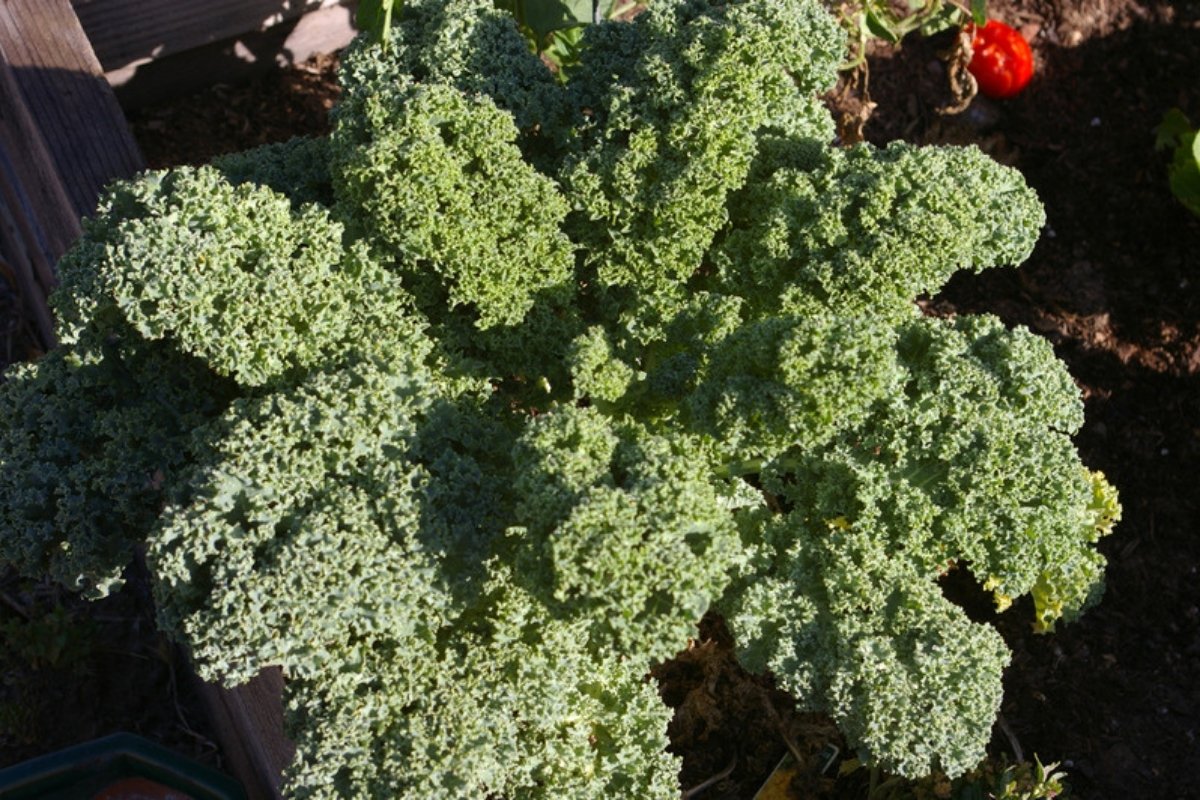
- Curly kale: the classic type, with dark green, frilly leaves and a slightly bitter, peppery taste
- Lacinato or Tuscan kale: the Italian type also known as cavolo nero or dinosaur kale, with long, narrow, dark blue-green, blistered leaves. Ideal for soups and stews with beans
- Red Russian: with flatter, oak-like, very tender leaves and reddish stems, good for baby leaf too
- Dwarf varieties: compact curly types such as 'Dwarf Green Curled', suited to containers
Height varies with variety, from about 30 to 90 cm.
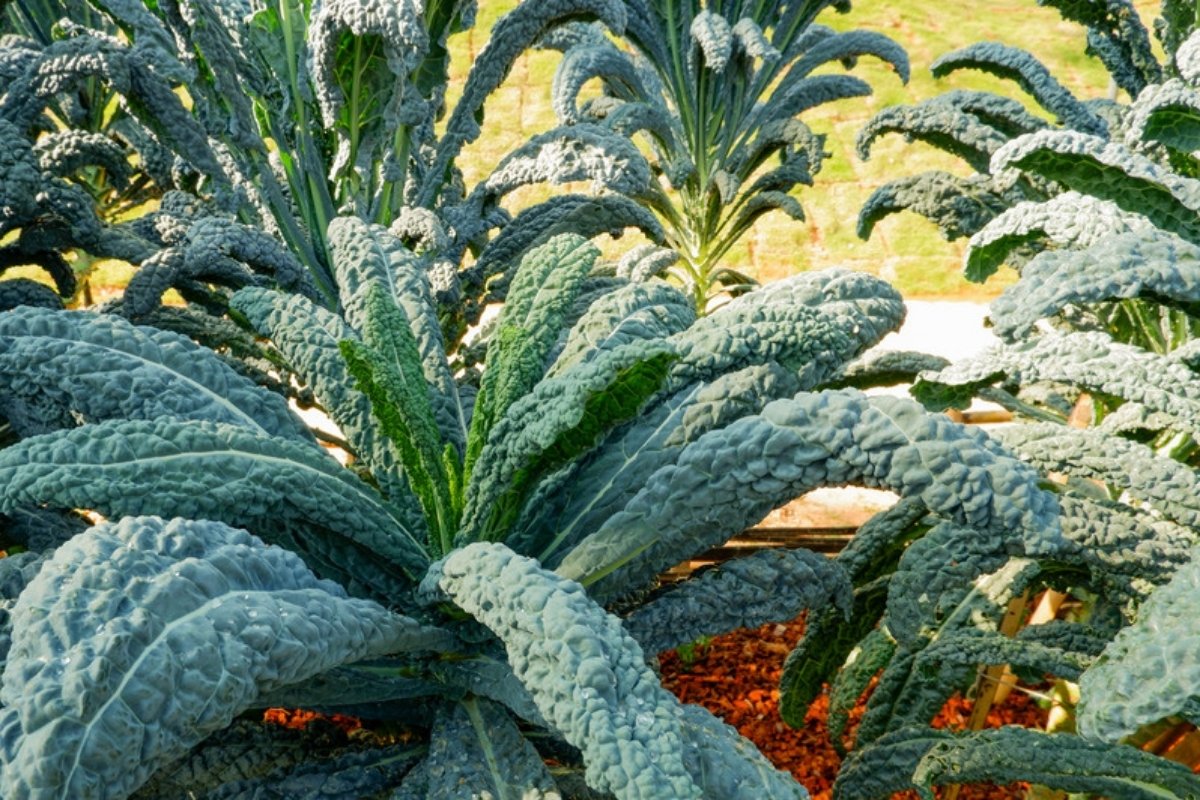
Lacinato or Tuscan kale has long, narrow, blistered leaves and suits soups and stews with beans.
When to plant kale
| Climate | Sowing | Harvest |
|---|---|---|
| Mild and Mediterranean | Late summer to late autumn | Autumn through spring |
| Cold regions and uplands | Early spring, mid to late summer for autumn and winter | Late spring before the heat, and autumn into winter |
Autumn sowing gives the best quality, because kale is a cool-season crop. It grows best at 15 to 20°C; above about 24°C, growth slows, the leaves turn bitter, and the plant tends to bolt. Kale, therefore, goes in alongside the other autumn sowing jobs in the vegetable garden.
Position and soil
Kale prefers full sun but tolerates partial shade, which is useful in warm areas, where afternoon shade protects the leaves. It performs best in fertile, free-draining soil rich in organic matter, with a pH of 6 to 7.5, and it tolerates slightly alkaline soil. According to the RHS, the soil should be firm around the roots, because tall plants rock in the wind and are easily loosened.
Before planting, enrich the soil with compost or rotted manure. Do not plant kale where cabbage, cauliflower, broccoli or another brassica grew the previous year, and return it to the same spot only after three to four years. It does very well after legumes such as broad beans, which leave nitrogen in the soil.
Sowing and transplanting
- Sowing: in a seedbed or module trays, 0.5 to 1 cm deep. Seeds germinate in 5 to 10 days in cool weather, or in 1 to 2 weeks at around 20°C
- Transplanting: when seedlings reach 10 to 15 cm, about 5 to 6 weeks after sowing. Ready-grown kale plants are also sold at garden centres
- Spacing: 40 to 50 cm between plants and 60 to 80 cm between rows. In raised beds, spacing can be closer
- For baby leaf: sow thickly, about 7.5 cm apart, and pick the leaves small for salads
- Firming and watering: firm the soil well around each seedling and water it in
- Mulching: a layer of straw or wood shavings holds moisture and suppresses weeds
Growth stages
| Stage | Timing | What to do |
|---|---|---|
| Germination | 5 to 14 days after sowing | Keep the tray evenly moist |
| Seedling | Up to 5 to 6 weeks | Transplant at 10 to 15 cm |
| Leafy growth | About 6 weeks after transplanting | Start picking when leaves are hand-sized |
| Continuous harvest | For months, through autumn and winter | Pick outer leaves, keep the growing tip |
| Bolting | Spring of the second year | Leaves turn bitter, replace the plants |
Watering
Kale needs steady soil moisture. In autumn, garden plants are watered 2 to 3 times a week, depending on the weather, while in winter, watering is cut back sharply, because growth slows and rain is usually enough. Kale tolerates short dry spells, but the leaves then become tough and bitter. Waterlogged soil, on the other hand, causes root rot and fungal disease, so water again only when the surface has dried.
Feeding
Kale mainly needs nitrogen, on which the deep green colour and tenderness of the leaves depend. With a good base of compost or manure at planting, a nitrogen-rich organic fertiliser once a month is enough while the plants are growing. Too much nitrogen, however, makes the plant more vulnerable to fungal disease and aphids.
Harvesting leaf by leaf
The first leaves are picked about six weeks after transplanting, or ten weeks after sowing, once they reach the size of a hand. Harvesting follows three rules:
- From the bottom up: pick the lowest, outer leaves first, close to the stem
- No more than one-third of the plant at a time, so it can keep growing
- Never the top: do not cut the central growing point, because that is where new leaves come from
This way, the harvest continues for many months, from autumn to spring. Low temperatures and light frosts make the leaves sweeter, and young plants survive down to about −4°C without serious damage, while mature plants are hardier still. Because kale is a biennial, in the spring of its second year, it sends up a flower stalk, and the leaves turn bitter, so that is the time to replace the plants.
Growing kale in pots
Kale is one of the best vegetables for containers, because each plant produces gradually for months:
- Container: a pot at least 25 to 30 cm across and deep for one plant, or a trough 80 to 100 cm long for 2 or 3 plants, with drainage holes and gravel at the bottom
- Variety: dwarf or compact types that do not topple
- Growing medium: potting compost for vegetables, or a mix of garden soil, rotted manure and perlite in a 3:2:1 ratio
- Position: a south- or west-facing balcony with plenty of sun
- Watering: usually every 2 days in autumn, less often in winter, always once the surface has dried
Growing kale indoors
Indoors, kale is best grown as baby leaf, sown thickly in trays under strong light and harvested young for salads. Light is the limiting factor, as shown by research on lighting for indoor baby kale, so a bright south-facing window or grow lights are needed. Kale can also be propagated from side-shoot cuttings of a mature plant, rooted in moist, free-draining compost, although seed remains the simplest method.
Common problems
- Cabbage white caterpillars: the caterpillars of the cabbage white butterfly eat the leaves. Protection relies on insect mesh and on biological products based on Bacillus thuringiensis
- Aphids: colonies on the undersides of leaves and at the growing tip. Controlled by washing off, insecticidal soap and the methods for aphids
- Flea beetles: small beetles that pepper the leaves of young plants with tiny holes. Insect mesh protects them in the first weeks
- Whitefly: sucks sap from the leaves, mainly in warm weather
- Slugs and snails: eat the leaves, especially of young plants. Controlled with ash around the plants or iron phosphate pellets
- Downy mildew and Alternaria: yellowing and dark spots on the leaves in humid conditions. Correct spacing and watering at the base help
- Bitter leaves and bolting: from heat, drought or the plant's second year
How to eat kale
Tender leaves are eaten raw in salads. Because they are a little tough, they are torn into pieces and massaged by hand for 1 to 2 minutes with a little olive oil, lemon or vinegar and salt until they soften. Kale is also boiled like other greens and served with lemon and salt, a traditional Greek way of eating it, and goes into pies, soups, omelettes and smoothies, or is baked into crisps.
Leaves keep in the fridge in a bag for about a week. For longer storage, blanch them in boiling water for 1 to 2 minutes, then freeze them; they will keep for several months.
Kale and blood thinners
Kale is one of the richest sources of vitamin K, which is involved in blood clotting. According to the NIH Office of Dietary Supplements, people taking warfarin or similar anticoagulants need to keep their vitamin K intake consistent because sudden changes can increase or decrease the medicine's effect. That does not mean kale is off the menu. It means keeping the amount roughly the same from day to day, and discussing any major dietary change with a doctor first.
Frequently asked questions
What is the best month to plant kale?
In mild climates, from late summer to late autumn, and in cold regions in early spring and again in mid to late summer. Autumn sowing gives the best quality.
How far apart should kale be planted?
About 40 to 50 cm between plants and 60 to 80 cm between rows. For baby leaf, sow much more thickly, about 7.5 cm apart.
How do you harvest kale so it keeps growing
Pick the lowest, outer leaves, no more than one-third of the plant at a time, and never cut the top. The plant then keeps producing new leaves from the centre for months.
What temperature can kale tolerate?
Young plants survive down to about −4°C without serious damage, and mature plants survive even lower temperatures, while light frosts make the leaves sweeter. Heat above about 24°C makes them bitter.
Can kale be grown in pots?
Yes, and it is one of the best vegetables to grow on a balcony. Use a pot at least 25 to 30 cm across for each plant, or a trough 80 to 100 cm long for 2 or 3 plants, in a sunny spot.
Does kale regrow after cutting
Yes, as long as the central growing point is left intact. New leaves keep coming from the centre until the plant bolts in its second spring.
Important notes
Every garden differs, and sowing dates shift with region, altitude and each year's weather. For persistent pest or disease problems, a local agronomist can help with an accurate diagnosis.
The information on vitamin K is for general awareness and does not replace medical advice.
References
- Royal Botanic Gardens Kew, Brassica oleracea L., Plants of the World Online.
- Royal Horticultural Society, How to grow kale.
- NC State Extension, Kale.
- The Old Farmer's Almanack, Kale, planting, growing and harvesting.
- NIH Office of Dietary Supplements, Vitamin K, fact sheet for health professionals.
- Kaiser Permanente, Consistent vitamin K diet.