

From January 2022 to August 2026, peaches and nectarines exported from Greece had a lower unit value than Spanish ones in 16 of the 18 markets where both countries sold significant quantities, and oranges in 22 of 24, according to a Wikifarmer analysis of Eurostat export data. Olive oil shows the opposite pattern. Greek peaches and oranges go mainly to Romania, Bulgaria, Poland and Germany, while kiwifruit, with exports more than five times their 2005 level, is now the most valuable of the three in export terms.
Romania and Bulgaria took 43% of Greek peaches
From January 2022 to August 2026 Greece exported 569,348 tonnes of peaches and nectarines at an average unit value of 0.87 €/kg, and over the four seasons from September 2022 to August 2026, 88% of the volume shipped between June and August (Eurostat Comext). Romania bought 152,675 tonnes, 26.8% of the volume, at 0.81 €/kg, 11% less than other buyers in the same months. Bulgaria bought 94,404 tonnes at 0.47 €/kg, 53% less, and Albania 7,127 tonnes at 0.39 €/kg, 59% less.
Poland, Germany and Czechia paid more. Poland bought 63,019 tonnes at 1.04 €/kg, 23% above other buyers, Germany 26,473 tonnes at 1.17 €/kg, 35% above, and Czechia 15,006 tonnes at 1.23 €/kg, 48% above. Volumes swing from year to year: exports reached 186,920 tonnes in 2017 and fell to 58,966 tonnes in 2021 and 75,635 tonnes in 2025, when the average unit value rose to 1.25 €/kg.
Greek kiwifruit exports grew more than fivefold since 2005
Greece exported 42,336 tonnes of kiwifruit at 0.61 €/kg in 2005 and 225,988 tonnes at 1.62 €/kg in 2025. From January 2022 to August 2026 Greek kiwifruit went to 76 countries, 967,088 tonnes in total at 1.48 €/kg, and over the four seasons from September 2022, 86% of the volume shipped between October and March.
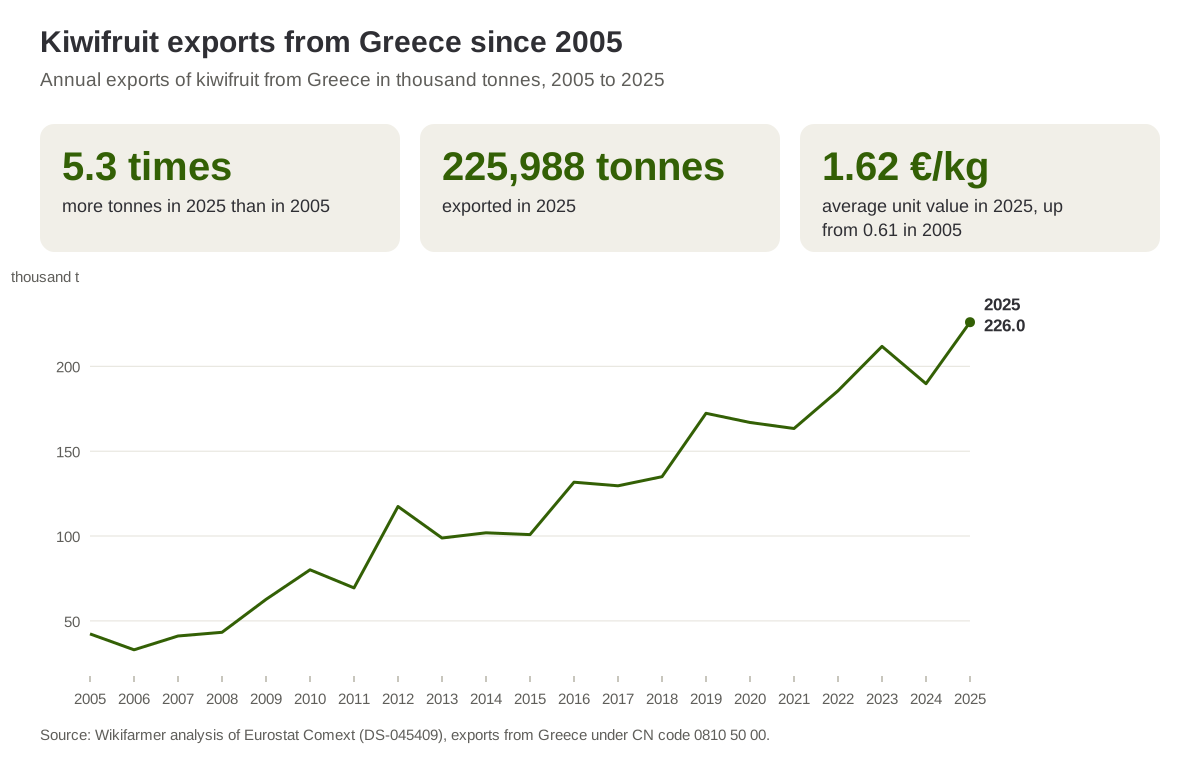
Annual exports of kiwifruit from Greece, thousand tonnes. Source: Wikifarmer analysis of Eurostat data.
Spain bought the most, 140,443 tonnes or 14.5% of the volume, at 1.71 €/kg, 18% above other buyers in the same months. Italy followed with 116,122 tonnes at 1.36 €/kg, 7% below, and the United States with 82,164 tonnes at 1.82 €/kg, 25% above. Canada paid 1.90 €/kg for 39,210 tonnes, 29% above other buyers, while Egypt paid 0.52 €/kg for 26,939 tonnes, 63% below.
Romania takes almost a fifth of Greek oranges
Greece exported 1,246,308 tonnes of oranges at 0.64 €/kg from January 2022 to August 2026, and over the four seasons from September 2022, 78% shipped between December and April. Romania bought 234,950 tonnes, 18.9% of the volume, at 0.65 €/kg, 3% above other buyers in the same months, while Germany bought 139,960 tonnes and Poland 122,439 tonnes, both at 0.75 €/kg and about 20% above other buyers.
Bulgaria bought 98,757 tonnes at 0.37 €/kg, 45% below other buyers, and Albania 46,140 tonnes at 0.25 €/kg, 62% below. Austria paid 0.84 €/kg for 45,046 tonnes, 30% above.
Spanish fruit fetches more in shared markets
The comparison with Spain covers markets where each country shipped at least 1,000 tonnes, and only the months in which both shipped. In Germany Greek peaches had a unit value 30% below Spanish ones, in Poland 25% below and in Romania 43% below. For oranges the Greek unit value was 20% lower in Germany, 30% in Italy, 27% in France, 25% in the United Kingdom and 14% in Poland.
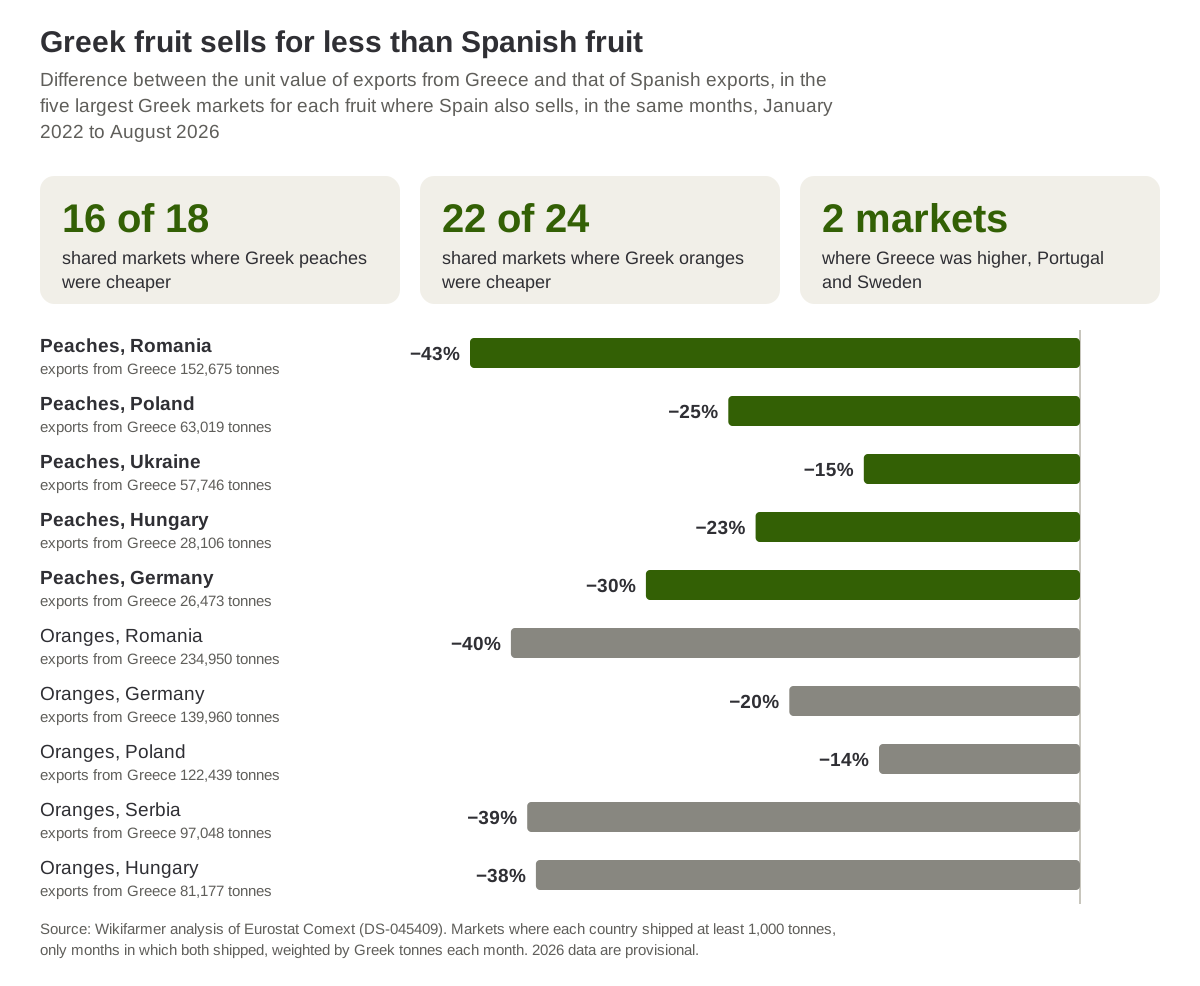
Difference between the unit value of exports from Greece and Spanish ones in the same markets and months. Source: Wikifarmer analysis of Eurostat data.
Greek shipments were priced higher only in Portugal and Sweden, where Greece shipped between 1,093 and 6,102 tonnes in four and a half years, depending on the fruit. The result holds when the comparison is also matched by tariff code, for example keeping flat peaches separate, which make up a larger share of Spanish shipments. Bulgaria and Albania, where Greek prices are lowest, are not in the comparison because Spain ships less than 1,000 tonnes there. For extra virgin olive oil the picture is reversed: shipments from Greece fetch higher unit values than Spanish ones in most of the markets where they meet.
| Fruit | Exports from Greece, tonnes | Average unit value, €/kg | Largest buyer | Shared markets where Greece was lower than Spain |
| Peaches and nectarines | 569,348 | 0.87 | Romania, 26.8% | 16 of 18 |
| Kiwifruit | 967,088 | 1.48 | Spain, 14.5% | not compared |
| Oranges | 1,246,308 | 0.64 | Romania, 18.9% | 22 of 24 |
Source: Wikifarmer analysis of Eurostat Comext (dataset DS-045409), exports from Greece and Spain, January 2022 to August 2026, downloaded 19 October 2026. 2026 data are provisional.
Unit values do not show variety or packaging
A unit value is the declared value of shipments divided by their weight, at the border of the exporting country and before international freight. Each code covers every variety, size, quality class and pack, so the lower Greek price may reflect what Greece ships as much as the price it achieves. The low prices to Bulgaria, Albania and North Macedonia are consistent with bulk loads or lower classes for nearby markets, a pattern seen in Spain too, where Portugal pays far less than other buyers for Spanish oranges. Trade data record neither class nor pack, so they cannot confirm this.
For exporters and buyers, unit values give a public monthly benchmark per market that applies only to similar produce, and the latest months are revised as Eurostat receives corrected declarations.
Frequently asked questions
Who buys Greek peaches? From January 2022 to August 2026 Romania took 26.8% and Bulgaria 16.6% of Greek peach and nectarine exports, followed by Poland and Ukraine.
Why does Greek fruit sell for less than Spanish fruit? Trade data do not show the reason. Unit values depend on variety, size, class and pack, which are not recorded, and the gap remains when the comparison is made in the same months and by tariff code.
How much have Greek kiwifruit exports grown? From 42,336 tonnes in 2005 to 225,988 tonnes in 2025, while the average unit value rose from 0.61 to 1.62 €/kg.
Which country pays the most for Greek oranges? Among the ten largest buyers, Austria, at 0.84 €/kg, 30% above other buyers in the same months, while Germany and Poland paid about 20% more. Switzerland paid even more, 0.94 €/kg, for a smaller volume of 10,353 tonnes.
What is an export unit value? It is the declared value of a shipment divided by its weight, at the border of the exporting country and before international freight.
Important notes
The analysis is Wikifarmer's, based on Eurostat monthly data on exports from Greece and Spain from January 2022 to August 2026. Each market is compared with the other buyers in the months it bought, so that the timing of purchases does not distort the result. Peaches and nectarines are added across the 2023 code change, and oranges across the 2017 change. Greece here is the country the goods leave from, which is not always the country of production. Unit values are not transaction prices, and 2026 data are provisional.
Sources
- Eurostat. (2026). International trade in goods database, Comext dataset DS-045409. European Commission.
- Eurostat. (2026). Comext database API, getting started. European Commission.