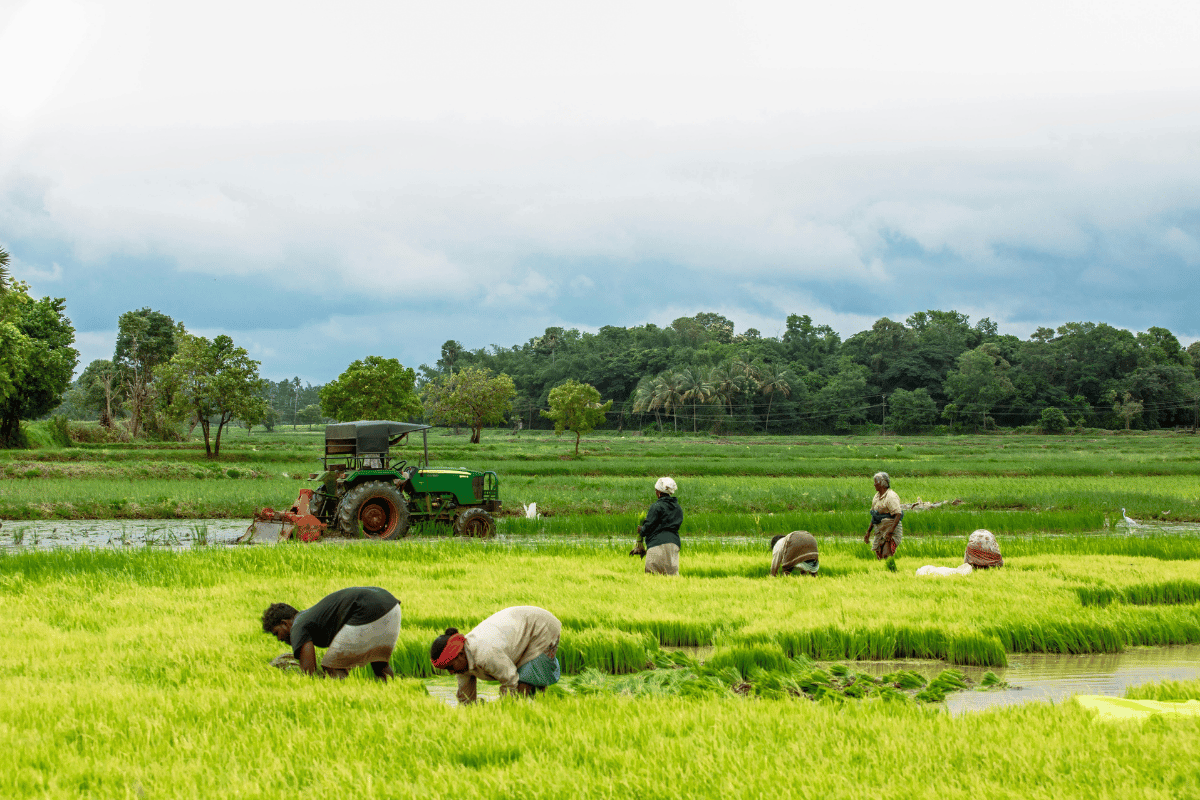
A farm worker in a high-income country generates just over USD 21,100 of agricultural output per year. A farm worker in sub-Saharan Africa or South Asia generates about USD 930. That gap, more than twenty to one, is the starting point of the OECD-FAO Agricultural Outlook 2026-2035, the ten-year projection report published jointly by the OECD and FAO, and this edition's special focus on agricultural labour productivity leads to an uncomfortable conclusion. Global farm incomes will grow over the next decade, and the gap will barely move.
What the 9% average conceals
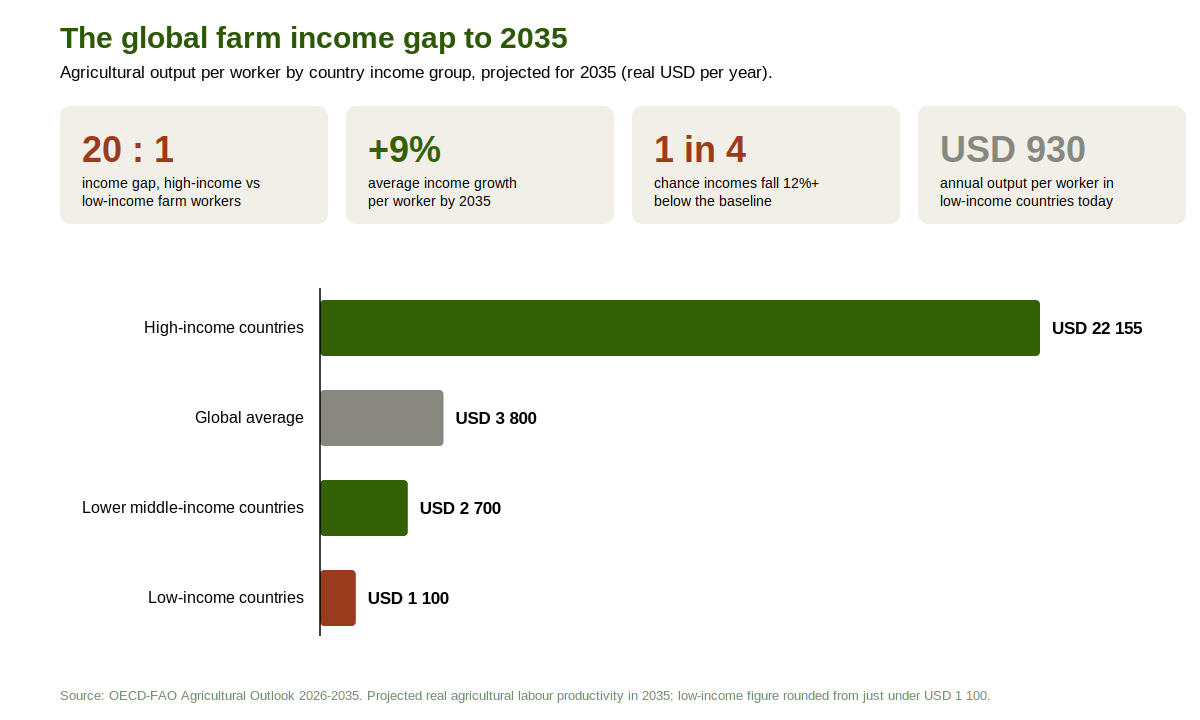
Average gross per capita agricultural incomes are projected to rise 9% by 2035, supported by productivity gains even as input costs climb and real agricultural prices stay broadly flat. The global average works out to about USD 3,800 of output per farm worker. Averages of this kind conceal more than they reveal.
High-income countries move from roughly USD 21,100 per worker in 2023-2025 to a projected USD 22,155 by 2035. The highest output per worker is found in North America, Western Europe and Oceania, where farms cultivate large areas with little labour, heavy mechanisation and significant financial commitments. Low-income countries move from about USD 930 to around USD 1,100 over the same period. The projected 17% increase sounds substantial until it is set against the base. An extra USD 170 per year, spread over a decade, does not lift a farming household out of poverty, and the report states plainly that these conditions remain inadequate for alleviating rural poverty.
The countries in between are where the movement happens. Lower middle-income countries are projected to post the strongest productivity gains, reaching about USD 2,700 per worker by 2035 as mechanisation improves land use intensity and the timing of planting and harvest. Many middle-income economies in Latin America, Eastern Europe and East and Central Asia are shifting out of labour-intensive production toward more commercialised, capital-intensive farming, which also frees labour for better-paid work off the farm.
Why productivity per worker matters more than yield
The report's framing is worth pausing on, because it separates two things that often get conflated. Yield growth raises output per hectare. Labour productivity raises output, and therefore income, per person. In rural economies where households have abundant labour and little capital, incomes depend more directly on how efficiently that labour is used, including access to off-farm work, than on biological gains alone.
That is why the report's recommended pathway runs through mechanisation and automation, better managerial decision-making, risk-mitigation tools and off-farm employment opportunities rather than through yield alone. The technologies involved, from machinery guidance to satellite-based monitoring and variable-rate applications, raise the value each worker produces, which is the quantity that sets rural incomes.
The report adds a caution that policymakers often skip. Mechanisation displaces labour, and where non-agricultural job creation does not keep pace, displaced workers move into precarious informal activities rather than higher-productivity sectors. Labour has already been leaving agriculture across many low- and lower-income countries, but it has too often landed in work that pays no better. Experience with rural youth employment programmes points to the same conclusion the Outlook reaches. Productivity gains on the farm only translate into rural income growth when there are decent jobs for the labour they release.
A one-in-four chance the decade disappoints
The projections above are a baseline, and agricultural incomes are volatile around any baseline. To quantify the risk, the report projected the observed fluctuations in gross agricultural income per worker from 2000 to 2025 forward across the next decade.
The result is a 25% probability that global income per worker falls at least 12% below baseline levels in any year to 2035. In low-income countries the potential decline exceeds 20%, which is more than the entire projected baseline increase of 17%. Put differently, there is roughly a one-in-four chance that farm incomes in the poorest countries end the decade below where they started. Income variability of this kind does damage beyond the bad years themselves, because instability discourages investment and deters the younger entrants that modernising agriculture depends on.
The policy response the report outlines follows from the risk profile. Resilience and diversification strategies to limit downside losses, better information so producers can manage their own risks, market tools such as insurance and futures to transfer risk, and government support concentrated on infrequent but catastrophic events.
What would actually close the gap
Structure explains most of the gap, and structure is slow to change. Countries where agriculture makes up a large share of GDP, mostly low- and lower middle-income economies, consistently show the lowest output per worker. Agriculture there employs a large share of national labour yet each worker generates little value, and the pattern connects directly to how farmland and capital are distributed, a dimension examined in the 2026 global farmland inequality report. High-income countries sit at the opposite corner, with agriculture a small share of GDP and high productivity per worker. Upper middle-income countries trace a gradual path from one corner toward the other.
For low-income countries the report is specific about what the package requires. Access to investment capital to mechanise production, quality inputs and advisory services, better rural infrastructure and logistics, more resilient production systems, and expanded off-farm employment, all pulling in the same direction. None of these is new advice. What the Outlook adds is the arithmetic of what happens without them. Ten more years of the current trajectory leaves a farm worker in sub-Saharan Africa earning in a year roughly what a farm worker in North America generates in three weeks, in a world that will be asking both to produce more.
Sources
- OECD/FAO. (2026). OECD-FAO Agricultural Outlook 2026-2035. OECD Publishing, Paris and FAO, Rome.