Food safety begins long before food reaches processors, retailers or consumers. Many foodborne hazards start on the farm, where contamination can come from water, soil, animals, workers, equipment and agricultural inputs. When these hazards go undetected, they can lower food quality, threaten public health and cause significant losses for farmers and food businesses.
Food safety incidents are often discovered further along the supply chain, but prevention starts on the farm with surveillance and monitoring. Surveillance means systematically collecting, analysing and interpreting information about hazards that may affect production. Instead of relying only on periodic inspections, it gives continuous oversight that helps farmers spot risks early and correct them before contamination spreads.
For farmers, surveillance is as much a practical management tool as a regulatory requirement. It supports productivity, protects consumer confidence and strengthens access to markets, and it matters more as production systems grow more complex and climate pressures bring new food safety risks.
What food safety surveillance involves
Food safety surveillance is the systematic collection and use of information to identify hazards that could compromise food safety. In practice it means observing production conditions, carrying out appropriate tests, recording unusual findings and passing risks on to the people responsible for managing them.
Farm surveillance feeds into national foodborne disease surveillance systems, but it also supports day-to-day decisions about hygiene and contamination on the farm itself. Unlike a one-off inspection, repeated monitoring lets farmers see changes over time, recognise recurring problems and check whether their corrective measures are working. What it covers depends on the production system, the hazards involved and the food safety requirements that apply.
| Food safety surveillance | Food safety inspection |
| Continuous and ongoing | Periodic or one-off |
| Identifies trends and emerging risks | Checks compliance at a given moment |
| Supports prevention | Identifies existing problems |
| Carried out by farmers and other stakeholders | Often carried out by external inspectors |
| Improves decision-making | Verifies compliance |
What to monitor depends on the type of production and the hazards identified, and checks should be prioritised by risk. A vegetable farm irrigating from surface water needs different monitoring from a poultry or dairy unit. The Codex Code of Hygienic Practice for Fresh Fruits and Vegetables gives guidance on managing biological, chemical and physical hazards during primary production and handling.
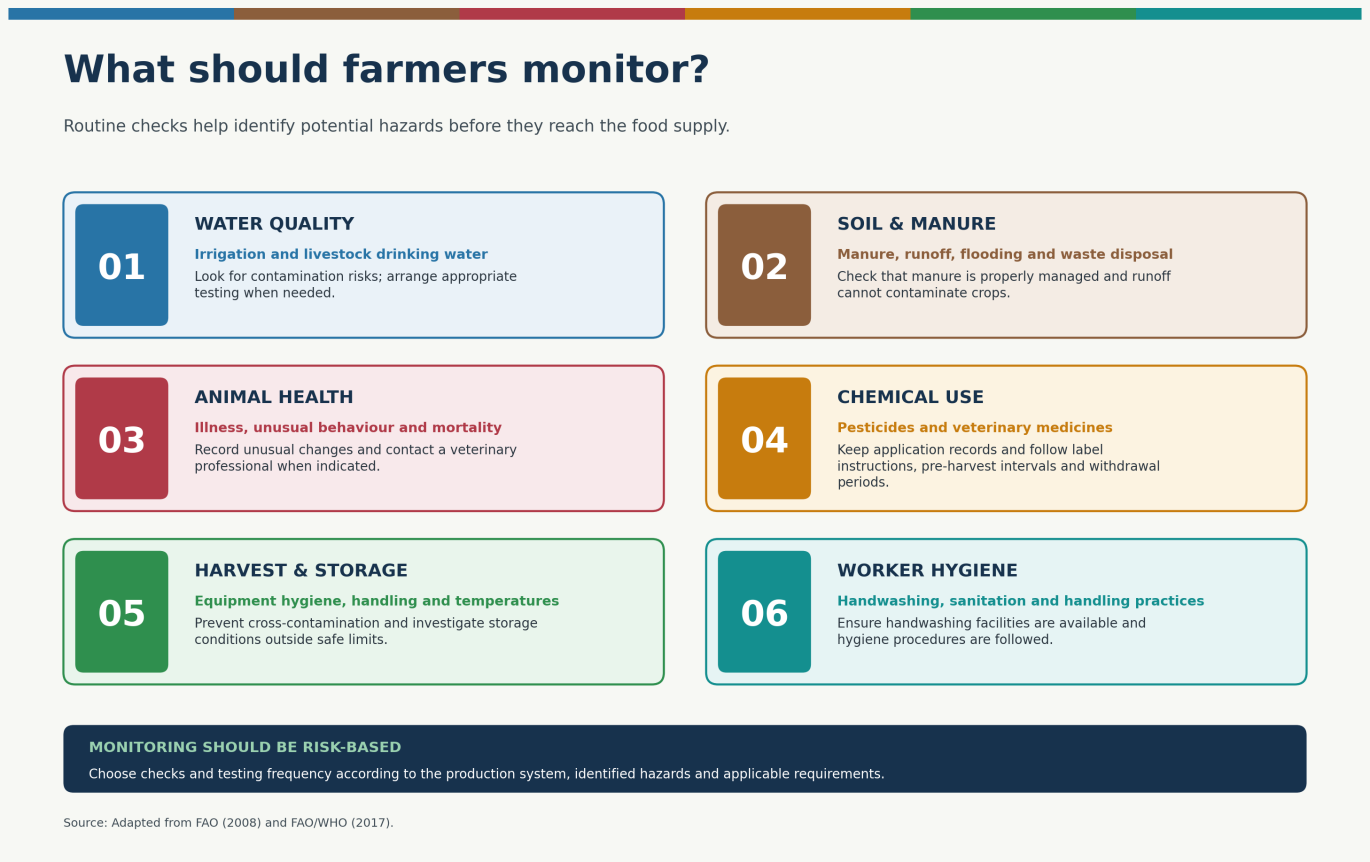
The main areas for routine food safety monitoring on farms. Adapted from FAO (2008) and FAO and WHO (2017).
Why early detection matters
It stops contamination spreading
Some hazards cannot be detected by appearance, smell or taste. Fresh vegetables can look healthy despite microbial contamination, and food-producing animals can carry some pathogens without showing any signs of illness. The pathogens associated with fresh produce include Salmonella, pathogenic Escherichia coli and Listeria monocytogenes.
Routine checks and targeted testing can reveal problems before affected products move further along the supply chain. If irrigation water turns out to be unsafe, the farmer can restrict its use, investigate the source and correct it. Suspected livestock disease can be reported promptly to the veterinary services for investigation and control. Early detection creates the chance to act before a risk grows, although it cannot guarantee that contamination will be prevented.
It limits avoidable losses
Food safety incidents can mean rejected produce, product withdrawals, livestock losses, interrupted production and damaged relationships with buyers, and farms supplying formal markets may face extra testing, traceability and compliance costs as well. The scale can be large. When E. coli was linked to romaine lettuce in the United States in 2018, the resulting losses across the supply chain were later estimated at between $276 million and $343 million, most of them borne by retailers, according to an economic analysis by Spalding and colleagues.
Finding a problem early limits that kind of damage. Records showing repeated faults in a cold store, for example, can prompt maintenance before large quantities of perishable food are spoiled. Risk-based approaches to food control direct attention to the hazards that pose the greatest threat, although the financial benefit always depends on the circumstances and on how effectively the farm responds.
It protects consumers
Food safety is a shared responsibility between producers, food businesses and public authorities, and protecting people requires cooperation across sectors. When farm findings point to a credible risk, farmers can hold back products that may be affected, investigate the source and notify the relevant authorities or buyers. Where several farms share irrigation systems, water sources or facilities, prompt communication matters even more, because the same hazard can affect all of them.
It supports traceability and compliance
Reliable records show what happened, where, and which products or production areas may be affected. Water test results, pesticide applications, veterinary treatments, animal health observations, manure management and harvest dates can all support an investigation, identify affected products and demonstrate compliance with legislation, buyer requirements and farm assurance schemes. Documented procedures for tracing and withdrawing products are also an important part of an effective food control system.
How farmers can monitor food safety risks
Effective monitoring does not always need sophisticated technology. Small farms can start with consistent observation, simple record-keeping and access to technical advice, while higher-risk operations need scheduled laboratory testing or specialised equipment. The process runs in four connected steps.
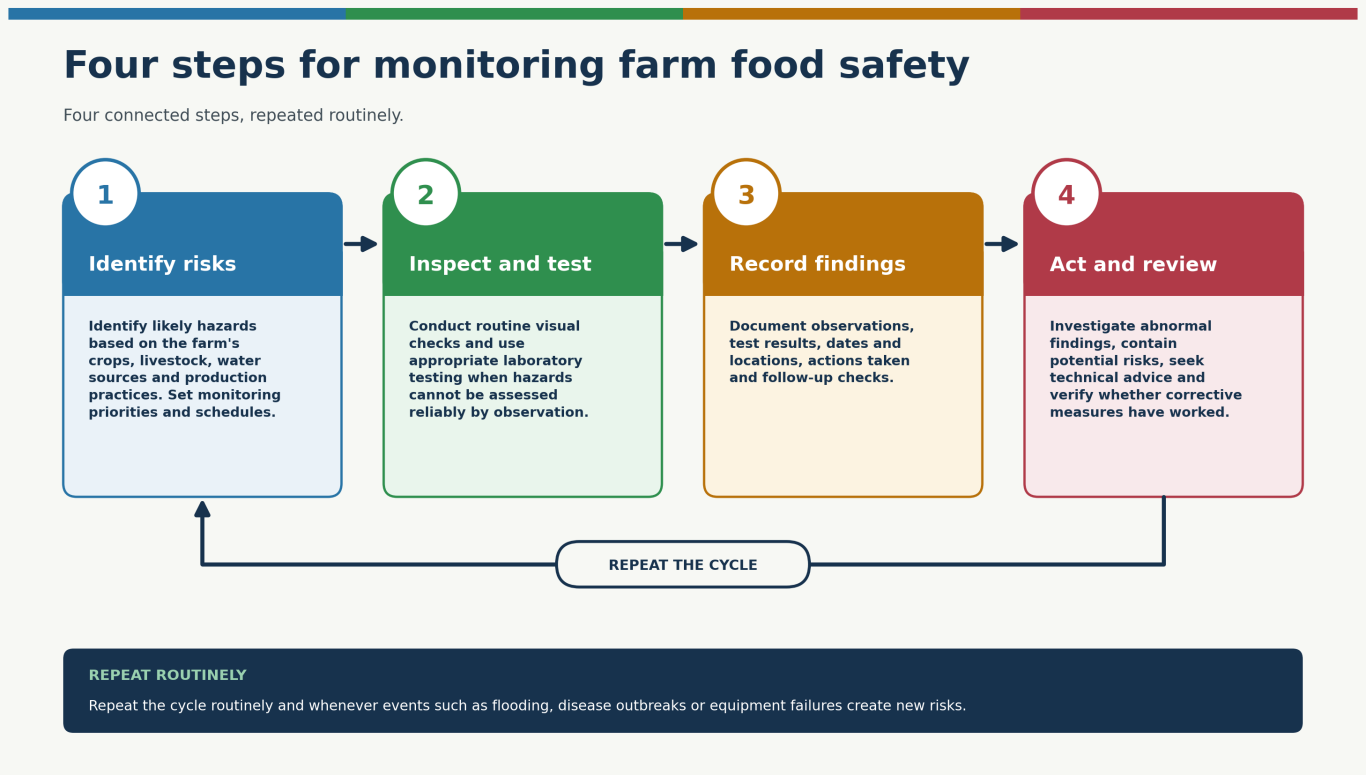
Four steps for monitoring farm food safety, repeated routinely and after events such as flooding, disease outbreaks or equipment failures.
Repeat the cycle routinely, and again after any event that creates new risks, such as flooding, a disease outbreak or an equipment failure.
Reporting what you find
Monitoring is useful only when significant findings reach people who can act on them. Delayed or incomplete reporting lets hazards persist, spread or enter the food supply. WHO guidance on foodborne disease surveillance stresses early detection, assessment, investigation and coordination between public health, food safety and laboratory services.
Farmers and workers should know which events need urgent attention and whom to contact. Depending on the hazard and local arrangements, that may be a farm manager, a veterinarian, an extension officer, a laboratory, a public health service or a food safety regulator. A useful report answers six questions:
- What happened?
- When did it occur?
- Where was it identified?
- Which crops, animals or products are affected?
- What actions have already been taken?
- What support is needed?
Farmers should distinguish suspected hazards from confirmed findings, but should not delay reporting a credible concern when prompt notification is required or a serious risk may be present. For animal diseases subject to notification, follow the procedures of the relevant veterinary authority. The World Organisation for Animal Health's Terrestrial Animal Health Code sets out international guidance on disease notification and surveillance. Products that may be unsafe should be held, traced, withdrawn or recalled under the applicable procedures, with authorities and buyers informed, and they should not be released simply because the first warning signs have gone.
Making surveillance work in practice
Surveillance depends on farmers and workers recognising risks and taking part in monitoring and reporting consistently. A system based only on external inspections, such as occasional laboratory visits, can miss problems that arise in between. Training should help workers recognise contamination pathways, follow hygiene procedures, keep records and know when to raise a concern, and it works best when it reflects the farm's own crops, livestock and practices.
Several practical barriers stand in the way. Laboratories may be distant, expensive or slow to return results. Workers may struggle to recognise less obvious risks or to interpret test results correctly. Weak links between farmers, laboratories, extension services, veterinarians and regulators can delay a response, and regular testing and record-keeping add cost and paperwork for farms with limited resources.
Extension services, veterinarians, cooperatives and producer organisations can connect farmers with advice, testing and reporting channels, and shared training and laboratory access cut costs for smallholders who cannot run their own monitoring.
Farmers may also hesitate to report problems for fear of penalties, lost buyers or damage to their reputation. Clear procedures, fair treatment and feedback from the authorities build the trust that prompt reporting depends on, and involving farmers in designing surveillance programmes brings practical barriers, such as sampling costs or the lack of a nearby laboratory, into view early.
The role of digital tools
Mobile apps, electronic records and sensors can make monitoring and reporting faster by helping farmers record observations, receive alerts and share information with the right professionals. A temperature sensor can alert a manager when a cold store drifts outside safe limits, water monitoring devices can track selected parameters, and digital records can show recurring failures in sanitation or production controls. At a larger scale, bringing together information from different surveillance sources helps authorities see patterns across the food chain.
Digital tools need maintenance and calibration, their results need proper interpretation, and an alert is only useful if it reaches someone able to act. Equipment costs, poor connectivity, digital skills and data protection concerns can also limit their use. For many smallholder farms, a well-kept paper logbook and a reliable contact at the extension or veterinary service will do more than a complex digital platform.
What surveillance looks like on a farm
A few scenarios show how routine monitoring turns into action.
Irrigation water: after a period of heavy rain, routine testing shows raised microbial contamination in a vegetable farm's irrigation source. The farmer switches to another water supply and adds monitoring before harvest, lowering the risk of contaminated produce.
Cold chain: routine temperature checks on a dairy farm pick up a fault in the refrigeration system before milk quality suffers. A prompt repair prevents spoilage and losses.
Worker hygiene: a review of hygiene records shows repeated lapses in handwashing among seasonal staff. Targeted training and closer supervision improve practice and reduce the chance of contamination.
In each case, finding the problem early is what allows the farmer to respond before a small issue becomes a food safety incident.
Early detection starts on the farm
Routine monitoring of water, animal health, worker hygiene, equipment sanitation and the farm environment lets farmers identify hazards before they become serious incidents. Treated as an ongoing part of farm management rather than a stand-alone obligation, surveillance supports better decisions, reduces losses and builds consumer trust. It also serves the wider One Health goal of protecting people, animals and the environment together, and farms that monitor well are better placed to produce safe food, meet requirements and reach demanding markets.
Sources
FAO (2008). Risk-based food inspection manual. FAO Food and Nutrition Paper 89. Rome.
FAO and WHO (2017). Code of hygienic practice for fresh fruits and vegetables, CXC 53-2003. Codex Alimentarius Commission.
Spalding, A., Goodhue, R. E., Kiesel, K., and Sexton, R. J. (2023). Economic impacts of food safety incidents in a modern supply chain, E. coli in the romaine lettuce industry. American Journal of Agricultural Economics, 105(2), 597-623.
WHO (2025). Strengthening surveillance of and response to foodborne diseases, introductory manual. Geneva.
WHO (2026). Food safety. Fact sheet.
WOAH (2024). Terrestrial Animal Health Code, notification of diseases and provision of epidemiological information. Paris.