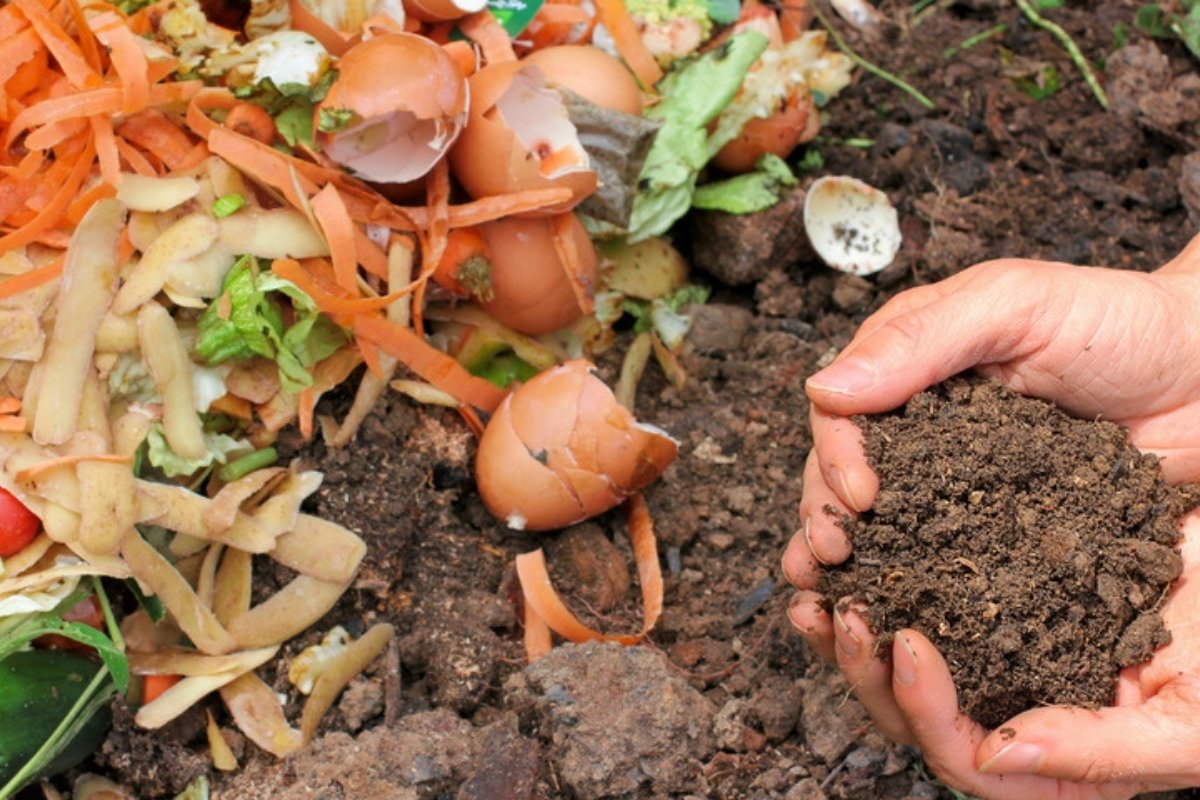
Every year, farms and food businesses generate large quantities of food waste and organic residues. Rather than going to landfill, much of it can be composted and returned to the soil, where it contributes to soil health and nutrient cycling. Not all organic waste is free of risk, though. Poorly managed compost can carry pathogens, weed seeds, plastics or chemical contaminants back into the farm, and from there to soil, water, crops and eventually consumers. Composting safely is therefore as much a food safety question as a sustainability one.
Composting is a biological process in which microorganisms break down organic matter under controlled conditions. During the active phase their activity generates heat, and that heat can reduce many pathogens, but how well it works depends on how the process is managed, meaning temperature, how long it is held, moisture and oxygen.
Why reuse is a food safety question
Agriculture produces large quantities of organic residues, and farms need organic matter and nutrients to keep soils productive. Composting bridges the two by turning suitable materials into more stable amendments. The same materials can also carry contamination picked up during production, harvest, transport, processing, storage or handling.
Animal-derived material may contain enteric pathogens. Crop residues can carry plant pathogens or contaminated soil. Depending on where it comes from, a waste stream may also hold chemical residues, plastics or metal. Material meant for reuse on the farm should therefore be judged by its source, composition and intended use, not only by its nutrient value.
The main contamination risks
Foodborne pathogens
Pathogenic microorganisms are among the most serious concerns when organic amendments are used in food production. Composting research has focused particularly on Salmonella, pathogenic Escherichia coli and Listeria monocytogenes, which can enter farm soils through contaminated amendments and form part of the contamination pathways that reach fresh produce.
Plant pathogens and weed seeds
Food safety discussions tend to focus on human pathogens, but reuse can also return plant pathogens and viable weed seeds to the field. Plant diseases cut yields and threaten food supply, and some also affect food quality or safety. Whether weed seeds and plant pathogens survive depends on the temperature reached, the composting method and other process conditions, and inadequate treatment lets them go back onto the land.
Chemical contaminants
Organic waste can contain pesticide residues, heavy metals and other chemical contaminants, and the level of risk depends heavily on where the material came from. Some organic contaminants break down during composting, depending on the compound and the conditions. Heavy metals such as cadmium, lead, chromium, nickel and zinc cannot be broken down biologically, and they remain in the finished compost. Being natural or biodegradable does not in itself make a material suitable for farmland.
Plastics and other physical contaminants
Food waste collection brings plastic, packaging, fruit stickers, glass and metal into compost streams. In one estimate from Vermont, 38% of food waste was still in its packaging. Composting does not remove these materials, and unless they are separated during collection, processing or screening they stay in the finished product. The quantities can be substantial: a review of municipal solid waste compost found that it could add up to 536 kg of plastic per hectare a year to amended soils.
Antimicrobial resistance
Animal manures and animal-derived food waste can contain antimicrobial-resistant bacteria and resistance genes. Aerobic composting reduces some of them, though by how much depends on the genes involved and the composting conditions. Inadequately treated waste can carry resistance into the farm environment, which makes good composting part of the wider effort to control antimicrobial resistance.
| Contamination risk | Main sources | Potential concern |
| Foodborne pathogens | Animal manure, contaminated food waste, soil | Contamination of soil, water and produce |
| Plant pathogens and weed seeds | Crop residues, infected plant material | Spread of plant disease and weeds |
| Chemical contaminants | Pesticide residues, heavy metals, contaminated waste | Persistence or build-up in soil |
| Physical contaminants | Plastics, glass, metals, packaging | Physical contamination and plastic particles in soil |
| Antimicrobial resistance | Animal manure and other organic wastes | Spread of resistance genes |
How composting reduces pathogens
As microorganisms break down the most easily degraded material, the pile passes through a hot thermophilic stage, and it is the heat of that stage that reduces most foodborne pathogens. Vegetative bacteria such as Salmonella, pathogenic E. coli and Listeria are substantially reduced when the right conditions are reached, but both the temperature and how long it is held matter.
A commonly used benchmark is to keep the pile above 55°C for between 3 and 15 days, depending on the method, with open windrows at the long end of that range and needing regular turning. Requirements vary between countries, so check the rules that apply where you farm.
That benchmark is harder to meet on a small scale than it sounds. The same statewide study in California found higher microbial risk in small, non-commercial composting systems, and traced it to the difficulty they had in reaching and holding sanitising temperatures. A farm-scale heap is exactly that kind of system.
Temperature also varies within the pile, and material in the cooler outer zones gets less treatment. Turning and mixing moves that material into the hot core so the whole batch is treated more evenly.
Heat is not the whole story
Microorganisms differ in how well they withstand heat. Spore-forming bacteria, including some Bacillus species, are far more heat-resistant than ordinary vegetative cells and much harder to inactivate. pH, moisture, ammonia and competition from the compost's own microorganisms all influence which pathogens survive.
Survival can also continue past the hot phase. Salmonella can persist and even regrow in finished compost, which is why curing and storage need the same care as the active stage.
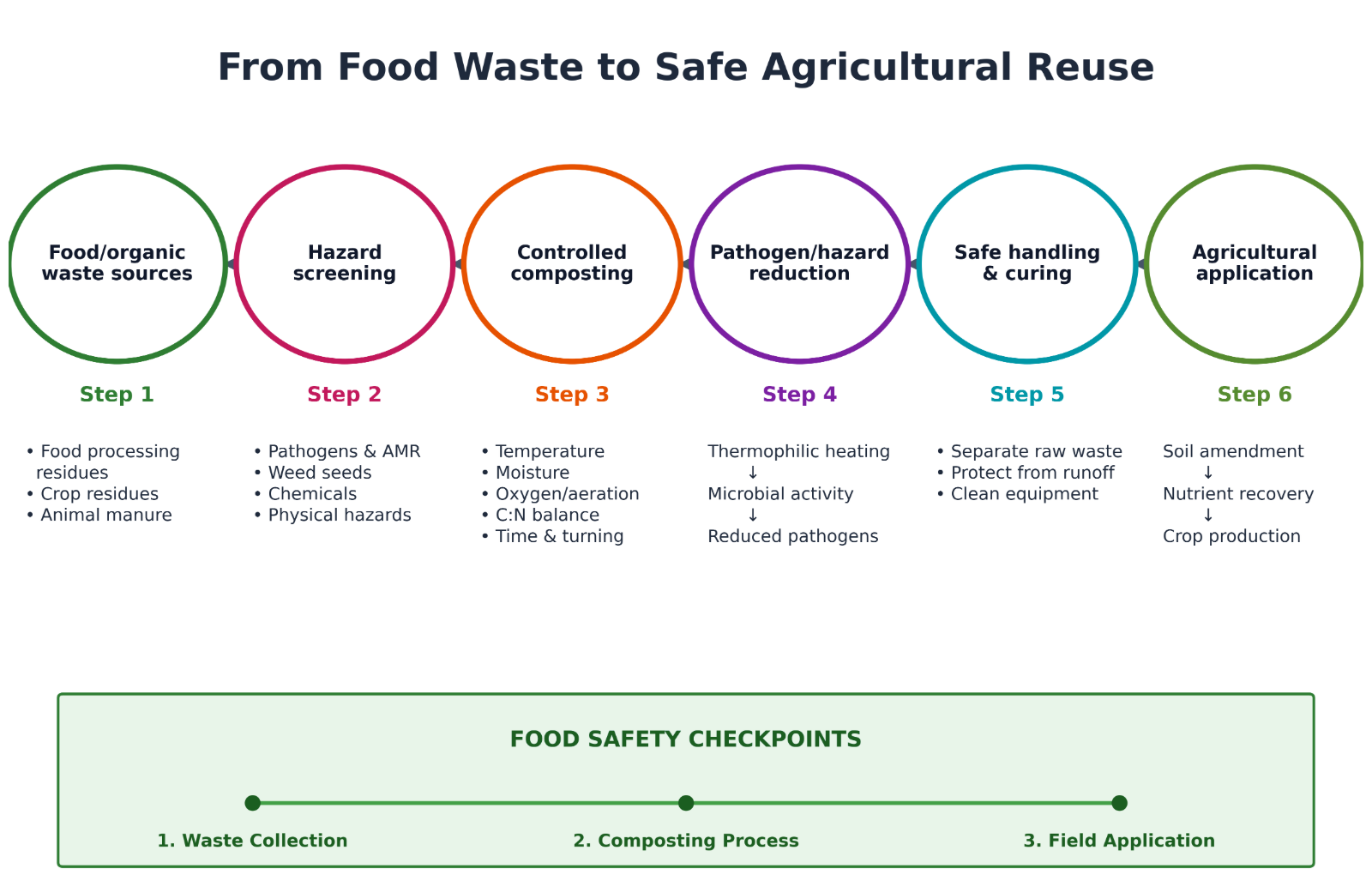
Food safety considerations across the composting and reuse pathway, with the main checkpoints from waste sourcing to field application.
What decides whether composting works
Several factors interact to determine whether a pile composts properly, as FAO's guide to on-farm composting sets out.
Moisture: microorganisms need enough moisture to stay active. Too much cuts off oxygen, while very dry material slows decomposition.
Oxygen: aerobic composting needs a steady supply of air. A good pile structure, turning and, where available, forced aeration keep the pile aerobic and prevent oxygen-starved pockets.
Carbon and nitrogen: the balance of carbon-rich and nitrogen-rich material drives microbial activity and heat. Dry leaves, straw and other carbon-rich residues can be mixed with nitrogen-rich food or animal waste to get the pile working.
Time and temperature: pathogen reduction depends on both. Hold the pile at temperature for the time local rules require, and do not cut the process short.
Why composting sometimes fails
A poorly managed pile leaves parts of the material undertreated when conditions do not support enough biological activity. The other common failure comes after treatment, when finished compost is contaminated again through animals, dirty water, equipment, workers or contact with raw waste.
A vegetable farm that collects processing residues, monitors the pile's temperature, moisture and aeration, turns it for even treatment, and stores the finished compost apart from raw waste, away from animals and runoff, recovers a resource. A farm that spreads partly decomposed food waste straight onto land for leafy vegetables moves a hazard instead. Surviving pathogens can reach the soil and irrigation water, and plastic fragments go into the field with the waste.
Compost and fresh produce
Fruit and vegetables can pick up contamination from soil, irrigation water, animals, workers, equipment and organic amendments. These routes matter most for crops eaten raw, because nothing later in the chain reliably removes the contamination. The Codex Code of Hygienic Practice for Fresh Fruits and Vegetables stresses control of all potential sources of microbial contamination at primary production, organic amendments included. How likely contamination is depends on the pathogen, the crop, the conditions, how the amendment is applied, and how long passes between application and harvest.
A checklist for farmers
The aim is to manage food waste reuse as a controlled process rather than simply returning organic waste to the soil.
Know the source: use residues from known sources where possible, and avoid material of uncertain origin or likely to carry hazardous contaminants.
Choose suitable feedstock: consider whether the material suits composting and its intended use, particularly where manure, food waste or possibly contaminated residues are involved.
Take out plastics and foreign material: separate packaging, plastic film, stickers, glass and metal before or during processing.
Manage the pile: monitor temperature, moisture and aeration throughout, and turn or mix the material to treat it evenly.
Do not judge compost by its looks: dark, mature-looking compost is not necessarily safe, and appearance cannot confirm that hazards have been reduced.
Protect finished compost: keep it apart from raw waste and protect it from animals, dirty water and unclean equipment during curing, storage and transport.
Keep equipment and hands clean: avoid carrying contamination between raw waste, finished compost, soil and crops.
Apply it properly: follow local or national rules on compost use, including application methods and, where relevant, the interval between application and harvest.
Think about the crop: take particular care with crops eaten raw, where food safety depends most on prevention during production.
Circular farming is not automatic
Circular farming does not mean every waste material should go back onto the farm. Safe reuse depends on choosing the right material, composting it properly and handling it responsibly afterwards, so that valuable organic matter returns to the soil without the biological, chemical or physical hazards it can carry. Done that way, food waste becomes a resource for both sustainable farming and safer food.
Sources
Codex Alimentarius. Code of hygienic practice for fresh fruits and vegetables, CXC 53-2003. FAO and WHO.
FAO (2003). On-farm composting methods. Food and Agriculture Organization of the United Nations, Rome.
Gurtler, J. B., Doyle, M. P., Erickson, M. C., Jiang, X., Millner, P., and Sharma, M. (2018). Composting to inactivate foodborne pathogens for crop soil application, a review. Journal of Food Protection, 81(11), 1821-1837.
Mia, M. S., and Zzaman, W. (2025). Food waste-derived organic fertilizers, critical insights, agronomic impacts, and pathways for sustainable adoption. International Journal of Food Science, 2025(1), 1551054.
Microbial food safety risk in finished soil amendments, a statewide cross-sectional study of organic waste processing systems in California (2026). Journal of Food Protection.
Okori, F., Lederer, J., Komakech, A. J., Schwarzböck, T., and Fellner, J. (2024). Plastics and other extraneous matter in municipal solid waste compost, a systematic review of sources, occurrence, implications, and fate in amended soils. Environmental Advances, 15, 100494.
Porterfield, K. K., Hobson, S. A., Neher, D. A., Niles, M. T., and Roy, E. D. (2023). Microplastics in composts, digestates, and food wastes, a review. Journal of Environmental Quality, 52(2), 225-240.