

As the year draws to a close, farmers have a chance to look back at the practices that protected their crops, livestock, workers and customers in 2026. Food safety depends on everyday decisions throughout production, and preventing contamination is generally easier than managing it once it has happened. Regular monitoring and accurate records help identify problems early, while changes in weather and production conditions can introduce new risks at different stages of production.
The following lessons offer practical guidance for improving food safety and strengthening farm resilience.
Prevention has to be part of routine farm work
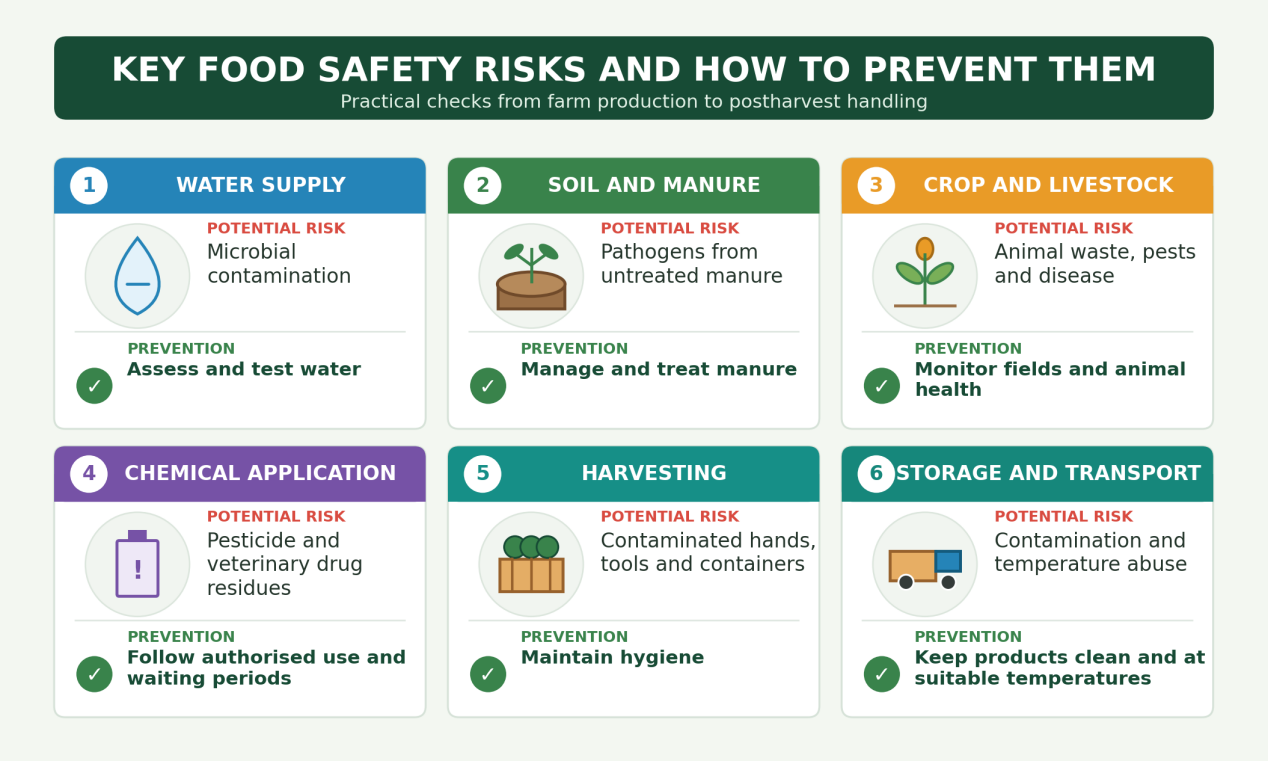
Food safety should be built into routine farm activities instead of being addressed only after contamination has occurred. That means identifying the hazards linked to each production activity, assessing how likely contamination is and putting preventive measures in place. These can include following Good Agricultural Practices (GAP), keeping equipment clean, protecting water sources, managing manure properly, providing handwashing facilities and keeping harvested produce away from potentially contaminated surfaces.
Regular inspection of farm activities shows where controls are weak and where more are needed. Farmers should check, for example, whether harvesting containers are clean, whether manure is adequately managed and whether workers have access to proper hygiene facilities. Workers should also understand how contamination can spread during planting, harvesting, sorting and packing, as Purdue University's vegetable crops team advises.
Water quality depends on the source and how it is used
Water used in production can carry harmful microorganisms to crops, livestock and the wider farm environment. The level of risk depends on the water source, its intended use and the likelihood of contamination. Surface water from rivers, ponds and streams can be exposed to farm runoff, animal waste and sewage. Groundwater can also become contaminated through poorly built wells, damaged infrastructure or seepage from nearby pollution sources, as the Codex code of hygienic practice for fresh fruits and vegetables sets out.
Farmers should list every water source used on the farm and assess how each could become contaminated. Microbiological testing, such as testing for Escherichia coli (E. coli) as an indicator of faecal contamination, can show whether water quality suits its intended use. The frequency and type of testing should reflect the water source, the farm activity and the guidelines that apply.
Irrigation method matters too. Overhead irrigation can bring contaminated water into direct contact with the edible parts of crops and raise the risk of microbial contamination. When assessing risk, consider the quality of irrigation water, how it is applied and the stage of crop development. Where contamination is suspected, investigate the source and correct it before using the water again for anything that could affect food safety.
Extreme weather brings new contamination risks
Weather variability affects more than yields. Flooding can carry sewage, animal waste and other contaminants into fields and water sources, high temperatures make safe storage harder, and long wet spells complicate harvesting and postharvest handling, according to FAO guidance on food safety in natural disasters.
Climate change also influences the distribution and persistence of foodborne pathogens and agricultural pests. Produce exposed to floodwater needs particular attention, especially edible parts that may have touched sewage, animal waste or other pollutants. Harvested products should likewise be protected from excessive heat, moisture and contamination during storage and transport. Building resilience in 2027 means including food safety in farm-level climate adaptation plans and considering how changing weather could affect water quality, soil, livestock health, harvest schedules and storage facilities.
Good records make problems traceable
Farm records help farmers understand what has happened, spot recurring problems and show that sound production practices were followed. Useful records include pesticide and fertiliser applications, veterinary treatments, water test results, cleaning schedules, worker training, pest control, harvest dates and storage conditions, as listed in the FAO and OIE guide to good farming practices.
Accurate records also support traceability. When a food safety problem occurs, they help farmers identify the affected batches and establish where the products went. They provide evidence during inspections and audits, support certification and help farmers meet the expectations of buyers and markets. Records should be accurate, accessible and kept up to date. For a small farm, a notebook or a simple spreadsheet can be enough, as long as information is recorded consistently and can be found when needed.
Chemical inputs need correct rates and waiting periods
Pesticides, fertilisers and veterinary medicines are important inputs, but incorrect use creates food safety risks. Applying pesticides at the wrong rate, ignoring pre-harvest intervals or skipping withdrawal periods after veterinary treatment can leave unacceptable chemical residues in food.
Farmers should follow product labels and regulatory requirements, use only authorised products for their intended purposes and keep application records. The pre-harvest interval is the minimum time between the last pesticide application and harvest. The withdrawal period sets how long farmers must wait before milk, eggs or meat from treated animals can enter the food chain.
Farmers should also make sure residues in food stay within the maximum residue limits (MRLs), the highest permitted concentrations of pesticide or veterinary drug residues in a food commodity. Workers who handle agricultural chemicals should be trained, use the recommended protective equipment and know how to store and dispose of chemicals safely.
Food safety depends on everyone working on the farm
Even with the right facilities and procedures, poor implementation can undermine food safety. Workers who do not understand hygiene requirements can contaminate produce without meaning to, through unwashed hands, dirty equipment, careless handling or inadequate cleaning. Training should be practical, continuous and relevant to each worker's tasks. Harvesting teams, for example, need to know how to handle produce without damaging it or placing it on contaminated surfaces, while cleaning and packing staff need to know how to use cleaning materials correctly and keep clean and dirty equipment apart.
Training alone is not enough. Food safety also needs a positive culture in which safe practices are understood, encouraged and followed by everyone on the farm. Managers and supervisors set expectations, provide the resources and encourage workers to report problems. Regular discussions, practical demonstrations and refresher training help these habits stick.
Ten questions to review food safety on the farm
The questions below can help assess current farm practices.
| Area | Questions to consider |
| Water quality | Do we know where our production water comes from, and when was it last assessed? |
| Soil and manure | Are manure, compost and other soil amendments managed to minimise contamination? |
| Chemical use | Are application rates, pre-harvest intervals and withdrawal periods followed and recorded? |
| Worker hygiene | Do workers have access to clean water, handwashing facilities and appropriate training? |
| Harvesting | Are tools, containers and handling surfaces kept clean? |
| Storage | Can harvested products be protected from contamination, excessive heat and moisture? |
| Records | Are farm activities and incidents documented consistently? |
| Traceability | Can we identify where harvested products have been distributed if a food safety problem occurs? |
| Food safety culture | Are workers encouraged to report unsafe practices and help improve food safety? |
| Reporting | Do workers know who to contact when they identify a potential food safety problem? |
Farmers do not need to fix every weakness at once. Identifying the most significant risks and setting realistic targets makes progress manageable. Applying sound food safety practices consistently protects consumers, reduces avoidable losses and strengthens confidence in farm products.
Sources
Codex Alimentarius Commission (2017). Code of Hygienic Practice for Fresh Fruits and Vegetables (CXC 53-2003). FAO and WHO.
Codex Alimentarius Commission (n.d.). Veterinary drug residues in food: Glossary. FAO and WHO.
FAO and OIE (2010). Guide to good farming practices for animal production food safety. Food and Agriculture Organization of the United Nations and World Organisation for Animal Health.
FAO (n.d.). Food safety in natural disasters. Food and Agriculture Organization of the United Nations.
Gary, T., and Deering, A. J. (2024, 28 June). Food safety considerations for vegetable farms. Vegetable Crops Hotline, Purdue University.
Health Canada (2022). Understanding preharvest intervals for pesticides. Government of Canada.
Hellberg, R. S., and Chu, E. (2016). Effects of climate change on the persistence and dispersal of foodborne bacterial pathogens in the outdoor environment: A review. Critical Reviews in Microbiology, 42(4), 548-572.
Nowicki, S., deLaurent, Z. R., de Villiers, E. P., Githinji, G., and Charles, K. J. (2021). The utility of Escherichia coli as a contamination indicator for rural drinking water: Evidence from whole genome sequencing. PLoS ONE, 16(1), e0245910.