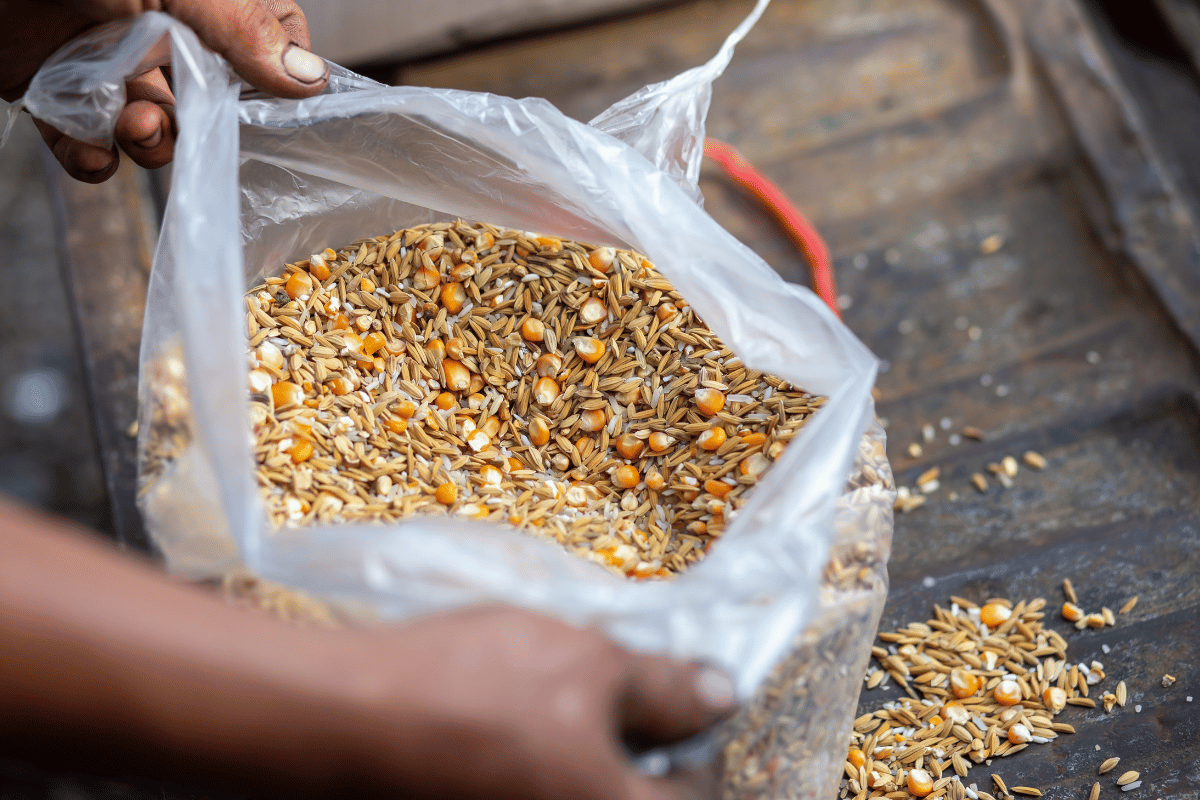
US feed spending is set to fall 6.8% in 2026 to 65.6 billion dollars, a third straight annual decline, while the crops that go into that feed sell for less than they cost to grow. Corn, soybeans, and wheat are all trading below their estimated 2026 break-even prices, which hands livestock producers cheaper rations and leaves grain growers with thin or negative margins. Behind the split sits a comfortable global grain balance. Corn supplies are heavy, soybean exports are weak, and a US wheat crop at a 60-year low has not lifted world prices.
Feed costs are heading lower for a third straight year
A large corn crop and record soybean crush are keeping feed grains and protein meal cheap into 2026. Corn is priced around 4.25 to 4.50 dollars per bushel for the year, and soybean meal around 275 to 325 dollars per ton, both below their long-run averages. Because feed costs run 60% to 70% of the operating budget in hog and poultry units, those lower grain prices flow straight through to feeding margins.
Hog and broiler producers gain the most from cheap feed and steady consumer demand. Dairy farmers face a tighter squeeze, as cheaper feed only partly offsets an easing all-milk price forecast at 20.70 dollars per hundredweight for 2026. Beef sits apart, with a cattle herd in its seventh year of contraction, holding prices high regardless of feed costs.
Grain growers are selling below break-even
Break-even prices for 2026, according to the USDA Agricultural Outlook Forum, sit near 5.00 dollars per bushel for corn, 12.27 for soybeans, and 7.96 for wheat, and the market is offering less than that for each. The June WASDE forecasts season-average prices of 4.40 dollars for corn, 11.40 for soybeans and 6.00 for wheat. That gap points to thin or negative margins across the major row crops, the mirror image of the relief their customers in the feed yard are seeing.
The European Union imports large volumes of soybeans and soybean meal, so its livestock sector gains from cheap global protein while its grain growers compete in a well-supplied market that caps prices.
Corn is the cushion under the whole complex
US corn ending stocks for 2025/26 climbed to 2.145 billion bushels in the June WASDE, the largest carryout in seven years, while world corn stocks sit near 281 million tonnes. The 2026/27 crop is projected at 15.995 billion bushels, down about 6% on a smaller area but still large by historical standards. At a forecast season-average price of 4.40 dollars per bushel, corn trades below its long-run average of roughly 4.71 dollars per bushel since 2007.
Plentiful, cheap corn caps the wider feed-grain market. Livestock feeders lean on corn rather than wheat when wheat is dear, so little of the small US wheat crop gets pulled into feed rations. That substitution keeps a short wheat crop from adding pressure to feed bills, and it is why cheap corn, not tight wheat, is setting the tone for feeding costs.
Soybeans stay weak on exports but heavy on supply
US soybean exports for 2025/26 fell to 1.51 billion bushels, the lowest in 13 years, after tariff measures curtailed shipments to China and cut the US share of global soybean trade to a record-low 23%. Domestic crush set a record near 2.75 billion bushels over the same period, leaving soybean meal plentiful at a forecast of 310 dollars per short ton. Large South American crops, with Brazil at a record 180 million tonnes and Argentina at 50 million, keep pressing on the US export share.
US soybean oil use for biofuel is forecast at 17.8 billion pounds for 2026/27, pulling oil into renewable diesel and away from export markets. The FAO vegetable oil index fell 4.6% in May as global supplies of palm and soybean oil built. The byproduct of all that crushing is a deep, low-cost pool of protein feed, which feeds straight back into the falling cost of livestock rations.
Even a 60-year low in US wheat has not lifted grain prices
US winter wheat production fell to 1.029 billion bushels for 2026/27, the smallest since 1965, yet the FAO Cereal Price Index rose only about 5% over the year to May, and wheat just 7.8%. A drought-driven loss of that size in a major exporter would normally lift the whole grain market. It has not, because world wheat stocks remain comfortable at 275 million tonnes and large Black Sea crops, led by Russia, near a record 88 million tonnes, are covering the gap.
US winter wheat exports are forecast down 135 million bushels to 775 million, as buyers turn to cheaper origins, so the shortfall does little to improve the price grain farmers receive. The season-average farm price, though up to 6.00 dollars per bushel on tight domestic supply, still sits below the cost of production. Tight US wheat has lifted the US price without rescuing margins.
Acreage, El Niño and China will set the next move
The USDA's June 30 Acreage report will update planted area for corn and soybeans and set the tone for new-crop supply. A developing El Niño raises the risk for Southern Hemisphere wheat and the next South American crops, with forecasters putting the odds of a very strong event late in the year above 60%, a swing factor for Australian and Argentine output. China's tariff stance on US soybeans, firm biofuel demand for soybean oil, and elevated energy and fertilizer costs tied to tensions around the Strait of Hormuz round out the watch list, with that last factor capable of lifting input bills and squeezing grain margins further into the new crop year.
References
- USDA. (2026). World Agricultural Supply and Demand Estimates (WASDE-672), June 2026. United States Department of Agriculture.
- USDA Economic Research Service. (2026). Farm sector income forecast. United States Department of Agriculture.
- Langemeier, M. (2026). Prospects for swine feed costs in 2026. farmdoc daily, University of Illinois.
- American Farm Bureau Federation. (2026). Risk management options for 2026: corn, soybeans and wheat.
- FAO. (2026). FAO Food Price Index, May 2026. Food and Agriculture Organization of the United Nations.
- The Western Producer. (2026). Bumper Black Sea wheat offsets U.S. disaster.
- USDA Economic Research Service. (2026). Wheat market outlook. United States Department of Agriculture.