Direct greenhouse gas emissions from crop and livestock production are projected to rise 6.5% over the next decade, according to the OECD-FAO Agricultural Outlook 2026-2035, the ten-year projection published jointly by the OECD and FAO. At the same time, the amount of emissions released per unit of food produced is expected to fall in every region. Both statements are true, and holding them together is the central tension in how agriculture confronts its climate footprint over the coming decade.
Why total emissions and intensity move in opposite directions
Agriculture, forestry and other land use account for roughly 22% of global human-caused greenhouse gas emissions, split fairly evenly between direct on-farm sources and the carbon dioxide released when land is cleared for farming. The Outlook measures only the direct on-farm part, primarily methane and nitrous oxide, using the IPCC Tier 1 method applied to livestock numbers, synthetic fertiliser use and rice area.
The reason total emissions still climb while intensity falls comes down to what drives production growth. Most of the extra food expected by 2035 will come from higher yields and better output per animal rather than from clearing new land or enlarging herds at the same rate as output. Producing more from the same base lowers the emissions attached to each tonne or litre. Herds and fertiliser use keep expanding in absolute terms, though, particularly in middle-income countries, so the total still rises even as each unit of output carries a lighter load. Efficiency is improving faster than the sector is growing cleaner overall.
Livestock account for more than three-quarters of the increase
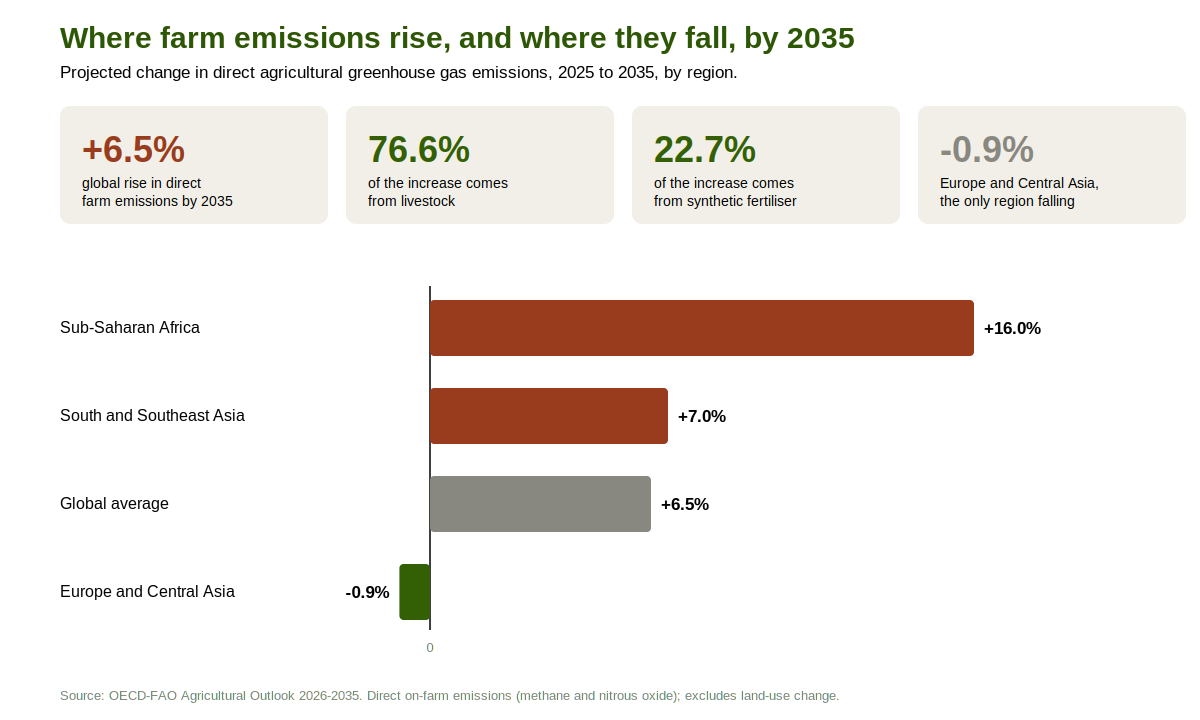
Ruminant and other livestock production is projected to generate 76.6% of the global increase in direct agricultural emissions to 2035. Synthetic fertiliser follows at 22.7%, through nitrous oxide released after application. The split matters for anyone deciding where mitigation effort should go, because it points squarely at animal agriculture rather than at crops as the main source of the coming rise.
Cattle and other ruminants dominate that livestock share because of enteric fermentation, the digestive process that produces methane, together with the methane and nitrous oxide from managing manure. Rice, often assumed to be a large and growing methane source, is expected to contribute relatively little to the increase, because the projected growth in rice output comes mainly from higher paddy yields rather than expanded flooded area. One accounting caveat sits underneath the fertiliser figure. The Outlook counts only the nitrous oxide released in the field, not the emissions from manufacturing the fertiliser itself, and including that upstream stage would roughly double the footprint attributed to fertiliser use.
The map of the increase runs through Africa and South Asia
Emissions do not rise evenly across the world. Direct agricultural emissions are projected to climb 16.0% in sub-Saharan Africa and 7.0% in South and Southeast Asia by 2035, driven by expanding ruminant herds. Over the same period, emissions in Europe and Central Asia are projected to fall 0.9%, continuing a decline of 3.4% in the previous decade that reflects environmental policy and structural change in the sector.
Sub-Saharan Africa illustrates why raw herd size can mislead. The region has more than three times the population of North America and more than three times the beef cattle, yet output per animal is only about a tenth of the North American level. On paper, concentrating mitigation on low-productivity herds looks efficient, since fewer, more productive animals could produce the same food with less methane. The report cautions against reading it that simply. Much of the region's ruminant production is pastoralist, moving herds in response to seasonal forage in a way that supports rangeland health, conserves hardy indigenous breeds and sustains livelihoods that few alternatives could replace. Cutting emissions there means better animal health, lower losses and improved grazing management rather than intensification built on more water and imported feed, which would trade one environmental problem for another.
What actually brings the total down
Falling intensity is not the same as falling emissions, and the gap between them is where policy has to work. The largest intensity improvements are expected in sub-Saharan Africa and South Asia, precisely because systems that start with high emissions per unit have more low-cost room to improve than high-yield systems where the easy gains are already banked. That is encouraging for efficiency, but it does not by itself reverse the absolute rise.
Closing that gap depends on tools that raise output per animal without expanding the herd. Better feeding, health and breeding do much of this work, and the report frames improved productivity as the main lever. Targeted options add to it, including feed additives that suppress enteric methane directly. Compounds such as 3-NOP, a feed additive that cuts cattle methane, can lower emissions while keeping productivity intact, and the wider set of on-farm measures is set out in a practical guide to reducing ruminant methane. Where mitigation carries a cost, carbon credits tied to sustainable practices can help fund the change, for example by capturing methane from manure through anaerobic digestion.
The report closes with a reminder that direct emissions are one dimension of sustainability, not the whole of it. Water use, soil health, biodiversity and the sector's capacity to store carbon all belong in a full account, as does the demand side, since high consumption of animal products in wealthy economies drives a large part of global agricultural emissions. The 6.5% figure sets the scale of the task. Whether the decade ends closer to that number or below it depends on how fast productivity gains and targeted mitigation can outrun the growth in herds and fertiliser that is otherwise built into the projections.
Sources
- OECD/FAO. (2026). OECD-FAO Agricultural Outlook 2026-2035. OECD Publishing, Paris and FAO, Rome.