


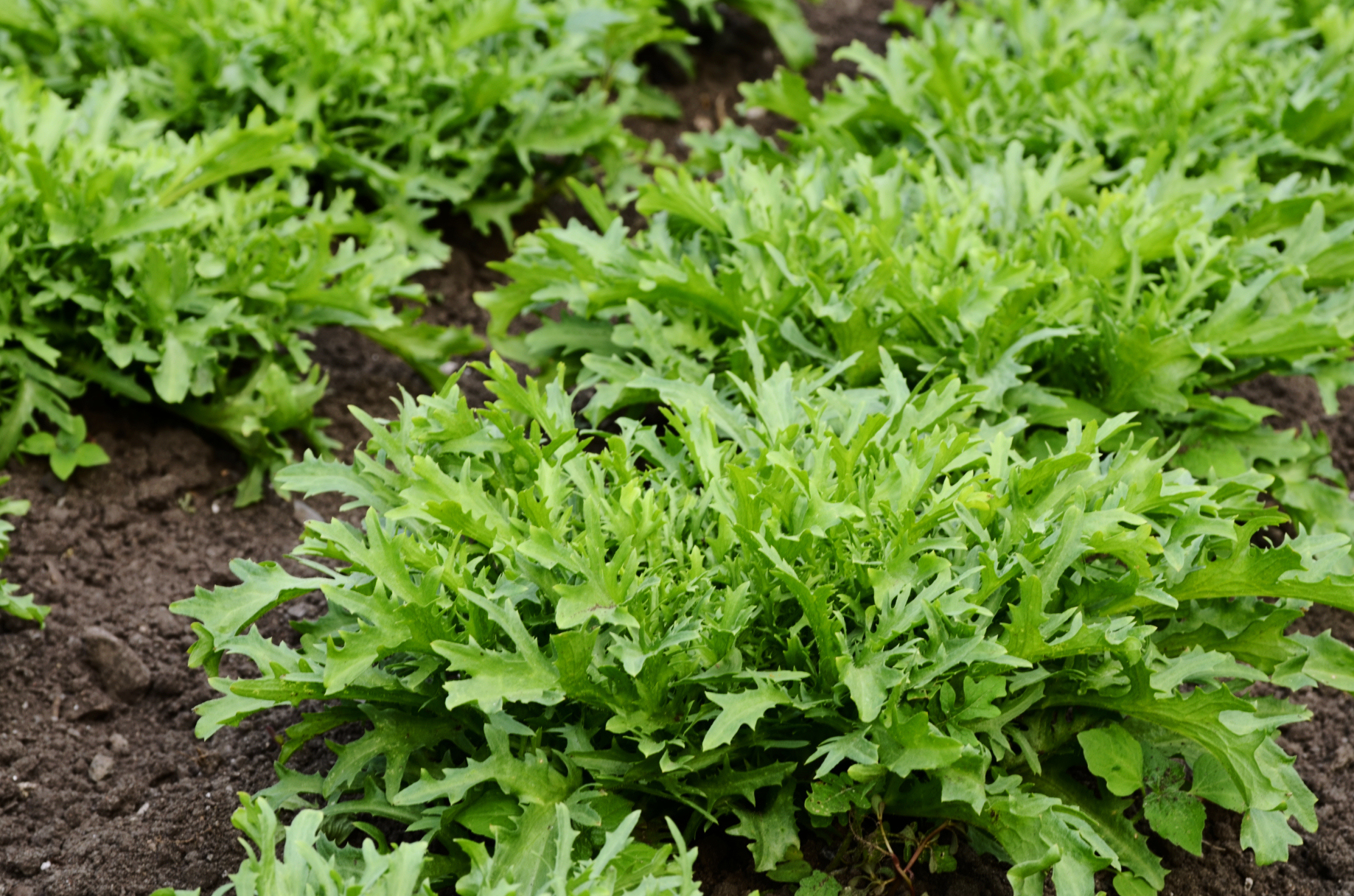
Endive (and escarole) is a biennial salad green that, in most cases, is treated as an annual crop. The scientific name of endive is Cichorium endivia, a member of the Asteraceae family. Many people are wondering about the difference between endive and escarole. The truth is that endive and escarole (var. latifolia) are different forms of the same plant. Escarole has broad leaves with smooth margins and a mild flavor. Endive has frilly-cut leaves and a bitter aftertaste.
The plant is native to the south of Asia (India) or the Mediterranean. The leaves can be consumed either raw or cooked.
Endives generally grow from a large rosette at 10-15 cm (4-6 inches) height, while when the plants enter the regenerative phase, they can produce an erect stem (50-150 cm or 20-60 inches tall). The plant resembles lettuce, but it tastes differently (bitter). The plant's root system consists of a deep central root that goes up to 1 m (3.3 feet) deep and many peripheral roots. The flowers are developed in clusters (1 to 5 flowers), and the flower stem can grow up to 1 m (3.3 feet) in length.
It is a dioecious plant; this means it has the male and female reproductive organs in separate individual plants. While the flowers are self-pollinated, the yields can be maximized with cross-pollination that is facilitated by bees and the air. Endive's flowers (blue-purple color) open early in the morning and wither a few hours later. The plants can be propagated either by seeds (usually) or by pieces of roots. The endive seeds (achenes) are light grey-brown and elongated with short bristles at the wider end.
Endive is considered to be a low-demanding crop. It is a tolerant plant to both relatively high and low temperatures. For this reason, the crop can be cultivated in many different environments or regions (from the tropics to temperate areas) (USDA hardiness zones 4-9). For optimum germination, the soil temperature should be around 20-24°C (68-75°F), while for maximum plant growth and best quality, endive needs an average daily temperature of 15-18°C (59 - 64°F) and full sun (some shade may be tolerated). Long days and cold temperatures can stimulate flowering. However, numerous bolt-resistant cultivars with shorter growth cycles are available in the market, suitable for endive cultivation in colder areas. The plants thrive when grown at an altitude of 500 m or more.
Endive Types and Variety Selection
There are two different types of endive (C. endivia):
- the curly endive (frisée or chicory), C. endivia var crispum and
- The broad-leaved (or flat-leaved) endive or escarole (or scarole), C. endivia var latifolia
While some include the Belgian endive (witloof chicory, leaf chicory, radicchio or radichetta) as a type of endive, the Cichorium intybus var. foliosum is considered a separate species, with many similarities, though, with C. endivia. The Belgian endive is more popular in Europe (France, Belgium, Netherlands), while recently, its consumption has expanded into new areas like the USA and Japan. Cichorium intybus var. foliosum is one of the three cultivar groups of Cichorium intybus: the witloof, the root chicory, and the leaf chicory.
All types are relatively resistant to cold (since they are cool-season vegetables) and can be cultivated from autumn or winter through spring, depending on the local conditions. Keep in mind that young plants are sensitive to frost. Specifically, farmers who want to cultivate endive and escarole in warmer areas or/and during spring and summer should select heat-resistant and bolting tolerant (or sloe-bolting) varieties. Furthermore, in regions-fields with known leaf disease history, the growers are advised to plant broad-leaved (or flat-leaved) endive that hold less water at their leaves and, as a result, are less prone to infections than the curly endive. Finally, the trends and the demand of the local market should also be considered when selecting a type or variety of endive.
Further Reading
10 Interesting Facts about Endive and Escarole
Endive and Escarole: Health Benefits and Nutritional Value
Endive & Escarole Plant Information and Environmental Requirements
How to Grow Endive (and Escarole) at Home
How to Grow Endive -Escarole for Profit
Endive (and Escarole) Soil Requirements, Preparation and Planting
Endive and Escarole Water Requirements & Irrigation Systems
Endive and Escarole Fertilization Requirements
Endive and Escarole Blanching, Yield, Harvest and Storage
Endive and Escarole Pests and Diseases
References
- Feature Vegetables: Endive
- Vegetables: Endive — UF/IFAS Gardening Solutions
- Exploration of genetic diversity within Cichorium endivia and Cichorium intybus with focus on the gene pool of industrial chicory — Genetic Resources and Crop Evolution
- Growing Lettuce Endive and Radicchio — University of Minnesota Extension
- Vegetable Growing Guides — Cornell Home Gardening
- Overview of Witloof Chicory (Cichorium intybus L.) Discolorations and Their Underlying Physiological and Biochemical Causes — Frontiers in Plant Science
- Endive and Escarole — Oregon State University
- Vegetable Growing Guides — Cornell Home Gardening