Over 1 billion hectares of agricultural land are degraded. Cities swallowed 24 million hectares of some of the most productive cropland in just two decades. And conservation agriculture has been expanding at more than 10 million hectares per year, reaching 205 million hectares globally by 2019.
Three processes, one resource. Two of them destroy it. One rebuilds it. All the data here comes from FAO's 2025 SOLAW report unless noted otherwise.
1,660 million hectares of degraded land
To put that number in perspective: 1,660 Mha is larger than Russia. More than 10% of the planet's land surface has been degraded by the way we use and manage it.
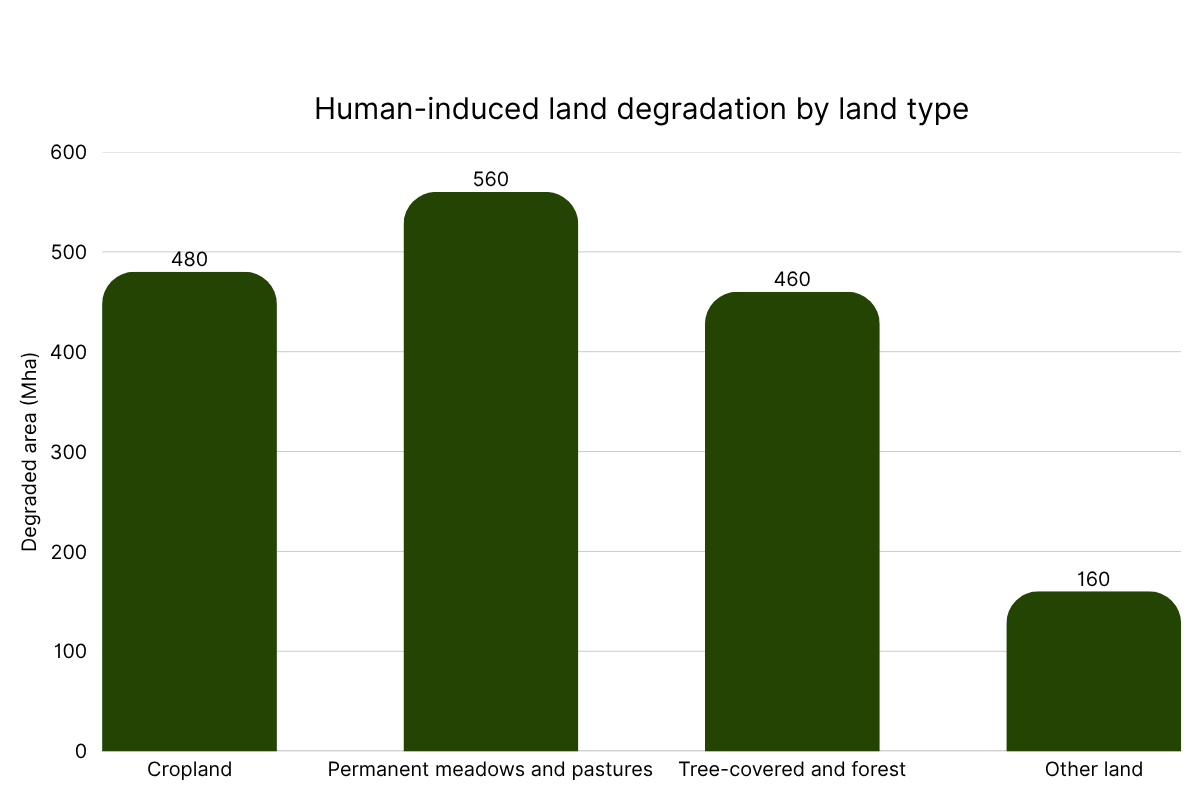
Cropland takes the biggest hit among agricultural categories: 480 Mha, with nutrient depletion, organic carbon loss, soil erosion and salt buildup as the main culprits. Pastures and meadows follow close behind at 560 Mha, mostly from overgrazing and invasive species. Add them up: over 60% of all human-induced land degradation is happening on agricultural land.
The UNCCD gives an even bleaker picture, estimating 52% of all agricultural land globally as degraded.
What happens to a farm when the soil breaks down
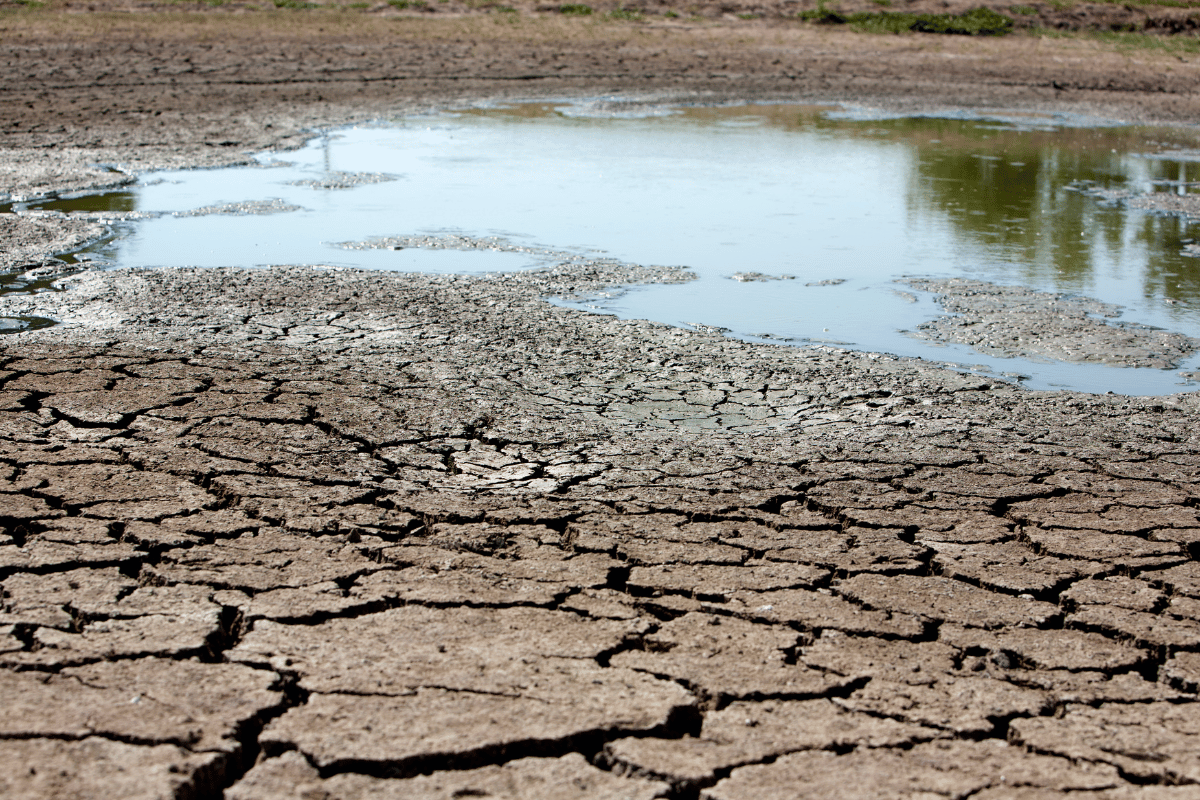
Think of healthy soil as a sponge. It absorbs rain, holds moisture for roots and releases water slowly. Now picture that sponge compressed, crusted over, stripped of its organic matter. Eroded soils can lose up to 90% of their ability to absorb water. Ninety percent. A field that used to soak up heavy rain now floods after a moderate rain, and the following dry week becomes a drought because the root zone holds almost no water.
That scenario is already playing out across roughly 128 Mha of rainfed cropland and 656 Mha of pastureland that frequently experience drought. In the 2022-2023 biennium, droughts affected 1.84 billion people across more than 100 countries. Salinization alone has damaged 82 Mha of rainfed cropland and 24 Mha of irrigated land.
Nutrient imbalances on both ends
Here's the thing about nutrient management: globally, we use 35% more fertilizer than in 2001. Yet the soil in many of the places that need it most keeps getting poorer.
In sub-Saharan Africa and South Asia, farmers pull out more nutrients with every harvest than they put back. Crop residues are burned or removed rather than returned to the soil. Season after season, the balance tips further into deficit. On the other side of the world, parts of East Asia and Western Europe dump nitrogen far beyond what crops can absorb, which pollutes groundwater and acidifies soils.
Pesticides tell a similar story of excess. Usage is up 60% since 2001, averaging 2.4 kg per hectare of cropland globally. Some countries apply six times that average. An estimated 64% of agricultural land is at risk of pesticide pollution.
Cities destroyed 24 million hectares of the best farmland in 20 years
Degradation eats land from within. Urbanization eats it from the outside. Between 1992 and 2015, the world's urban areas more than doubled, from 33 Mha to 71 Mha. In the process, they consumed 24 Mha of some of the most fertile cropland on Earth, plus 3.3 Mha of forest and 4.6 Mha of shrubland.
Let's be honest about why: the best agricultural land and the most desirable urban sites are the same land. Flat terrain, alluvial soils, near water, close to existing settlements. A city planner and a farmer look at the same valley floor and see very different futures for it. Without land-use planning that prices in agricultural value, the city wins every time.
Bioenergy piles on. Production is up more than 50% since 2000. Biodiesel consumption in 2023 was 2.5 times its 2010 level. Cash crops for export markets take another slice. Each use is legitimate on its own. Stacked together, they squeeze the land available for food production from every angle.
205 million hectares of conservation agriculture and growing
Now for the part of this story that actually runs in the other direction. Conservation agriculture (CA) has been growing steadily and has real, measured results at scale.
CA rests on three legs: minimum tillage, permanent soil cover and crop rotation. In 2015-2016, it covered 180.4 Mha (12.5% of global cropland). Three years later, 205.4 Mha (14.7%). The expansion rate has held above 10 Mha per year since 2008-2009.
What does that actually deliver?
- Erosion drops by half compared with conventional tillage. Remember that sponge analogy? Halving erosion is how you start putting the sponge back together.
- Yields climb 15 to 25% in Southern Africa, where CA has been widely adopted. Those gains come from better water retention, improved soil biology and reduced nutrient loss.
- Water infiltration improves because undisturbed soil keeps its pore structure intact. For rainfed systems in drought-prone areas, that extra stored moisture can be the difference between a harvest and a failed season.
- Soil organic carbon builds over time as residues decompose on the surface rather than being burned. More carbon means better structure, more biological activity, and stronger water-holding capacity. The improvements compound.
All three legs or it falls over
One thing CA often gets wrong: growers adopt zero tillage alone and expect results. Skip the soil cover or the rotation, and you get no yield improvement and no carbon gain. The three practices reinforce each other. Reduced tillage preserves structure. Cover protects the surface. Rotation breaks pest and disease cycles while feeding soil biology.
Some growers see a yield dip in the first season, especially in colder climates, where surface residue delays soil warming in spring. Starting with a small trial plot makes sense. Pairing CA with legume rotation or intercropping helps manage that transition.
Drought-tolerant varieties and rainwater harvesting
CA fixes the soil side. Water needs its own answers.
Drought-tolerant crop varieties have measurably increased yields and reduced crop failure rates in Africa's drier regions. Drought-tolerant maize in particular has delivered documented gains where it has been introduced. In Ethiopia, rainwater harvesting systems have increased yields during dry seasons. For the 128 Mha of rainfed cropland that regularly face drought, capturing rain when it falls is often more realistic than building irrigation infrastructure. Simple soil and water conservation structures can be the first step.
Putting the numbers side by side
The losses: 1,040 Mha of agricultural land degraded. Urban areas consumed about 1.7 Mha of land per year between 1992 and 2015, with 24 Mha of that from prime cropland.
The gains: conservation agriculture has been adding over 10 Mha of better-managed land per year. Erosion has been cut in half. Yields are up 15-25% and are being adopted at scale.
CA works on land already in production. It reverses degradation where it is applied. The 50% erosion reduction and 15-25% yield increase in Southern Africa are measured at scale, over multiple seasons.
The gap between 205 Mha under CA and 480 Mha of degraded cropland is still enormous. Closing it requires seed access, advisory support, functioning input markets, and policies that reward keeping soil healthy over the long term. The practices exist. The results are proven. Getting them onto the other 275 Mha is the hard part.
References
- FAO. 2025. The State of the World's Land and Water Resources for Food and Agriculture 2025. Rome.
- FAO & IIASA. 2025. Global Agro-ecological Zoning version 5 (GAEZ v5) Model Documentation. Rome
- Pittelkow, C.M. et al. 2015. Productivity limits and potentials of the principles of conservation agriculture. Nature, 517: 365-368.