

At the Athens Central Market the most frequent wholesale price of chestnuts was €3.50 per kilo in the bulletins of 2, 3 and 5 November 2026, while on the same days of 2025 it was €4.50, so this year's price is 22.2% lower, according to a Wikifarmer analysis of the OKAA price bulletins. At the Central Market of Thessaloniki the price moved the other way, at €4.50 per kilo from 23 October to 2 November, against €4.30 in the same period of 2025, while Greek chestnut exports reached 2,990 tonnes in the 2025/26 season, 47.3% more than in the previous season, according to Eurostat data.
In Athens the price fell from €4.00 to €3.50 in the first week of the season
Chestnuts appeared this year in the OKAA price bulletins on 12 October, at €4.00 per kilo, the same as on 13 October. On 15 October the price was €3.80, and from 19 October to 5 November it stayed at €3.50 in every bulletin. Last year the price was €4.00 in every bulletin from 9 to 30 October and rose to €4.50 from 3 November, where it stayed through November and December. The average October price was €3.66 per kilo this year, against €4.00 in October 2025 and October 2024 and €2.92 in October 2023.
In November and December the average price was €3.46 per kilo in 2020, €3.82 in 2021, €3.15 in 2022 and €3.67 in 2023, before rising to €4.50 in 2024 and 2025. The current price of €3.50 is therefore close to the levels of 2020 to 2023. In the three seasons with prices from October, 2023, 2024 and 2025, the average November price was higher than the October price. Prices are in euros and are not adjusted for inflation.
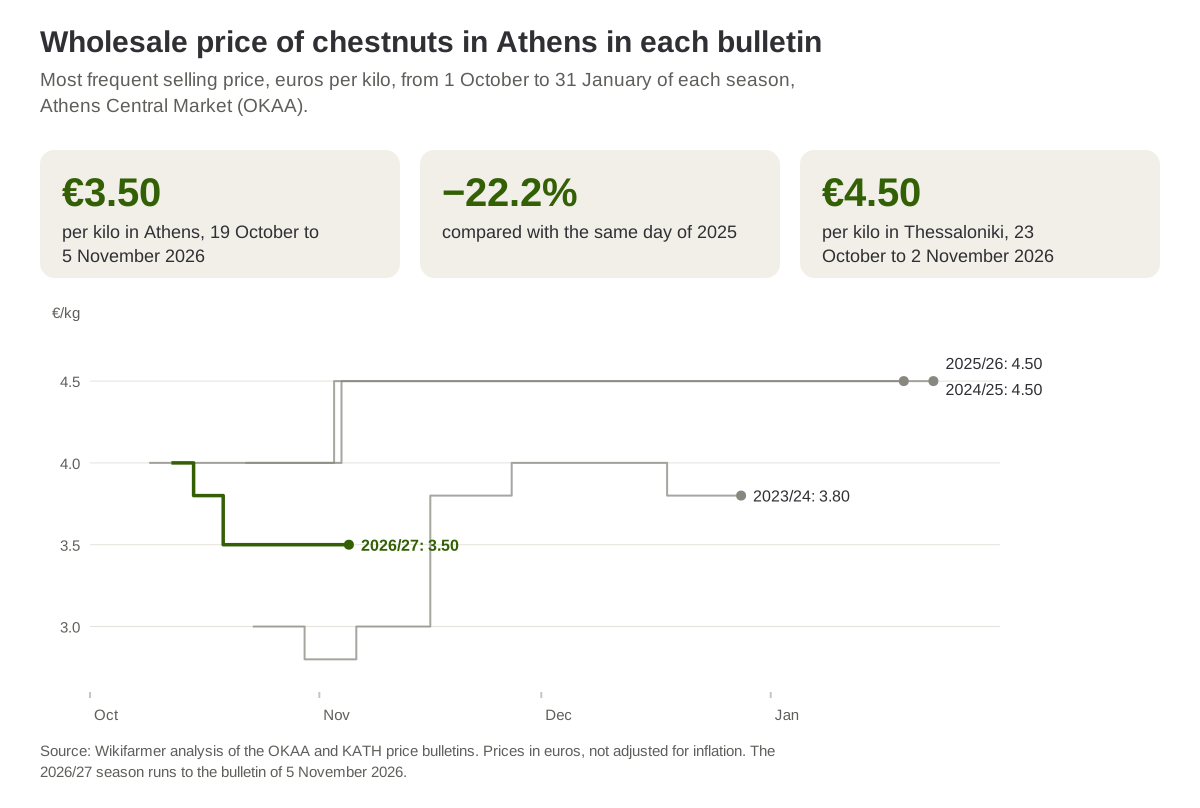
Source: Wikifarmer analysis of the OKAA and KATH price bulletins. The 2026/27 season runs to the bulletin of 5 November 2026.
In Thessaloniki the price is 20 cents higher than last year
At the Central Market of Thessaloniki (KATH) chestnuts appeared in the bulletins this year on 23 October, as in 2024, while in 2025 they appeared on 20 October. The dominant price was €4.50 per kilo in all five bulletins up to 2 November 2026, against €4.30 in every bulletin from 23 October to 3 November 2025 and an average of €4.29 in the same period of 2024. On 2 November 2026 the market offered 19.7 tonnes of chestnuts, against 22.4 tonnes on 3 November 2025.
From October to December the average price in Thessaloniki was €4.38 per kilo in 2024 and €4.24 in 2025. The two markets report different kinds of price, to the nearest ten cents, so the gap in level between them carries little weight, while the change within the same market from year to year shows how the price is moving.
In Madrid the September price was 15.5% lower than last year
At Madrid's central wholesale market, Mercamadrid, the average price of chestnuts in September 2026, the first month of the season, was €3.54 per kilo, 15.5% lower than the €4.18 of September 2025, with 275 tonnes on the market against 109 tonnes. From October to December the average price, weighted by the quantities sold, was €3.61 per kilo in 2023, €4.06 in 2024 and €4.39 in 2025. Mercamadrid's chestnuts from October to December 2025 came mainly from the provinces of Ávila, with 43.3% of the quantity, Toledo, with 23.3%, and Cáceres, with 19.0%.
Greek chestnut exports rose in the 2025/26 season at a lower average value
From September 2025 to August 2026 Greece exported 2,990 tonnes of chestnuts in shell, 47.3% more than the 2,029 tonnes of the 2024/25 season, according to Eurostat's Comext foreign trade database. The value of exports was €7.26 million and the average declared value €2.43 per kilo, 14.5% lower than the €2.84 of the previous season. From the 2014/15 to the 2022/23 season exports ranged from 3,317 to 4,362 tonnes, then fell to 2,590 tonnes in 2023/24 and to 2,029 tonnes in 2024/25, the smallest quantity of any season since 2014/15.
Italy took 39.5% of exports in the 2025/26 season, with 1,181 tonnes, followed by Albania with 20.7%, Germany with 14.6% and Serbia with 6.3%. The average declared value of exports to Italy fell from €3.38 to €2.67 per kilo and to Germany from €4.41 to €4.13, while exports to Albania were declared at €0.62 per kilo in both seasons. October accounts for about two thirds of each season's exports, between 62% and 65% in the last four seasons, so the picture for the 2026/27 season will show in the October data.
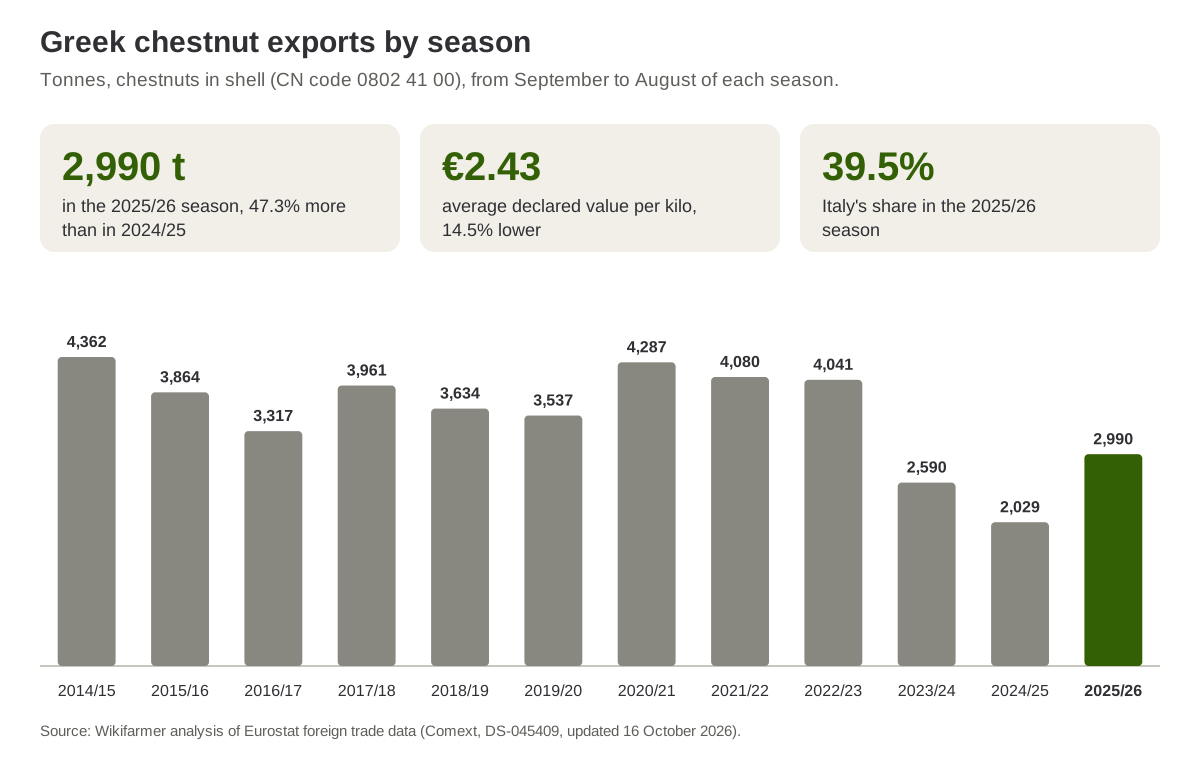
Source: Wikifarmer analysis of Eurostat foreign trade data (Comext, DS-045409, updated 16 October 2026), CN code 0802 41 00. Seasons run from September to August.
The prices matter to chestnut growers and wholesale buyers
In Athens the wholesale price of chestnuts in early November is lower than in the two previous seasons, while in Thessaloniki it is slightly higher than last year. The picture matters to chestnut growers who sell through the central markets of Athens and Thessaloniki, to the exporters who ship chestnuts mainly to Italy, and to the traders and shops that buy wholesale. For another autumn product, apple prices at the packing station were lower than last year this autumn in most EU countries.
In the coming weeks the OKAA and KATH bulletins will show whether the price in Athens rises in November, as it did in the three previous seasons, and Eurostat's October data, published in mid-December, will show how many chestnuts Greece exported at the start of the season. For fruit that comes onto the market at the same time of year, citrus prices fall from November to Christmas in most years.
The four sources measure different things
The analysis is by Wikifarmer, based on the price bulletins of the Athens Central Market (OKAA, data from October 2020) and the Central Market of Thessaloniki (KATH, data from 21 August 2024), on Mercamadrid's monthly volume and price data from the City of Madrid's open data portal (2019 to September 2026) and on Greece's exports under CN codes 0802 41 00 (chestnuts in shell) and 0802 42 00 (shelled chestnuts) from Eurostat's Comext database (dataset DS-045409, updated 16 October 2026). OKAA gives the most frequent and KATH the dominant price of each bulletin, and each bulletin has a single price for chestnuts. The OKAA data cover about three bulletins a week, so "every bulletin" refers to the bulletins analysed. The KATH quantity is the quantity offered for sale. At Mercamadrid the price is the most frequent selling price from each origin, weighted by quantity, and chestnuts are recorded as domestic, with small quantities from China. Since 2022 Mercamadrid has recorded much smaller quantities of chestnuts, which appears to reflect a change in how it records data, so quantities before and after 2022 are not compared. Export seasons run from September to August, and the average value is declared value divided by declared quantity. Shelled chestnuts were only 104 tonnes in the 2025/26 season and are not included in the totals. Prices are not adjusted for inflation, and the analysis does not examine the causes of the changes. All figures were recomputed independently from the original files. They describe what prices did and are not a forecast.
Sources
- Central Markets and Fisheries Organisation (OKAA). (2026). Price bulletins (in Greek).
- Central Market of Thessaloniki (KATH). (2026). Fruit and vegetable price bulletins (in Greek).
- Eurostat. (2026). International trade in goods, Comext database (DS-045409), updated 16 October 2026.
- Ayuntamiento de Madrid. (2026). Mercamadrid, volumen y precio de productos comercializados. City of Madrid open data portal.