
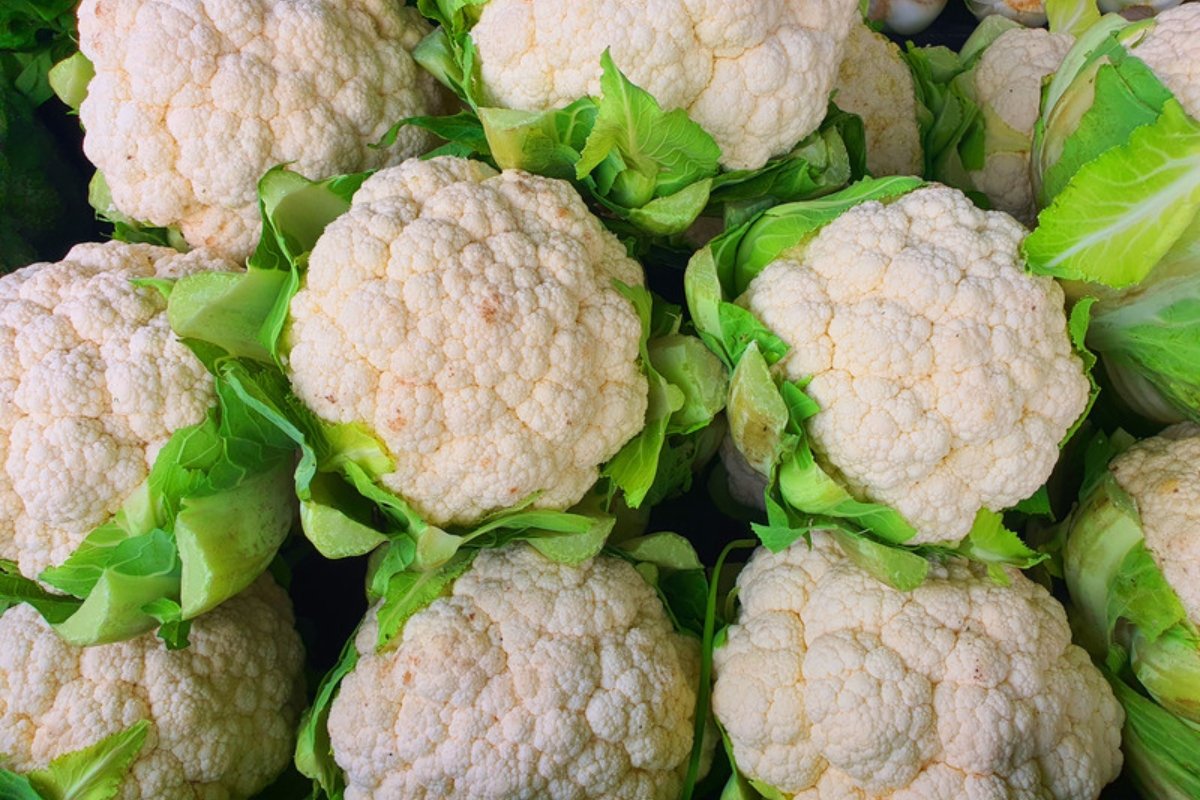
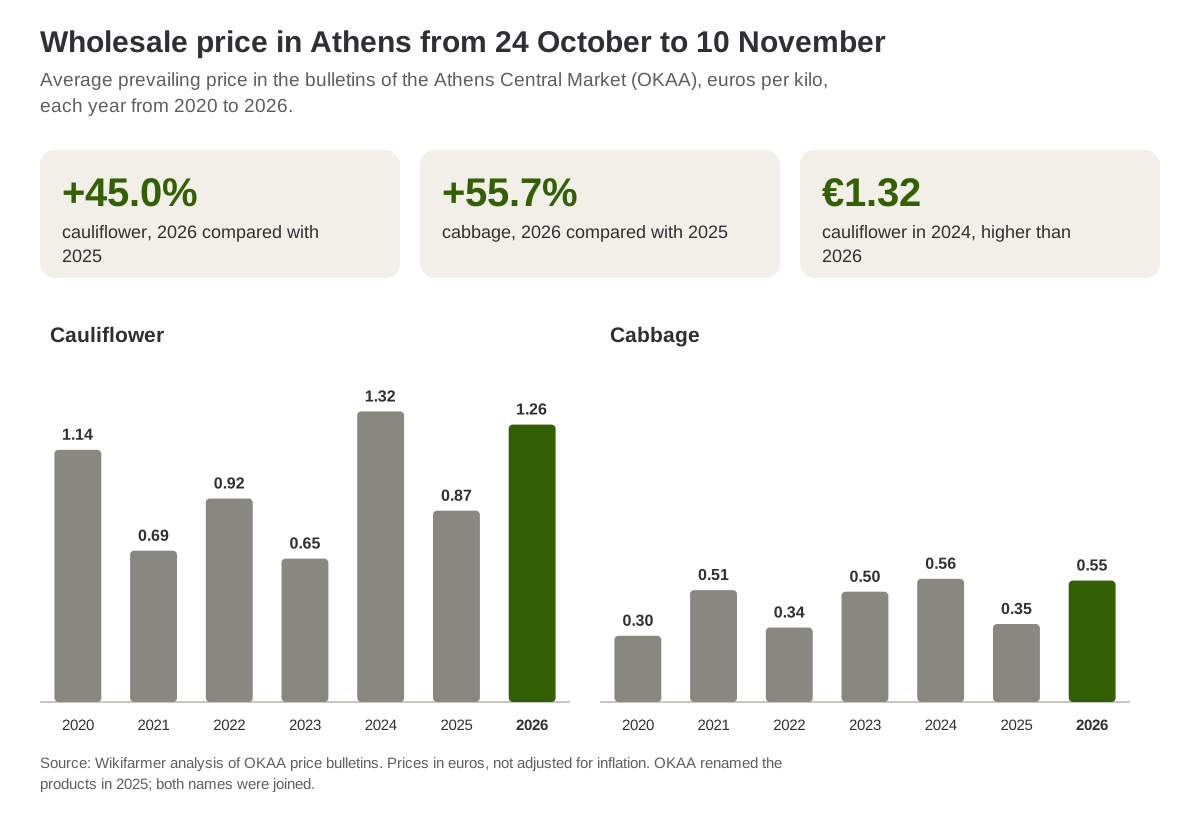
At the Athens Central Market the price of cauliflower averaged €1.26 per kilo from 24 October to 10 November 2026, 45.0% higher than in the same weeks of 2025 and slightly lower than in 2024, according to a Wikifarmer analysis of the price bulletins of the Athens Central Market (OKAA) and the Thessaloniki Central Market (KATH). Over the same weeks the cabbage price was 55.7% higher than last year and almost the same as in 2024, while in Thessaloniki the prices of cauliflower, cabbage, broccoli and leeks were between 11.7% and 35.3% higher than last year from 15 to 31 October. Both markets print last year's price next to today's in their bulletins, and a comparison of a single day often shows a much bigger rise than a comparison of whole weeks.
In Athens cauliflower and cabbage prices are the second highest since 2020
In the OKAA price bulletins the prevailing price of cauliflower from 24 October to 10 November averaged €1.14 per kilo in 2020, €0.69 in 2021, €0.92 in 2022, €0.65 in 2023, €1.32 in 2024, €0.87 in 2025 and €1.26 in 2026. This year's price is the second highest of the seven years after 2024, and the same holds for cabbage, whose price was €0.30 in 2020, €0.51 in 2021, €0.34 in 2022, €0.50 in 2023, €0.56 in 2024, €0.35 in 2025 and €0.55 per kilo in 2026. Both prices fell in 2025 and returned this year close to the level of 2024. Of the years before 2024, only 2020 came close to this year's cauliflower price, while for cabbage 2021 and 2023 were slightly lower, at €0.51 and €0.50.
Leeks appear in the OKAA bulletins in these weeks only in 2022, in three bulletins, in 2025 and in 2026, so this year's leek price, €1.23 per kilo, can only be compared with last year's €0.95, and it is 29.3% higher. Broccoli is not listed in the OKAA bulletins from the start of October to 10 November 2026. Earlier, from mid-September to mid-October, aubergine, tomato and pepper prices in Athens were far above last year.
Source: Wikifarmer analysis of OKAA price bulletins. Prices in euros, not adjusted for inflation.
The gap with last year opened when the 2025 cauliflower price fell in late October
From 2 to 23 October 2025 cauliflower sold in Athens for between €1.10 and €1.40 per kilo, and on 20 October 2025 the price was €1.40, the same as in the first bulletin of this season to list it, on 19 October 2026. Last year the price then fell to €1.00 on 27 October, €0.90 on 30 October and €0.80 from 4 November, while this year it stayed between €1.20 and €1.30 in every bulletin from 20 October to 10 November. The rise from last year therefore depends on which days are compared. If each 2026 bulletin from 15 October is compared with the bulletin of the same weekday a year earlier, the cauliflower price is 29.3% higher, cabbage 51.8% and leeks 27.3%. For cabbage the gap was there throughout, as this year's price was between €0.50 and €0.55 in every bulletin from 15 October, against €0.32 to €0.40 from 16 October to 10 November 2025.
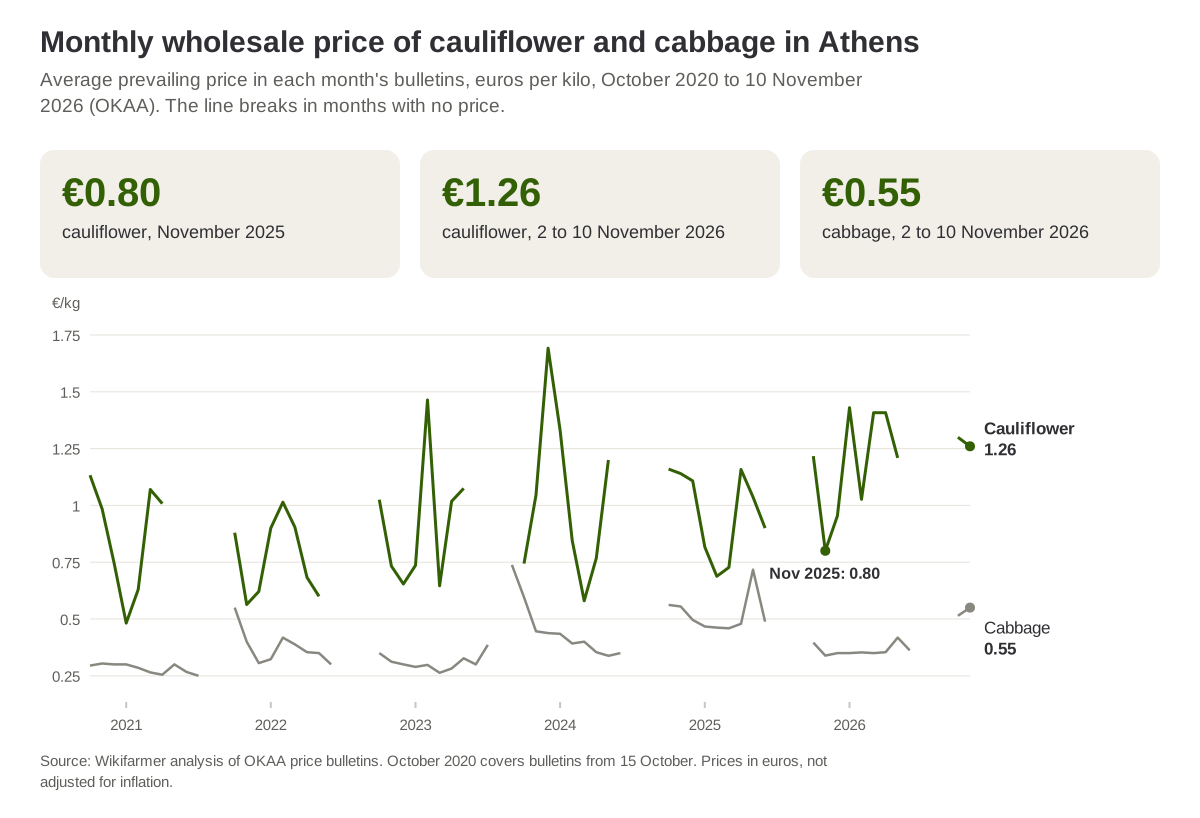
Source: Wikifarmer analysis of OKAA price bulletins. The line breaks in months when the product is not listed in the bulletins, usually June to September for cauliflower.
In Thessaloniki prices rose between 12% and 35% from last year
In the KATH price bulletins the dominant price of cauliflower from 15 to 31 October averaged €1.59 per kilo in 2026, 35.3% higher than in 2025, when it was €1.18, and slightly above 2024, when it was €1.57. The leek price was €1.24, 14.5% higher than last year and the highest of the three years with data. The cabbage price, €0.40, was 18.5% higher than last year but well below the €0.61 of 2024, and the broccoli price, €1.48, was 11.7% higher than last year and below the €1.53 of 2024.
From 1 to 19 October 2026 the cauliflower price in Thessaloniki was between €1.90 and €2.00 per kilo, higher than in any October bulletin of 2024 or 2025, and the broccoli price was between €1.75 and €2.00. Both prices then fell, to €1.40 and €1.10 on 30 October, before rising again to €1.70 and €1.60 on 2 November, in the latest bulletin KATH had posted on its website by 11 November.
A one-day comparison with last year shows a bigger rise
In the KATH bulletin of 2 November 2026 cauliflower is priced at €1.70 per kilo, with last year's price of €0.90 printed next to it, a rise of 88.9%. That comparison falls on a day when this year's price had just risen from €1.40 and last year's was at its lowest October level, while over the whole period from 15 to 31 October the average price is 35.3% higher. The same applies to cabbage in the same bulletin, at €0.45 against €0.30, or 50.0% up, against 18.5% for the second half of October.
The last-year price printed in the bulletins almost always matches the bulletins of a year earlier, of the same weekday at OKAA and of the same date at KATH, so the difference comes from a single day not standing for whole weeks of prices that change often.
Cauliflower prices also rose from last year in Spain and Portugal
In the weekly prices that member states report to the European Commission, the price of cauliflower leaving the packing station from 28 September to 25 October 2026 was 31.7% higher than last year in Greece, 21.7% higher in Spain and 89.7% higher in Portugal. In Portugal, however, last year's prices were very low, €38.75 per 100 kilos on average, and this year's have been falling week by week. In Italy and Germany the price was slightly higher than last year, by 2.3% and 5.0%, while in France it was 5.9% and in Belgium 8.6% lower, so the largest rises were recorded in Greece, Spain and Portugal.
The prices matter to vegetable growers and wholesale buyers
Wholesale prices matter to growers of cauliflower, cabbage, broccoli and leeks who sell through the central markets, to those planning commercial cauliflower farming and the next plantings, and to the traders and shops that buy from the markets. The comparison with last year shows a large rise because prices in 2025 were lower than in 2024 and lower than this year, while against 2024 only Thessaloniki leeks have a clearly higher price.
The next OKAA and KATH bulletins will show whether the cauliflower price in Athens stays at €1.20 or higher, after averaging €0.95 per kilo in December 2025, and the European Commission's prices for the November weeks will show whether the rise in Spain continues.
The markets and the EU data report different kinds of price
The analysis is by Wikifarmer, based on the daily price bulletins of the Athens Central Market (OKAA, data from 15 October 2020) and the Thessaloniki Central Market (KATH, data from 21 August 2024), and on the weekly fruit and vegetable prices that member states report to the European Commission (Agri-food Data Portal). In 2025 OKAA renamed the products in its bulletins, from «Κουνουπίδια» to «Κουνουπίδι» and from «Λάχανα» to «Λάχανο», while leeks also appear as «Πράσσα» or «Πρασσα», and the names were joined. The average prices are averages of the bulletins that list the product in each period, six to nine bulletins a year in Athens for cauliflower and cabbage and ten to twelve in Thessaloniki. The periods were chosen so that every year has data, 24 October to 10 November for Athens and 15 to 31 October for Thessaloniki, and because prices change within a few weeks, a different period gives a different rise. Bulletin prices are usually rounded to five or ten cents, so small differences carry little weight. The EU comparison uses weeks 40 to 43 of 2026 and 2025, only those present in both years, which for Greece means weeks 41 to 43. Packing-station prices are a different kind of price from the wholesale prices of the central markets and are compared only as percentage changes. Prices are not adjusted for inflation, and the analysis does not examine the causes of the rise. All numbers were recomputed independently from the original files. The figures describe what prices did and are not a forecast.
Sources
- Central Markets and Fishery Organisation (OKAA). (2026). Statistical price bulletins (in Greek).
- Thessaloniki Central Market (KATH). (2026). Fruit and vegetable price bulletins (in Greek).
- European Commission, DG Agriculture and Rural Development. (2026). Agri-food Data Portal, API guide. European Commission.