How regenerative orange groves help fight climate change
The global call to address climate change has become an urgent priority as global warming continues to rise due to increasing anthropogenic carbon emissions. While agriculture is often viewed as part of the problem through its contribution to greenhouse gas emissions, it also holds significant potential to be part of the solution. Among the most promising players are evergreen crops like citrus trees, which have shown a remarkable ability to absorb and store atmospheric carbon.
The climate potential of citrus farming
Recent studies have highlighted promising insights in the Mediterranean region, where citrus ranks as the second-most cultivated food crop in Europe. A study conducted in Eastern Spain on Clementine mandarin trees, which are managed under typical farming practices such as drip irrigation, has revealed that these citrus plantations act as significant carbon sinks by capturing around 10 metric tons of carbon per hectare each year. Most of this carbon was absorbed through the leaves, while fruit harvest and soil respiration losses remain comparatively low. The study also showed that each mature tree stores between 55 and 66 kilograms of carbon, with annual growth in branches, leaves, and fruit contributing significantly to carbon uptake.
The concept of carbon-negativity in citrus farming
Carbon-negative oranges come from a citrus plantation that not only offsets all their greenhouse gas emissions but also removes more carbon dioxide from the atmosphere, which is more than they release. This results in a net negative carbon footprint, which helps fight climate change. This net carbon fixation is mainly driven by tree leaves that perform photosynthesis and absorb large amounts of carbon dioxide. In fact, the orange leaves alone take in a large amount of carbon, around 15.4 metric tons per hectare each year, along with trees storing more than 50 kg of carbon per tree. On average, the whole orchard can lock away about 10 metric tons of carbon per hectare every year.
This approach includes three main strategies. The first one is carbon sequestration, which involves capturing atmospheric carbon dioxide and storing it in soils and plants through agroforestry, cover crops, no-till farming, biochar, and silvopasture. The second is emissions avoidance, which reduces farm-related emissions through decreased use of synthetic fertilizers, improved water and fuel efficiency, and the adoption of renewable energy. The third is carbon offsetting, which involves buying carbon credits. However, truly carbon-negative farms focus on actively removing carbon rather than just offsetting emissions.

Regenerative practices for carbon-negative citrus groves
Regenerative farming works by adding carbon to the soil and reducing its depletion. Common practices such as cover-cropping, composting, and no-till farming boost organic matter and strengthen soil structure. At the same time, biological processes like increasing biodiversity and incorporating agroforestry raise biomass inputs. Collectively, these create more stable soil aggregates and protective layers of organic matter that store carbon for many decades. Below are key regenerative practices and their specific roles in citrus farming systems that lead to carbon-negative citrus groves.
Cover crops and composting: Building soil carbon
Maintaining cover crops and managing spontaneous herbaceous vegetation are essential in regenerative citrus groves. These ground covers are not removed but mowed, allowing their organic matter to remain in place, continuously feeding the soil. The constant ground cover adds fresh organic matter, protects soil from erosion, and supports microbial life. Additionally, the use of organic compost contributes to increasing soil organic carbon, improves soil PH, strengthens nutrient cycling, and encourages beneficial microbial and soil fauna activity. Together, cover cropping and composting build healthier, more carbon-rich soil that contributes to long-term carbon storage.
Reducing soil disturbance: the no-till advantage
The regenerative citrus farm systems focus on minimizing soil disturbance by avoiding tillage and synthetic inputs. This low-disturbance approach helps preserve soil integrity and maintain higher levels of organic matter and soil carbon. This less soil disruption means a more stable and active biological community within the soil where enzymes and organisms play key roles in breaking down organic matter and recycling nutrients. These conditions are ideal for carbon sequestration which makes reduced tillage a crucial practice in transitioning to carbon-negative citrus groves.
Agroforestry integration: Mimicking natural systems
Agroforestry, a key feature of regenerative farming, involves planting native and exotic forest species within citrus rows. This careful integration and strategic spacing ensure that the system optimizes both fruit yield and environmental benefits. The trees contribute organic inputs like leaf litter and woody debris, which enhance soil carbon levels. This results in soils with higher soil organic carbon (8.36 dag kg−1) in the surface layer compared to organic and conventional systems. This also results in lower bulk density and better physical structure miming natural forest, helping groves move closer to a carbon-negative one.
Biodiversity and soil fauna: The hidden carbon helpers
Regenerative practices promote the presence of a diverse and rich mix of herbaceous species, soil microorganisms such as earthworms, fungi, and insects, and larger soil fauna. These organisms help bind soil particles to aggregates, which is essential for retaining and storing carbon in the soil. In biodynamic systems, the absence of pesticides and consistent synthetic inputs establishes an environment where soil fauna thrive. As a result, these systems enhance soil health, carbon storage, and ecosystem stability. These key steps produce carbon-negative citrus groves.
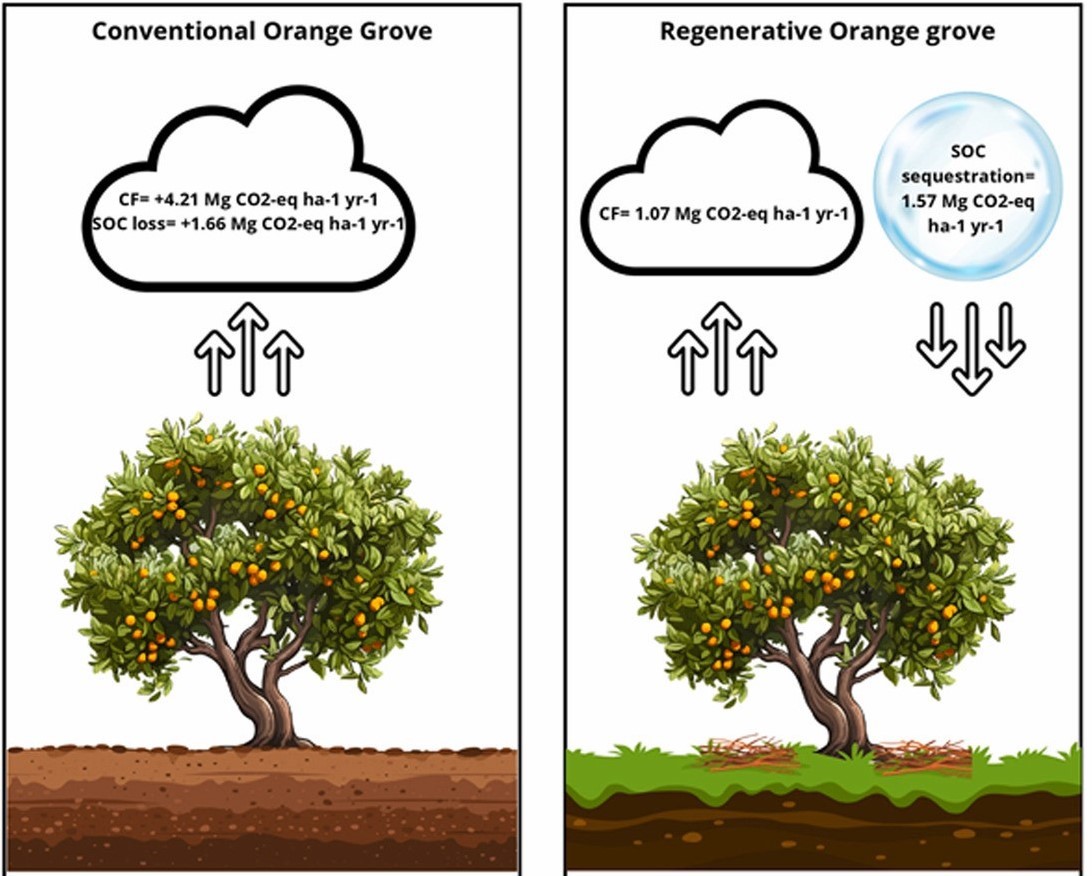
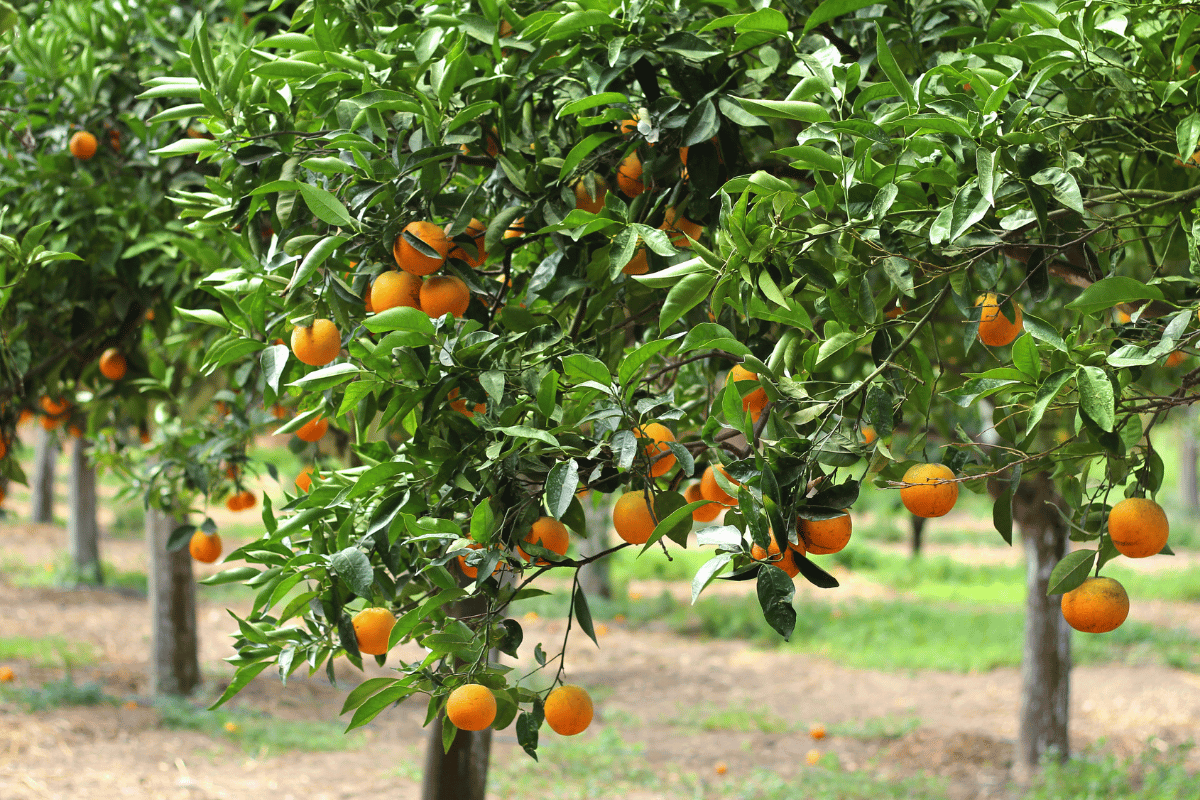
Figure: an orange grove in Sicily practicing regenerative agriculture (Cammarata et al., 2025).
Case studies: carbon-negative orange farming in Spain and Greece
Bollo Natural Fruit: A CO₂-neutral citrus farm in Spain
Bollo Natural Fruit is setting a powerful example in sustainable agriculture in Spain through its commitment to regenerative farming and renewable energy that contributes to nearly CO₂-neutral orange fruit. They grow orange and mandarin trees at their 'El Cerro' farm in Carmona, Seville, where they implement a natural, sustainable, and biodiversity-friendly farming model. This model is carefully designed to minimize the consumption of water, energy, and chemical inputs while maintaining a strong commitment to protecting the habitat and native species. A major pillar of Bollo Natural Fruit's carbon reduction strategy lies in its energy practices, emphasizing sustainability and self-sufficiency.
The company uses clean energy across its operations, continues to expand its reliance on renewable energy sources, and actively promotes operation with self-generated electricity for on-site use. This enables it to reduce reliance on external energy supplies and minimize its carbon footprint. These efforts have positioned Bollo Natural Fruit as a leader in climate-responsible agriculture. They are among the first to market fruits that are CO₂-neutral, which have achieved the ability to absorb 99% of their carbon emissions across all operations. According to Teresa González, Director of Sustainability, their practices at El Cerro are customized to support the surrounding ecosystem, positioning the farm as a regenerative agriculture model.
Southern Lights Farm: Regenerative orchard in Greece
The Southern Lights farm in Skala, Greece, founded by Sheila Darmos, is built on regenerative agriculture principles aimed at restoring ecosystems, enriching soil, and reducing the environmental impact of farming. Over 35 years, the land has been free of chemical fertilisers, pesticides, ploughing, and burning. The farm mimics a forest by growing layered fruits such as figs, mulberries, citrus, and berries, efficiently using sunlight and space while boosting biodiversity. The farm's soil is rich in mycelium, a fungal network that enhances nutrient absorption like natural forests. With more than 100 types of fruit grown in one space, the farm promotes a thriving environment for insects, birds, and small animals.
All organic matter, such as tree prunings, is left on the ground to enrich the soil and support microorganism habitats. This closed-loop, self-sustaining system reduces dependence on energy-intensive inputs and helps capture carbon naturally. While not officially labelled as “carbon-negative”, the approach supports carbon absorption and presents a promising example of sustainable agriculture in Southern Greece. The farm could earn more by selling its organic fruit in Germany, where demand and prices for ecological products are higher. Still, Sheila Darmos chooses to sell locally for ethical reasons. Nevertheless, the farm's achievements show that regenerative orchards can be productive and profitable.
Conclusion
The move toward carbon-negative citrus farming represents a powerful shift in how agriculture can address climate change. In places like Eastern Spain, clementine orchards absorb up to 10 metric tons of carbon per hectare annually. Farms like Bollo Natural Fruit, producing CO₂-neutral oranges, and Sheila Darmos's practice of pesticide-free operations for years prove that sustainability and profitability can go hand in hand. The regenerative practices, such as cover cropping, composting and agroforestry, help restore soil health and boost productivity. To scale this impact, support is required from policymakers, conscious consumers, and continued research into soil carbon storage. As more citrus groves adopt these methods, the orange tree becomes a clear symbol of how climate solutions can grow one grove at a time.
References
- Cammarata, M., Tadiello, T., Scuderi, A., Millar, N., & Basso, B. (2025, March 1). Regenerative practices can lead to carbon-negative orange groves in Sicily.
- WasteX. (2024, May 17). 5 Techniques to achieve Carbon-Negative Agriculture. WasteX.
- Pilon, L. C., Ambus, J. V., Blume, E., Jacques, R. J. S., & Reichert, J. M. (2023b). Citrus orchards in Agroforestry, Organic, and Conventional Systems: Soil quality and functioning. Sustainability, 15(17), 13060.
- Ortiz, N. (2024, February 15). Fruta limpia en carbono en una finca de Sevilla. Agrónoma ABC, Tu Portal De Noticias, Actualidad Y Precios Sobre Agricultura.
- Lambrechts, T. (2024, November 26). Regenerative Agriculture | A portrait in Greece. FoodUnfolded.
- Sicily: The Island of Orange Groves - Italy segreta. (2023b, June 5). Italy Segreta.