
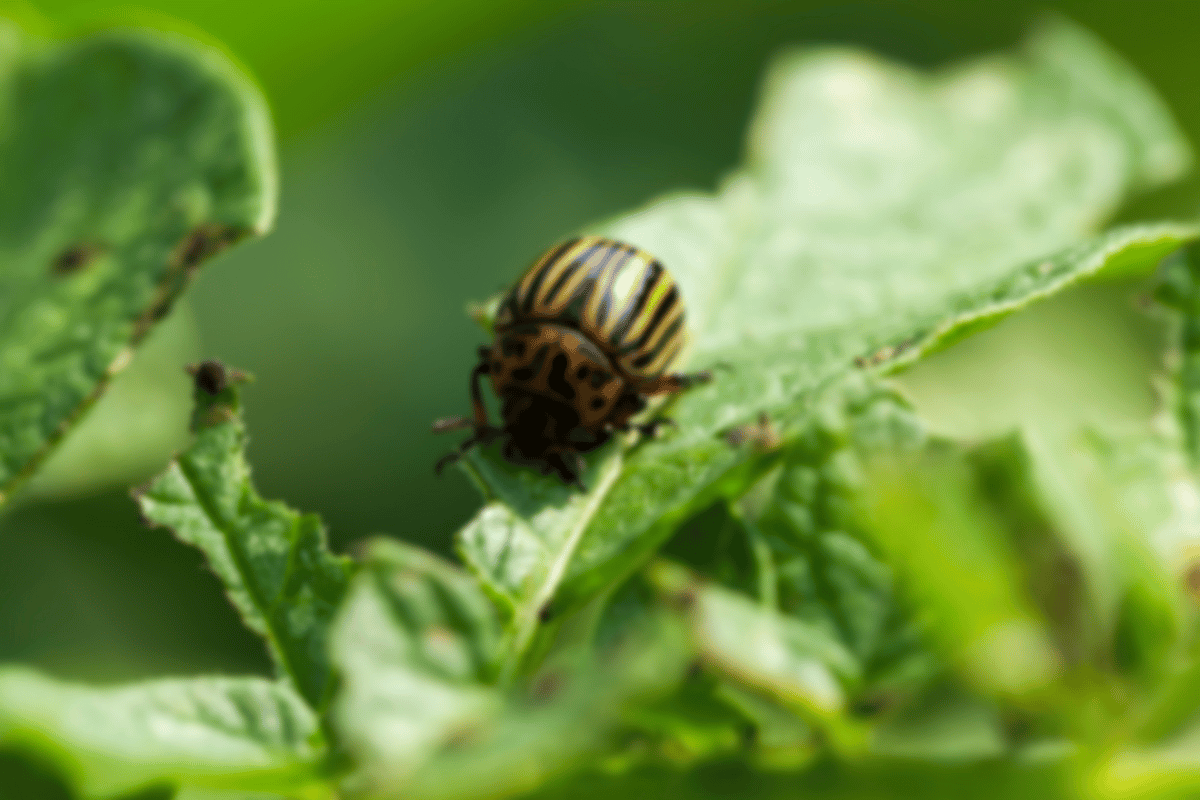
Few agricultural pests carry as much historical and political weight as the Colorado potato beetle. In Germany, it was once declared a weapon of war, plastered across propaganda posters and blamed for Cold War food shortages. Today, it remains one of the most persistent and destructive pests of potato cultivation, a serious challenge for growers ranging from small-scale gardeners in Bavaria to commercial farmers in Brandenburg.
A pest with a Cold War past
From the Rocky Mountains to the Rhine
The Colorado potato beetle (Leptinotarsa decemlineata), in the order Coleoptera and family Chrysomelidae, is native to the region between Colorado and northern Mexico. Wild populations feed mainly on buffalo bur plants such as Solanum rostratum, Solanum angustifolium, and several related species in the family Solanaceae. When European settlers introduced the cultivated potato to North America in the 19th century, the beetle made a swift and devastating switch to the new host. By 1874, it had spread across the entire North American continent. By the early 20th century, it had reached Europe, most likely arriving with American troops during World War I, and had established itself near Bordeaux in southwestern France (Alyokhin, 2009).
From there, its eastward march was steady and difficult to slow. By the 1930s, German agricultural authorities were closely watching what they called the Käferfront, or beetle front, as it approached national borders. In 1934, an early infestation was identified in Stade, near Hamburg. Officials responded with strict control measures, including the destruction of affected fields, the application of benzol to the soil, and mandatory preventive use of arsenate-based pesticides for farmers within a five-kilometre radius. At that stage, the priority was to keep Germany free of the Colorado potato beetle altogether. The ambition did not survive the Second World War. By 1950, nearly half of all potato fields in the Soviet-occupied zone of Germany were infested.
The Amikäfer, propaganda, fear, and mass mobilisation
In 1950, a new name appeared for the insect in East Germany, Amikäfer, short for Amerikanischer Käfer, the "American beetle". Authorities in the German Democratic Republic, eager to blame their agricultural difficulties on Western enemies, claimed the beetles were deliberately dispersed by American aircraft. Propaganda posters depicted the beetle marching across Germany, with its yellow and black wing stripes restyled in the red, white, and blue of the Stars and Stripes. Campaigns called the response a "war of peace" and urged all citizens, including children, to collect and destroy beetles through organised drives and public mobilisation. The propaganda faded by the 1960s, but the beetle stayed. It has been a fixture of European potato farming ever since.
Key facts at a glance
|
Statistic |
Value |
|
Potential yield loss without pest control |
Up to 50% |
|
Eggs a single female can lay in 4 to 5 weeks |
500+ |
|
Hectares of potatoes grown in Germany annually (2025) |
~301,000 |
Identifying the Colorado potato beetle
Adults, larvae, and eggs, what to look for
The good news is that the Colorado potato beetle is one of the easiest agricultural pests to identify. The less encouraging news is that once you have spotted it, you are usually already dealing with the beginnings of an infestation. The species name decemlineata itself refers to the ten lengthwise stripes on the wing covers.
|
Life stage |
Morphological description |
Habitat |
|
Adult |
6 to 11 mm long, rounded, bright yellow-orange body with 10 bold black stripes running lengthwise over the wing covers |
On leaves and stems, will drop to the soil when disturbed |
|
Eggs |
Small (1 mm), bright yellow-orange, laid in tight clusters of 20 to 40 on the underside of leaves, darken to orange-red before hatching |
Undersides of lower and mid-canopy leaves |
|
Young larvae |
Bright red with a black head and two rows of black dots along each side, soft-bodied and hump-backed |
On and near egg clusters, move upward as they grow |
|
Older larvae |
Orange-pink, around 12 mm long, with the same black dots and markedly plumper bodies |
Upper canopy leaves, where they cause the most visible damage |
Source: data compiled from the University of Maine Cooperative Extension Colorado potato beetle field guide.
Life cycle and seasonality in Germany's climate
Adult beetles overwinter several inches underground in the soil or within woody vegetation near or inside potato fields. They emerge in spring when soil temperatures exceed around 14 °C, typically from April to May in most of Germany. They start feeding immediately, and females begin laying eggs within days. One female can produce over 500 eggs during her four-to-five-week lifespan. In Germany's temperate climate, the beetle typically completes one or two generations per season. Rising summer temperatures associated with climate change are increasingly making two complete generations more frequent in northern regions, resulting in a second emergence of larvae during the tuber bulking stage, which is when the crop is most vulnerable (Alyokhin, 2009).
Why the Colorado beetle is so hard to eradicate
If the beetle were easy to control, it would not have earned such a formidable reputation. The core problem lies in its genetics. L. decemlineata has one of the highest capacities for developing insecticide resistance among agricultural pests (Göldel et al., 2020). Schoville et al. (2018) report that around 17% of its genome consists of transposable elements, mobile DNA sequences that can shift position within the genome, which likely supports the beetle's rapid adaptation to chemical stressors. For many years, conventional synthetic insecticides have been heavily relied on to control the Colorado potato beetle because of their rapid effectiveness. The prolonged and repeated use of these chemicals has produced significant problems, particularly the widespread development of resistance.
Resistance was observed early. The beetle developed resistance to DDT by 1952 and to dieldrin by 1958, and it has since evolved resistance to every major class of insecticides, including pyrethroids, organophosphates, carbamates, and increasingly neonicotinoids. Recent EU regulations have removed several widely used active substances such as chlorpyrifos, thiacloprid, and thiamethoxam from the market, leaving growers with an increasingly limited range of control options (Göldel et al., 2020). Long-term monitoring studies by German and Czech researchers further demonstrate widespread resistance to pyrethroids and organophosphates, alongside declining efficacy of neonicotinoids. The clear lesson is that reliance on a single chemical class is not a sustainable strategy (Kocourek et al., 2024).
Control strategies, conventional and organic
Integrated pest management
The history of controlling the Colorado potato beetle has often been described as a long period of mismanagement, mainly because growers have leaned too heavily on insecticides. In many cases, control strategies still rely on a single method, with limited adoption of integrated pest management, which raises the risk of failure because the beetle can rapidly adapt to both chemical and non-chemical measures. Research shows that it can quickly overcome resistant plant varieties and even adapt to strategies such as crop rotation. There is no single solution, whether chemical or alternative, that can provide long-term control. A more effective approach is to combine multiple strategies so that beetle populations are kept below the threshold at which they cause economic damage, rather than trying to eradicate them entirely (Alyokhin, 2009).
Cultural controls
Colorado beetle populations can be reduced through fairly common cultural methods, with crop rotation being one of the most effective and easily implemented. As Colorado potato beetles overwinter in the soil, rotating potato cultivation with non-host crops, maintaining a minimum two-year gap, and avoiding other solanaceous plants such as tomatoes, aubergines, and peppers, significantly reduces pest persistence and infestation risk.
Mulching has shown promising results in recent German potato field trials. Research published in Frontiers in Agronomy (Winkler et al., 2024) found that organic mulching with cereal-legume mixtures such as triticale and vetch reduced Colorado potato beetle infestation pressure and could be applied at field scale, offering a practical and low-maintenance strategy for farmers.
Hand-picking remains a labour-intensive but highly effective method for small plots. It involves the manual removal of adults and larvae into soapy water, alongside the destruction of egg clusters by crushing or removing infested leaves. This is best done in the morning when beetles are less active.
Biological control
In organic production systems, Bacillus thuringiensis var. tenebrionis (Btt) serves as a key biological control agent, particularly in Germany, because of its targeted toxicity against young Colorado potato beetle (CPB) larvae. It should be applied at the onset of egg hatching, preferably in the evening or under low-light conditions to prevent UV degradation. Visible blackening of larvae indicates that the application is working.
The beetle has very few effective natural enemies in Europe, which is a large part of why it has been so successful here. Predatory stink bugs such as Perillus bioculatus and Podisus maculiventris attack eggs and larvae and have been studied extensively as biocontrol agents in both North America and Europe. Perillus bioculatus has even established small self-sustaining populations in parts of Eastern Europe and the Balkans in recent years. Ladybird beetles, ground beetles, parasitoid wasps, and parasitoid flies of the genus Doryphorophaga also contribute to pest pressure, though populations are rarely high enough to provide meaningful control on their own. Encouraging biodiversity of natural predators, including ground beetles and birds, can support pest regulation, though the effect tends to be supplementary rather than sufficient as a standalone strategy (Alyokhin, 2009).
Chemical control
Insecticides remain the most effective option for large-scale control where their use is permitted. They have to be rotated between different modes of action to slow resistance development. In Germany, several insecticidal active substances are currently available, including spinetoram (a naturally derived spinosyn), chlorantraniliprole (a diamide), and azadirachtin (a neem-based compound), according to the Bavarian State Research Center for Agriculture (LfL, 2025). Because the regulatory framework for plant protection products is subject to ongoing changes, growers should confirm the current registration and approval status of each product before application.
RNAi technologies in modern beetle management
Scientists at the Max Planck Institute for Molecular Plant Physiology in Potsdam-Golm and the Max Planck Institute for Chemical Ecology in Jena are advancing one of the more promising recent innovations in Colorado potato beetle management, RNA interference (RNAi). The technique works by engineering potato plants to accumulate double-stranded RNA sequences that target essential genes in the beetle. The RNA effectively switches off important genes in the pest, which either kills it or reduces its ability to reproduce. A related line of research uses helpful bacteria such as Escherichia coli to produce cysteine proteases that interfere with the beetle's digestion, making survival more difficult. Other pest-control methods using bacteria, fungi, and microbes are already in use in countries outside Europe.
Early results showed that transforming the plant's chloroplast genome rather than its nuclear genome resulted in much higher concentrations of the protective RNA, which makes the method more effective. Because the technique targets beetle genes specifically, it is highly precise and poses minimal risk to non-target insects. It also avoids producing foreign protein in the plant, which addresses some public concerns about genetically modified crops. Although genetically modified potato varieties can significantly reduce pesticide use and improve productivity, they are not widely accepted by all farmers and consumers, particularly those who prefer organic or ecological farming, and they are not permitted in certain farming systems. The use of GM crops remains a subject of ongoing debate, particularly around food security, environmental sustainability, and public acceptance (Göldel et al., 2020).
Conclusion
The Colorado potato beetle has remained a major agricultural pest in Europe for more than a century and holds a particularly significant place in Germany's farming history. The management approach has evolved considerably, from early arsenate-based pesticide campaigns to its symbolic role during the Cold War, and more recently to its position in modern genetic and ecological research. Its success as a pest is driven by high reproductive capacity, strong adaptability, and rapid development of resistance to many control measures, making it one of the most challenging threats to potato cultivation.
The beetle can still be managed effectively through a consistent and informed approach. Regular field inspections are essential for the early identification of eggs, larvae, and adult beetles, allowing timely intervention before infestation becomes severe. Crop rotation is a fundamental component of sustainable Colorado potato beetle management, because it reduces overwintering populations by interrupting the beetle's life cycle. Adding integrated organic methods, including hand-picking, biological control agents, and habitat management, further improves long-term pest suppression. A clear understanding of the beetle's biology, feeding behaviour, and seasonal development gives commercial farmers and home gardeners alike a stronger basis for protecting their potatoes.
References
- Alyokhin, A. (2009). Colorado potato beetle management on potatoes: current challenges and future prospects. Fruit, Vegetable and Cereal Science and Biotechnology, 3(1), 10–19.
- Göldel, B., Lemic, D., & Bažok, R. (2020). Alternatives to synthetic insecticides in the control of the Colorado potato beetle (Leptinotarsa decemlineata Say) and their environmental benefits. Agriculture, 10(12), 611.
- Kocourek, F., Doležal, P., Hausvater, E., Horská, T., Sopko, B., Sedlák, P., Sedláková, V., & Stará, J. (2024). Six-year monitoring of pesticide resistance in the Colorado potato beetle (Leptinotarsa decemlineata Say) during a neonicotinoid restriction period. PLOS ONE, 19(5), e0303238.
- Schoville, S. D., Chen, Y. H., Andersson, M. N., Benoit, J. B., Bhandari, A., Bowsher, J. H., et al. (2018). A model species for agricultural pest genomics, the genome of the Colorado potato beetle, Leptinotarsa decemlineata (Coleoptera, Chrysomelidae). Scientific Reports, 8(1), 1931.
- Winkler, J., Junge, S., Nasirahmadi, A., Hensel, O., Finckh, M. R., & Kirchner, S. M. (2024). Reduction of Colorado potato beetle damage by various organic mulches. Frontiers in Agronomy, 6, 1335388.
- Bayerisches Staatsministerium für Ernährung, Landwirtschaft und Forsten (LfL). (2025). Currently registered insecticides in potato production. Bavarian State Research Center for Agriculture.
- University of Maine Cooperative Extension. (n.d.). Colorado potato beetle field guide.