Carbon farming discussions tend to focus on practices such as agroforestry, cover cropping, and biochar. Peatlands are one of the most significant natural climate solutions, and one of the least discussed. They are waterlogged ecosystems built from deep accumulations of organic matter, which makes them exceptional long-term carbon stores. Drain them, though, and the carbon locked away over thousands of years is released back to the atmosphere, together with other greenhouse gases, particularly nitrous oxide.
Peatlands cover only about 3% of the global land surface, yet they hold an estimated 600 billion tonnes of carbon, close to a third of all soil carbon and more than is stored in all the world's forest biomass combined. That storage comes from waterlogged conditions that slow the decomposition of organic matter over millennia. Protecting, restoring, and rewetting peatlands has therefore become one of the more effective carbon farming strategies available, with real potential for long-term greenhouse gas mitigation.
Why peatlands matter for the climate
Peatlands form where partially decomposed plant material builds up under saturated conditions over thousands of years. The low oxygen in that waterlogged environment slows decomposition to a crawl, so plant material accumulates instead of breaking down, and the peat becomes a long-term natural carbon sink. This is why so small a fraction of the land surface can hold so large a share of the planet's terrestrial carbon.
Intact peatlands worldwide take up roughly 0.37 gigatonnes of carbon dioxide a year. That benefit depends entirely on keeping the water table high. Once a peatland is drained, decomposition speeds up and the system can flip from a carbon sink into a major source of emissions.
Water is what holds the carbon in place
Hydrology is the single factor that governs carbon storage in a peatland. Under natural waterlogged conditions the high water table keeps oxygen out of the soil, creating the anaerobic environment that slows decomposition and allows peat and its stored carbon to accumulate. When a peatland is drained for agriculture or peat extraction, the water table drops and oxygen reaches the peat. Aerobic decomposition sets in, and the stored carbon is released as carbon dioxide while nitrous oxide emissions can also rise.
Drainage does lower methane emissions, since methane is produced under anaerobic conditions, but the increase in carbon dioxide and nitrous oxide usually far outweighs that methane benefit. The net effect is that drained peatlands typically become significant emitters. Keeping the water table high, or restoring it, is what preserves the carbon.
What decides whether a peatland stores or emits
Water table depth is the most important control on whether a peatland acts as a sink or a source. Lowering the water table by as little as 10 cm can markedly increase carbon dioxide emissions by exposing peat to oxygen and speeding decomposition. Keeping groundwater close to the surface is therefore essential, which is why rewetting is treated as a high-priority mitigation action to halt ongoing carbon loss.
Vegetation also shapes the greenhouse gas balance. Different plant communities affect carbon storage and methane emissions through how they grow and how they interact with the soil. Sphagnum mosses build peat and tend to produce less methane, while sedges and reeds can channel methane from the soil into the atmosphere. Trees and shrubs influence the water table, carbon uptake, and nutrient cycling, and so affect the overall balance.
Climate and temperature add a further layer. Higher temperatures raise microbial activity, which accelerates decomposition and greenhouse gas production, so tropical peatlands generally decompose organic matter faster than temperate or boreal ones, and emissions rise in the warmer parts of the year. Rising global temperatures can intensify this feedback in already degraded peatlands by disturbing their hydrology. Land uses such as agriculture, grazing, forestry, and peat extraction push the balance further, turning intact tropical peat swamp forests that once acted as sinks into major sources of emissions.
Best practice in management and restoration
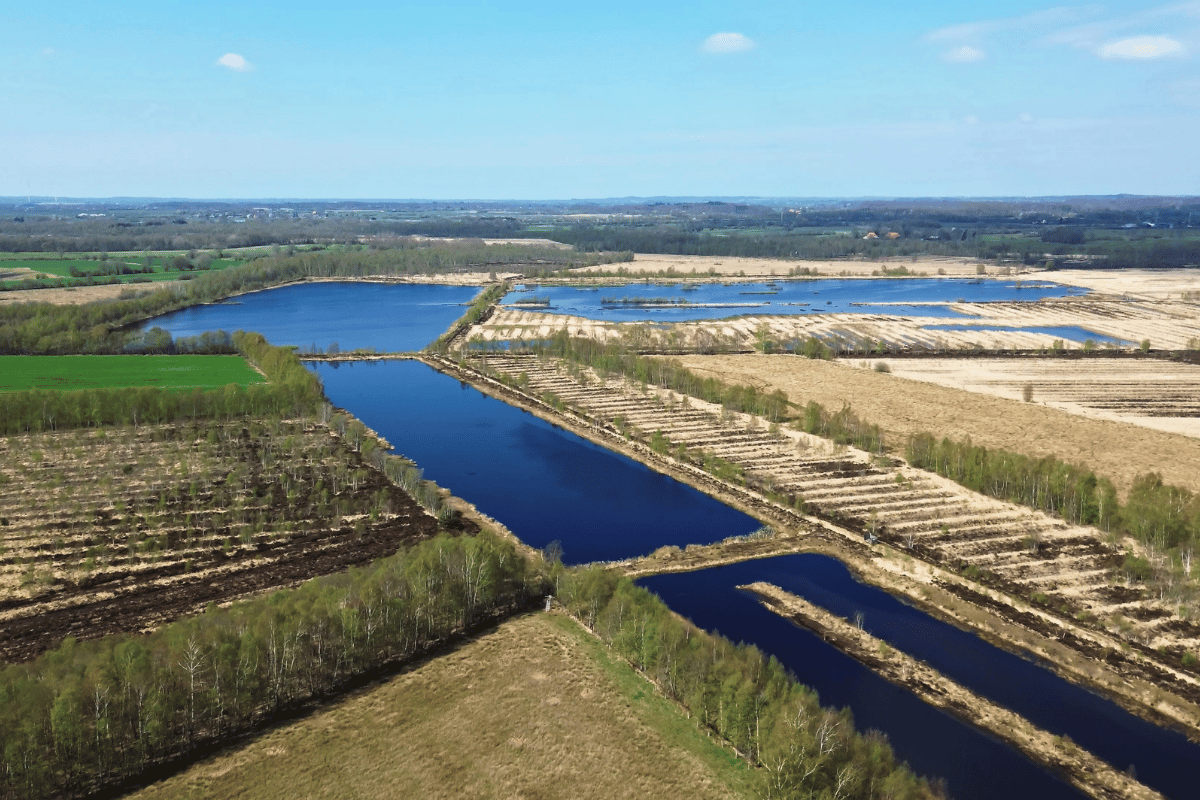
Rewetting is widely regarded as the most effective way to restore a degraded peatland and cut its emissions. It aims to bring back the natural water regime by blocking drainage ditches, installing bunds or weirs, and infilling drains near the surface, so the water table sits close to the peat, typically within 0 to 20 cm. That limits how far oxygen can penetrate and slows aerobic decomposition, which sharply reduces the carbon dioxide and nitrous oxide emissions that come from drained peat. Studies show rewetting lowers overall greenhouse gas emissions compared with a drained, degraded peatland.
One trade-off is worth understanding. Rewetting can raise methane emissions, because restoring saturated, anaerobic conditions favours the microbes that produce methane, and the increase is usually largest in the first years after restoration. It tends to fade as vegetation establishes and the ecosystem settles, and the large reductions in carbon dioxide from peat oxidation and in nitrous oxide from drained soils generally outweigh that short-term methane rise, leaving a net climate benefit over the long term.
Paludiculture has emerged as a productive companion to rewetting. It means cultivating water-tolerant, biomass-producing species under wet conditions, so land stays in use while the water table stays high. Common paludiculture species include cattail (Typha), common reed (Phragmites), alder, and willow. The approach keeps the water table up, limits peat degradation, supports biodiversity, produces renewable biomass, and gives landowners an alternative income, which makes it a practical way to combine climate mitigation, restoration, and production on the same ground.
Measuring the carbon benefit
Quantifying the climate benefit of peatland projects takes solid monitoring. Eddy covariance systems track net ecosystem carbon exchange continuously over large areas, giving high-resolution data on carbon dioxide moving between the peatland and the atmosphere. At finer scale, static or dynamic chambers measure carbon dioxide, methane, and nitrous oxide from specific vegetation and soil surfaces. Water table monitoring with wells and automated sensors follows the hydrological conditions that drive emissions, and remote sensing, including satellite imagery, aerial survey, and synthetic aperture radar, assesses vegetation cover, surface moisture, land-use change, and restoration progress across large landscapes. Together these methods form the measurement, reporting, and verification frameworks that underpin credible carbon accounting and carbon credits.
Peatlands and carbon markets
Peatland restoration is increasingly finding a place in voluntary carbon markets, on the strength of its emissions reductions and long-term storage. Several standards support these projects, including Verra, Gold Standard, the Peatland Code, and MoorFutures. To generate credits, a project has to demonstrate additionality, permanence, robust measurement and verification, a credible baseline, and independent third-party checking. Because the benefits build up slowly, crediting frameworks for peatlands typically run over 20 to 50 years to make sure the mitigation is real and durable.
The wider benefits of restoration
Healthy peatlands do far more than store carbon. They provide habitat for specialised plants and animals that depend on wetlands, they buffer floods by holding water and releasing it slowly, and they improve water quality by filtering out pollutants and sediment before water reaches rivers and groundwater. Rewetting and restoration can bring many of these services back while also cutting emissions, improving habitat connectivity and water regulation and making the landscape more resilient to drought and extreme weather.
Restoration has limits worth being honest about. A restored peatland may not fully regain the ecological character of an undisturbed one, since recovery is slow and complex, so its biodiversity and ecosystem services may not reach the level of an intact system even as they improve markedly on a degraded one.
Where this leaves carbon farming
Peatlands are among the largest terrestrial carbon stores on Earth, and they regulate the global carbon cycle out of all proportion to the land they occupy. Sustainable management, above all rewetting and paludiculture, can cut emissions substantially, prevent further degradation, and support long-term carbon storage, while also protecting biodiversity, regulating water, and supporting rural livelihoods. As countries pursue net-zero commitments, peatland restoration stands out as one of the most effective nature-based solutions available, and pairing it with sound monitoring, carbon accounting, and supportive policy is what will let peatlands do the climate work they are capable of.
Sources
McDonald, H., Frelih-Larsen, A., Lóránt, A., Duin, L., Pyndt Andersen, S., Costa, G., and Bradley, H. (2021). Carbon farming, making agriculture fit for 2030. European Parliament, Policy Department for Economic, Scientific and Quality of Life Policies.
Limpens, J., Berendse, F., Blodau, C., Canadell, J. G., Freeman, C., Holden, J., et al. (2008). Peatlands and the carbon cycle, from local processes to global implications. Biogeosciences, 5, 1475–1491.
Joosten, H., Tapio-Biström, M.-L., and Tol, S. (Eds.). (2012). Peatlands, guidance for climate change mitigation through conservation, rehabilitation and sustainable use. FAO and Wetlands International.
Günther, A., Barthelmes, A., Huth, V., Joosten, H., Jurasinski, G., Koebsch, F., and Couwenberg, J. (2020). Prompt rewetting of drained peatlands reduces climate warming despite methane emissions. Nature Communications, 11, 1644.
IUCN. Peatlands and climate change.
Quinty, F., and Rochefort, L. (2003). Peatland restoration guide. Canadian Sphagnum Peat Moss Association and New Brunswick Department of Natural Resources and Energy.
Bianchi, A., Larmola, T., Kekkonen, H., Saarnio, S., and Lång, K. (2021). Review of greenhouse gas emissions from rewetted agricultural soils. Wetlands, 41, 108.
Wichtmann, W., Schröder, C., and Joosten, H. (Eds.). (2016). Paludiculture, productive use of wet peatlands. Schweizerbart Science Publishers.
Bonn, A., Reed, M. S., Evans, C. D., Joosten, H., Bain, C., Farmer, J., et al. (2014). Investing in nature, developing ecosystem service markets for peatland restoration. Ecosystem Services, 9, 54–65.
IPCC. (2014). 2013 supplement to the 2006 IPCC guidelines for national greenhouse gas inventories, wetlands. Intergovernmental Panel on Climate Change.