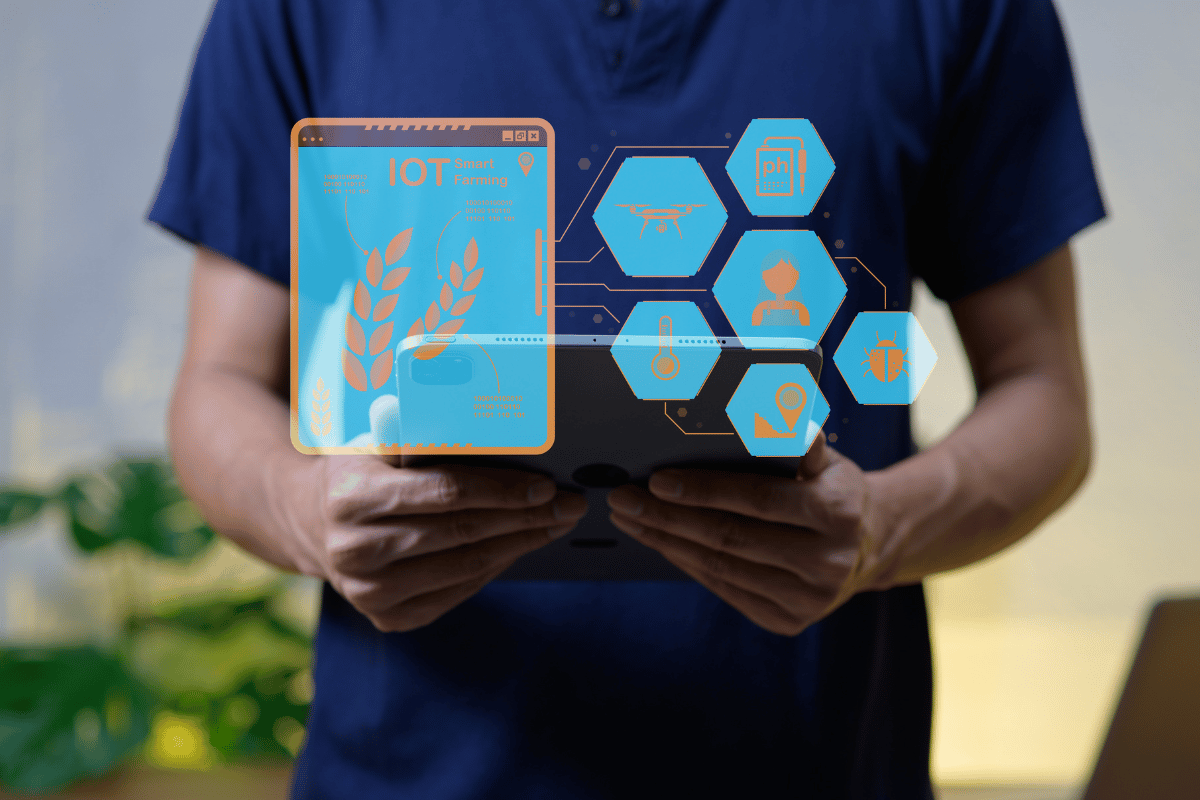
An IoT-based farming system uses interconnected devices and sensors to monitor and manage agricultural activities in real time. By integrating the Internet of Things into agriculture, farmers can collect data on soil moisture, temperature, humidity, crop conditions, and livestock health, then act on that data through sensors, GPS, drones, and automated irrigation technologies to improve decision-making and resource use (Talaviya et al., 2020; Tzounis et al., 2017). Farooq et al. (2020) note that smart irrigation systems deliver water based on actual crop needs, helping reduce waste and improve efficiency. Across these applications, IoT-based smart farming increases productivity, reduces operational costs, and supports more sustainable practices through precise, data-driven methods.
What smart farming actually solves
Conventional farming, whether rural or urban, operates largely on scheduled intuition. A farmer waters on a timetable, applies fertilisers according to a calendar, and scouts for pests by walking the field periodically. This approach works to a point, but it is inherently inefficient because it tries to manage a highly dynamic biological system with a standardised, one-size-fits-all method.
Two tomato plants located only one metre apart can experience noticeably different conditions in soil moisture, root health, and pest pressure, yet conventional practice treats them identically. At the field scale, this averaging means chronic overwatering in some zones and underwatering in others, fertiliser runoff from areas that did not need the application, and delayed detection of pest infestations that could have been caught earlier.
IoT-based smart farming is fundamentally about replacing scheduled average responses with real-time individual responses (Tzounis et al., 2017). The goal is to give every plant, or at least every microzone of a growing area, exactly what it needs, when it needs it, and nothing more.
How the system fits together
Before diving into components, it helps to have a mental model of the overall system. Think of it as three concentric layers that interact continuously (Tzounis et al., 2017).
The sensing layer is closest to the physical world. It is the set of devices that perceive conditions in the field or greenhouse. The network layer is the communication infrastructure that moves data from the sensors to where it can be processed. The intelligence layer is where data becomes decisions, through software running either locally (on-site edge computing) or remotely (cloud platforms). Data flows outward through these layers, and control signals flow back inward. A soil moisture sensor detects dry conditions, transmits that reading over a wireless network, an algorithm determines that irrigation is needed, and a signal goes back to open a valve. This loop of sense, transmit, decide, and act is the heartbeat of the entire system (Farooq et al., 2020; Tzounis et al., 2017).
The sensing layer in depth
Sensors are where the system touches reality, so it is worth understanding what is actually being measured and why each measurement matters agronomically.
Soil sensors are arguably the most important category. Capacitance-based soil moisture sensors work by measuring how the dielectric properties of soil change with water content, since wet soil and dry soil respond differently to an electric field, and that difference maps to a moisture percentage (Farooq et al., 2020). More sophisticated sensors measure soil electrical conductivity, which correlates with nutrient concentration and salinity, a useful signal for detecting whether a plant is being overfertilised or whether salt is accumulating in irrigated soils (Tzounis et al., 2017).
Atmospheric sensors measure temperature, humidity, carbon dioxide concentration, and light (photosynthetically active radiation, or PAR). These variables matter because plant growth is governed by their relationships rather than by any single one. High temperature combined with low humidity creates a vapour pressure deficit, which is the driving force that pulls water out of leaves, and smart systems use this calculation dynamically to anticipate irrigation needs before the soil even registers dryness (Farooq et al., 2020).
Imaging and spectral sensors represent a qualitative leap beyond simple numerical measurements. Multispectral cameras capture light reflected from plant canopies at wavelengths invisible to the human eye (Liakos et al., 2018). The NDVI (Normalised Difference Vegetation Index) is a ratio of near-infrared to red reflectance and is a particularly powerful indicator, because healthy chlorophyll-rich leaves reflect near-infrared strongly while absorbing red light, whereas stressed, yellowing, or diseased leaves shift that ratio in predictable ways (Liakos et al., 2018). A drone producing an NDVI map can reveal nitrogen deficiency, water stress, or early-stage fungal infection days before visible symptoms appear.
Weather stations at the farm level add local forecasting capability. Combining on-site atmospheric data with regional forecast feeds allows predictive irrigation scheduling, where the system can decide not to irrigate this morning because rain is forecast for the afternoon, saving water while maintaining optimal soil moisture (Farooq et al., 2020).
These sensors relay data continuously or on a schedule. A soil moisture probe might send a reading every 10 minutes, for example. Using this data, a farm controller can trigger actions or alerts.
Connectivity and the network layer
Moving data from sensors distributed across a field to a processing system is a non-trivial engineering challenge, and the choice of communication technology involves real trade-offs. IoT architecture relies on a three-layer model of perception, network, and application to analyse sensor and actuator devices and communication technologies across farming domains such as agriculture, food consumption, and livestock farming (Kamilaris et al., 2017).
LoRaWAN (Long Range Wide Area Network) has become the workhorse of agricultural IoT because it can send small amounts of data over long distances while using very little power. Battery-operated sensors can run for years without replacement. It is well-suited to sending a temperature reading every few minutes but is not suitable for video, because the data rate is too low.
Zigbee and Z-Wave are short-range mesh protocols used in more contained settings like greenhouses. Each device helps pass information to the next, which allows the network to cover obstacles and weak-signal areas. They use more power than LoRa but support higher data rates.
NB-IoT and LTE-M use mobile networks, so farmers do not need to build their own wireless system. This makes them attractive in regions with good mobile coverage, but they are limited where connectivity is poor, which is often exactly where farming happens.
The practical reality in many deployments is a hybrid approach where LoRa sensors transmit locally to a farm gateway, which aggregates data and forwards it over cellular or broadband to a cloud platform.
Turning data into decisions
Raw sensor data is not inherently useful. It needs interpretation. The real value comes when the system uses that data to make decisions. The simplest systems follow rules. If soil moisture falls below a set level, the irrigation valve turns on for a defined amount of time. Even this basic logic can make farming much more efficient (Kamilaris et al., 2017).
More advanced systems use prediction models. Evapotranspiration models estimate how much water a crop will lose based on temperature, humidity, wind speed, and solar radiation, which allows irrigation systems to water proactively before a moisture deficit occurs rather than reactively responding after it has developed. The Penman-Monteith equation, the FAO standard for this calculation, can be run continuously in the cloud using real-time sensor inputs, turning a complex agronomic calculation into automated irrigation without manual effort.
Machine learning goes further. It can recognise plant diseases from leaf images, detect unusual sensor readings, and alert the farmer when something is wrong (Talaviya et al., 2020). Some of the most advanced systems use digital twins, continuously updated virtual models of the entire farm, calibrated by real sensor data, that can simulate the consequences of management decisions before they are implemented. A question such as "what happens to yield if I increase nitrogen application by 15% in the northern field?" becomes something the model can answer probabilistically, drawing on historical data and crop growth simulations.
Actuator systems and closing the loop
A sensing and intelligence system without actuation is just an expensive monitoring dashboard. The real power comes when the system can physically respond to what it learns. Actuators include irrigation valves, pumps, fertiliser injectors, fans, heaters, grow lights, and greenhouse ventilation systems. If soil moisture drops too low, the system can automatically open a valve and start watering. In greenhouse farming, the system can also control temperature, airflow, shading, and carbon dioxide levels.
Some farms are starting to use robots and autonomous vehicles. These machines can spray crops, remove weeds, or harvest fruit with high precision. Autonomous farm machinery is still costly and used mostly for high-value crops, but adoption is gradually increasing (Talaviya et al., 2020).
Data flow in practice
Picture a tomato greenhouse equipped with soil moisture sensors, temperature and humidity sensors, a weather data feed, and a cloud-based monitoring system. These sensors transmit data at regular intervals, enabling continuous analysis of conditions across different zones (Tzounis et al., 2017). The system checks each zone separately and notices that one area is drying out faster because of the airflow near a vent. It automatically waters that area without irrigating the whole greenhouse.
At the same time, an integrated imaging system may detect early signs of fungal infection in a localised area (Liakos et al., 2018). The farmer receives a real-time alert with the exact location and visual evidence, which allows a prompt and precise intervention before the issue spreads (Talaviya et al., 2020). By the end of the season, this kind of setup can reduce water use, lower fertiliser waste, cut pesticide use, and improve yield because plant stress is caught early.
Conclusion
IoT smart farming can improve productivity, reduce waste, and make farming more efficient. It is especially useful for greenhouse growers and larger commercial farms, where automation can save a significant amount of time and resources. Adoption is still limited by high costs and the need for technical expertise, but lower-cost solutions are becoming more widely available, including small sensor boards, open-source platforms, and smartphone-based crop apps. These can make smart farming more accessible over time.
The potential of IoT is not limited to large commercial operations. Small-scale farmers and urban growers can also benefit significantly by adopting targeted solutions that address their specific challenges, such as water management, disease control, or nutrient optimisation. A step-by-step approach works well. Farmers begin by identifying their most critical constraint and implementing appropriate IoT solutions from there. This modular and needs-based adoption ensures both practicality and long-term sustainability in smart farming systems.
References
Farooq, M. S., Riaz, S., Abid, A., Umer, T., & Zikria, Y. B. (2020). Role of IoT technology in agriculture, a systematic literature review. Electronics, 9(2), 319. Role of IoT Technology in Agriculture: A Systematic Literature Review — Electronics
Kamilaris, A., Kartakoullis, A., & Prenafeta-Boldú, F. X. (2017). A review on the practice of big data analysis in agriculture. Computers and Electronics in Agriculture, 143, 23–37. A review on the practice of big data analysis in agriculture — Computers and Electronics in Agriculture
Liakos, K. G., Busato, P., Moshou, D., Pearson, S., & Bochtis, D. (2018). Machine learning in agriculture, a review. Sensors, 18(8), 2674. Machine Learning in Agriculture: A Review — Sensors
Talaviya, T., Shah, D., Patel, N., Yagnik, H., & Shah, M. (2020). Implementation of artificial intelligence in agriculture for optimisation of irrigation and application of pesticides and herbicides. Artificial Intelligence in Agriculture, 4, 58–73. Implementation of artificial intelligence in agriculture for optimisation of irrigation and application of pesticides and herbicides — Artificial Intelligence in Agriculture
Tzounis, A., Katsoulas, N., Bartzanas, T., & Kittas, C. (2017). Internet of Things in agriculture, recent advances and future challenges. Biosystems Engineering, 164, 31–48. Internet of Things in agriculture, recent advances and future challenges — Biosystems Engineering