


How Cover Crops Improve Soil Health: A Natural Solution for Farmers
Introduction
Did you know that approximately 33% of the world's agricultural soils are degraded (FAO, 2015)? This alarming figure highlights the urgent need for farmers to adopt sustainable practices that can restore and enhance soil health. One effective approach is the use of cover crops, which are typically grown during the off-season or as part of crop rotation systems. These crops contribute to soil health by preventing erosion, enhancing soil structure, increasing organic matter, fixing nitrogen, and naturally suppressing pests and weeds (Van Eerd et al., 2023).
In this article, we will explore five essential ways that cover crops can improve soil quality. We will also share practical tips for farmers planning to use them, discuss their socio-economic impacts, and examine their role in promoting sustainable agriculture. With growing scientific support and real-world success stories, understanding the power of cover crops is key to building a more resilient future in farming.
What Are Cover Crops?
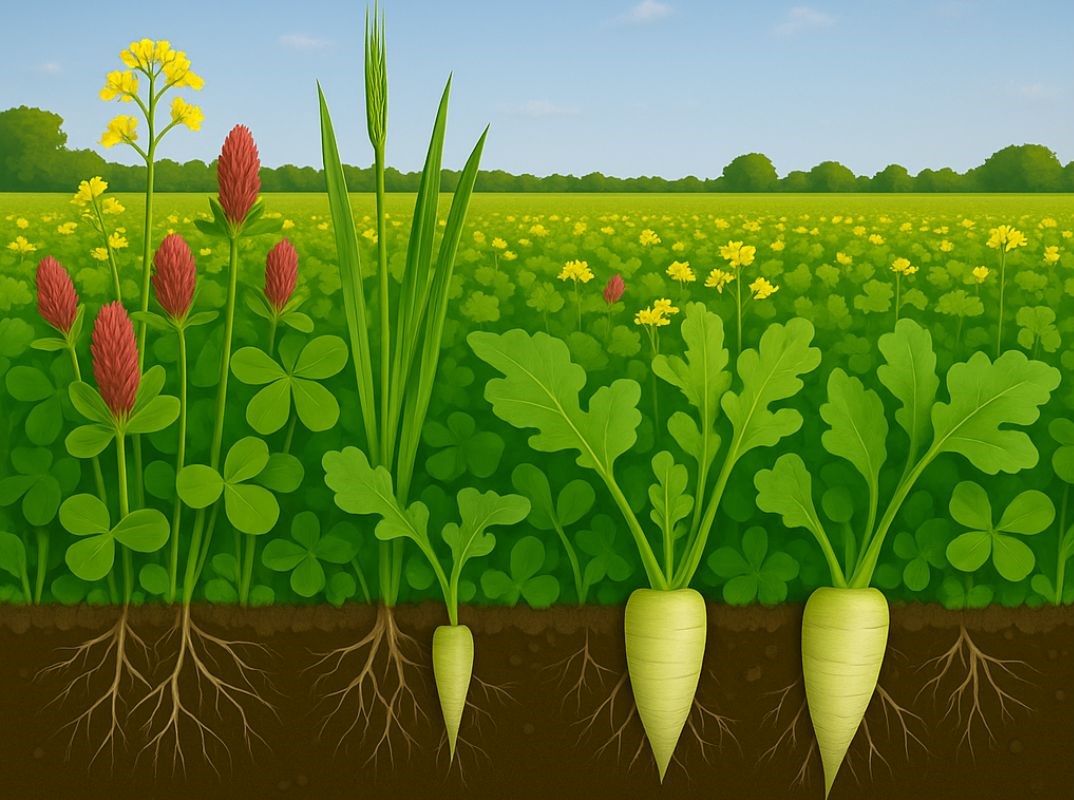
Cover crops are plants grown primarily to improve soil health rather than for harvesting. These crops, such as clover, radish, rye, and mustard, serve various functions in farming systems. The primary objectives of using cover crops include:
- Soil Protection: Cover crops protect the soil from erosion caused by wind and water, enhancing its integrity over time (Sharma et al., 2018; Van Eerd et al., 2023).
- Moisture Retention: By providing shade and ground cover, cover crops help retain soil moisture, which is critical in dry conditions (Sharma et al., 2018; Van Eerd et al., 2023).
- Weed and Pest Suppression: Cover crops can outcompete weeds and disrupt pest cycles, reducing reliance on chemical herbicides (Van Eerd et al., 2023; Abdalla et al., 2019).
The benefits of cover crops extend beyond individual farms, contributing to improved biodiversity, carbon sequestration, and overall ecosystem health (Van Eerd et al., 2023; Abdalla et al., 2019; Sharma et al., 2018). Effective implementation of cover crops has successfully bolstered agricultural sustainability in various regions.
5 Key Ways Cover Crops Improve Soil Health
1. Preventing Soil Erosion
Soil erosion is a major agricultural concern, leading to nutrient loss and diminished soil fertility. Cover crops are crucial in minimizing erosion by stabilizing the soil structure. Studies indicate that cover crops such as ryegrass are particularly effective in reducing soil erosion rates. The establishment of cover crops provides above-ground biomass, thus protecting soil from the impact of raindrop splashes and surface runoff (Van Eerd et al., 2023; Dabney et al., 2001).
Research shows that the incorporation of cover crops can significantly lower erosion rates. Enhancing soil organic matter content through cover crop residues can improve soil aggregate stability, decreasing susceptibility to erosion (Van Eerd et al., 2023; Gentsch et al., 2024). Implementing cover crops can reduce soil erosion by up to 90% in specific regions, showcasing their effectiveness as an erosion control measure (Dabney et al., 2001).
2. Enhancing Soil Structure
Cover crops contribute significantly to improving soil structure. Research shows that species with deep and dense root systems, such as radish and rye, help increase soil aggregation and porosity (Gentsch et al., 2024; Hao et al., 2023). These structural improvements lead to better soil aeration, enhanced water infiltration, and greater nutrient availability for subsequent crops (Gentsch et al., 2024; Van Eerd et al., 2023).
Studies further indicate that cover crops promote the formation of stable soil aggregates, which support more effective moisture retention and air movement within the soil profile (Gentsch et al., 2024; Hao et al., 2023). Improved soil structure also fosters a diverse and active microbial community, which is essential for efficient nutrient cycling and overall soil health (Gentsch et al., 2024; Hao et al., 2023; Gao et al., 2022).
3. Boosting Organic Matter & Soil Microbes
The decomposition of cover crops contributes organic matter to the soil, which is essential for maintaining soil health. Organic matter enhances soil fertility by providing a habitat for beneficial microbes, critical in breaking down nutrients and making them available to crops. Research shows that soils with higher organic matter content exhibit greater resilience, improving their ability to withstand drought and reduce nutrient leaching (Hao et al., 2023; Abdalla et al., 2019).
Healthy soils enriched with organic matter also support greater microbial diversity and activity. Several studies have found significant correlations between cover cropping and increased soil microbial biomass, directly enhancing nutrient cycling and fertility (Gao et al., 2022; Hao et al., 2023). Moreover, microbial activity contributes to improved soil structure and aggregate stability, further reinforcing the benefits of cover cropping practices (Gentsch et al., 2024; Hao et al., 2023).
4. Fixing Nitrogen & Reducing Fertilizer Costs
Leguminous cover crops such as clover and vetch fix atmospheric nitrogen through symbiotic relationships with rhizobia bacteria, thereby providing a significant source of biologically available nitrogen to the soil (Kebede, 2021). This process of biological nitrogen fixation reduces the need for synthetic nitrogen fertilizers, as the nitrogen made available by legumes supports both the cover crop and subsequent cash crops (Kebede, 2021). The amount of nitrogen contributed varies depending on species, biomass, and management practices (Kebede, 2021).
In addition to enhancing soil fertility, nitrogen-fixing cover crops are consistent with sustainable agricultural practices. Research demonstrates that integrating these crops into farming systems improves nutrient cycling and soil health while also helping to reduce greenhouse gas emissions associated with synthetic fertilizer production and use (Abdalla et al., 2019; Hao et al., 2023). These benefits contribute to more resilient and environmentally friendly agricultural systems.
5. Suppressing Weeds & Pests Naturally
Cover crops provide a natural barrier against weeds by outcompeting them for resources such as light, water, and nutrients (Menalled et al., 2023; Malaspina et al., 2024). Fast-growing cover crops such as rye, vetch, and canola can significantly reduce weed density and diversity through their rapid establishment and high biomass production (Malaspina et al., 2024; Menalled et al., 2023). Research demonstrates that cover crop mixtures can suppress weeds as effectively as chemical herbicides in some cases, and weed suppression increases with greater cover crop biomass (Malaspina et al., 2024; Menalled et al., 2023).
Additionally, some cover crops, particularly legumes, can help control soil-borne pests by breaking pest cycles (Kebede, 2021). While cover crops alone may not eliminate all weeds or pests, they serve as a valuable component of integrated weed and pest management systems, reducing the need for chemical inputs and promoting ecological balance within farming systems (Malaspina et al., 2024).
Practical Tips for Farmers
For aspiring farmers looking to incorporate cover crops into their agricultural systems, several practical considerations can enhance successful implementation:
Timing:
Plant cover crops before or after main cash crops. For example, planting cover crops after harvesting summer crops can maximize their growth and benefits, as demonstrated in studies where fall-seeded cover crops improved soil health and reduced erosion (SARE, 2007; Kaye & Quemada, 2017).
Selection:
Choose the right cover crops based on local soil types, climate conditions, and the intended main crops. Research has shown that "selecting appropriate cover crop species based on local agroecological conditions is essential for maximizing benefits" (Kaye & Quemada, 2017). For instance, farmers in drier conditions may benefit from drought-resistant cover crop species like legumes, which are noted for their adaptability and nitrogen-fixing capabilities (Kebede, 2021).
Termination:
Terminate cover crops effectively before planting main crops to avoid competition for resources. Methods can include mowing or using herbicides just before planting to ensure the successful establishment of cash crops (Kaye & Quemada, 2017). Studies indicate that "proper timing and method of cover crop termination are critical to avoid competition with the subsequent cash crop" (Kaye & Quemada, 2017).
Rotation:
Integrate cover crops into a crop rotation plan to maximize soil health benefits and enhance biodiversity. Crop rotation with cover crops can help prevent pest pressures and improve soil nutrient profiles (Sustainable Agriculture Research and Education (SARE), 2007; Kaye & Quemada, 2017). For example, "including cover crops in rotations has been shown to break pest cycles and improve soil structure and nutrient cycling" (SARE, 2007).
Monitoring:
Conduct regular soil health assessments to monitor improvements in soil fertility, microbial activity, and organic matter content post-cover cropping. Research supports the idea that "monitoring soil health indicators after cover cropping provides valuable feedback for adaptive management" (Kaye & Quemada, 2017).
By taking these proactive steps, farmers can harness the benefits of cover crops while ensuring that their agricultural practices are sustainable and economically viable.
Socio-Economic Impacts of Cover Cropping Practices
The implementation of cover crops and conservation agriculture (CA) practices provides substantial socio-economic as well as agronomic benefits. Adoption of CA, including cover cropping, minimum tillage, and crop rotation, has been linked to significant increases in maize yields and improvements in soil quality. For example, Nyirenda and Balaka (2021) found that maize yields under CA practices in Central Malawi were more than double those under conventional practices. Galani et al. (2022) also reported yield increases ranging from 20% to 80% under CA in different environments.
Training and participatory demonstrations are crucial for successful adoption. Holden et al. (2018) showed that lead farmers who hosted demonstration plots played a key role in promoting CA adoption among neighboring farmers, as hands-on learning increased confidence and practical skills. Chinseu et al. (2019) further emphasized that training and demonstration are more effective than awareness campaigns alone and that farmer-to-farmer knowledge exchange supports sustained adoption.
The labor requirements of CA, including cover crop establishment and minimum tillage, can create both opportunities and challenges. Dougill et al. (2017) reported that while CA can increase labor demand and create short-term rural employment, these requirements can also be a barrier for resource-poor households, especially those headed by women. Nevertheless, communities that adopt CA practices often report improved food security and reduced input costs due to better soil fertility and resilience to climate shocks (Nyirenda & Balaka, 2021).
Barriers to wider adoption remain significant. Chinseu et al. (2019) identified key drivers of dis-adoption in Malawi, including lack of post-project support, technological mismatches with local farming systems, financial constraints such as the cost of herbicides, and social norms that favor conventional tillage. Dougill et al. (2017) and Holden et al. (2018) stress that targeted training, demonstration plots, and institutional support are essential to bridge knowledge and resource gaps and facilitate broader adoption of CA and cover cropping.
Conclusion & Call to Action
In summary, covering crops provides a wide range of essential benefits for improving soil health and building resilient, sustainable farms. Cover crops play a key role in sustainable agriculture by preventing soil erosion, improving soil structure, fixing nitrogen, and naturally suppressing pests. Their socio-economic advantages, such as supporting farm productivity and contributing to environmental sustainability, make them a valuable tool for farmers everywhere.
If you are considering adding cover crops to your farming system, start with a small area and observe how different species, management strategies, and timings affect your land. Every farm is unique, so it's important to experiment and learn what works best for your conditions. As more farmers share their experiences, the agricultural community can continue to grow its collective knowledge and success with cover cropping.
Have you used cover crops before? What has your experience been like? Share your insights or questions in the comments below. Your story could help others on their journey to more sustainable farming.
References
Food and Agriculture Organization of the United Nations. (2015). Status of the world’s soil resources (SWSR) – Main report. FAO. FAO publication I5199E
Van Eerd, L. L., Chahal, I., Peng, Y., & Awrey, J. C. (2023). Influence of cover crops at the four spheres: A review of ecosystem services, potential barriers, and future directions for North America. Science of the Total Environment, 858, 159990.
Abdalla, M., Hastings, A., Cheng, K., Yue, Q., Chadwick, D., Espenberg, M., ... & Smith, P. (2019). A critical review of the impacts of cover crops on nitrogen leaching, net greenhouse gas balance and crop productivity. Global change biology, 25(8), 2530-2543.
Sharma, P., Singh, A., Kahlon, C. S., Brar, A. S., Grover, K. K., Dia, M., & Steiner, R. L. (2018). The role of cover crops towards sustainable soil health and agriculture—A review paper. American Journal of Plant Sciences, 9(9), 1935-1951.
Gentsch, N., Riechers, F. L., Boy, J., Schweneker, D., Feuerstein, U., Heuermann, D., & Guggenberger, G. (2024). Cover crops improve soil structure and change organic carbon distribution in macroaggregate fractions. Soil, 10(1), 139-150.
Dabney, S. M., Delgado, J. A., & Reeves, D. W. (2001). Using winter cover crops to improve soil and water quality. Communications in Soil Science and Plant Analysis, 32(7-8), 1221-1250.
Hao, X., Abou Najm, M., Steenwerth, K. L., Nocco, M. A., Basset, C., & Daccache, A. (2023). Are there universal soil responses to cover cropping? A systematic review. Science of the Total Environment, 861, 160600.
Gao, H., Tian, G., Khashi u Rahman, M., & Wu, F. (2022). Cover crop species composition alters the soil bacterial community in a continuous pepper cropping system. Frontiers in Microbiology, 12, 789034.
Kebede, E. (2021). Contribution, utilization, and improvement of legumes-driven biological nitrogen fixation in agricultural systems. Frontiers in Sustainable Food Systems, 5, 767998.
Malaspina, M., Chantre, G. R., & Yanniccari, M. (2024). Effect of cover crops mixtures on weed suppression capacity in a dry sub-humid environment of Argentina. Frontiers in Agronomy, 5, 1330073.
Menalled, U. D., Smith, R. G., Cordeau, S., DiTommaso, A., Pethybridge, S. J., & Ryan, M. R. (2023). Phylogenetic relatedness can influence cover crop-based weed suppression. Scientific Reports, 13(1), 17323.
Kaye, J. P., & Quemada, M. (2017). Using cover crops to mitigate and adapt to climate change. A review. Agronomy for sustainable development, 37, 1-17.
Sustainable Agriculture Research and Education (SARE). (2007). Managing cover crops profitably (3rd ed., A. Clark, Ed.). Sustainable Agriculture Network.
Dougill, A. J., Whitfield, S., Stringer, L. C., Vincent, K., Wood, B. T., Chinseu, E. L., ... & Mkwambisi, D. D. (2017). Mainstreaming conservation agriculture in Malawi: Knowledge gaps and institutional barriers. Journal of environmental management, 195, 25-34.
Chinseu, E., Dougill, A., & Stringer, L. (2019). Why do smallholder farmers dis‐adopt conservation agriculture? Insights from Malawi. Land Degradation & Development, 30(5), 533-543.
Nyirenda, H., & Balaka, V. (2021). Conservation agriculture-related practices contribute to maize (Zea mays L.) yield and soil improvent in Central Malawi. Heliyon, 7(3).
Holden, S.T., Fisher, M., Katengeza, S.P., & Thierfelder, C. (2018). Can lead farmers reveal the adoption potential of conservation agriculture? The case of Malawi. Land use policy, 76, 1113-123
Galani, Y.J. H., Ligowe, I. S., Kieffer, M., Kamalongo, D., Kambwiri, A.M., Kuwali, P ., … & Orfila, C. (2022). Conservation agriculture affects grain and nutrient yields of maize (Zea mays L.) and can impact food and nutrition security in Sub-Saharan Africa. Frontiers in nutrition, 8, 804663.