
In the week starting 12 October 2026 a tonne of butter in the EU cost 1.19 times as much as a tonne of skimmed milk powder, the smallest ratio in the 615 weeks since January 2015, according to a Wikifarmer analysis of the weekly EU average prices published by the European Commission. The two prices drew close because they moved in opposite directions over the past year, as butter fell to €400.61 per 100 kg, 30.9% lower than in the same week of 2025, while skimmed milk powder rose to €336.89, 54.6% higher.
The ratio has been below 1.3 for the last three weeks
At the start of 2026, in the week of 5 January, butter cost €426.92 per 100 kg and skimmed milk powder €207.35, a ratio of 2.06, close to the median since 2015 of 1.90 (European Commission, Agri-food Data Portal). Since the week of 10 August, for ten consecutive weeks, the ratio has been lower than in any week before 2026 except four isolated weeks in 2016 described below. In the last three weeks it fell below 1.3, to 1.28 in the week of 28 September, 1.28 in the week of 5 October and 1.19 in the week of 12 October. In that last week butter fell 3.3% and skimmed milk powder rose 3.7%.
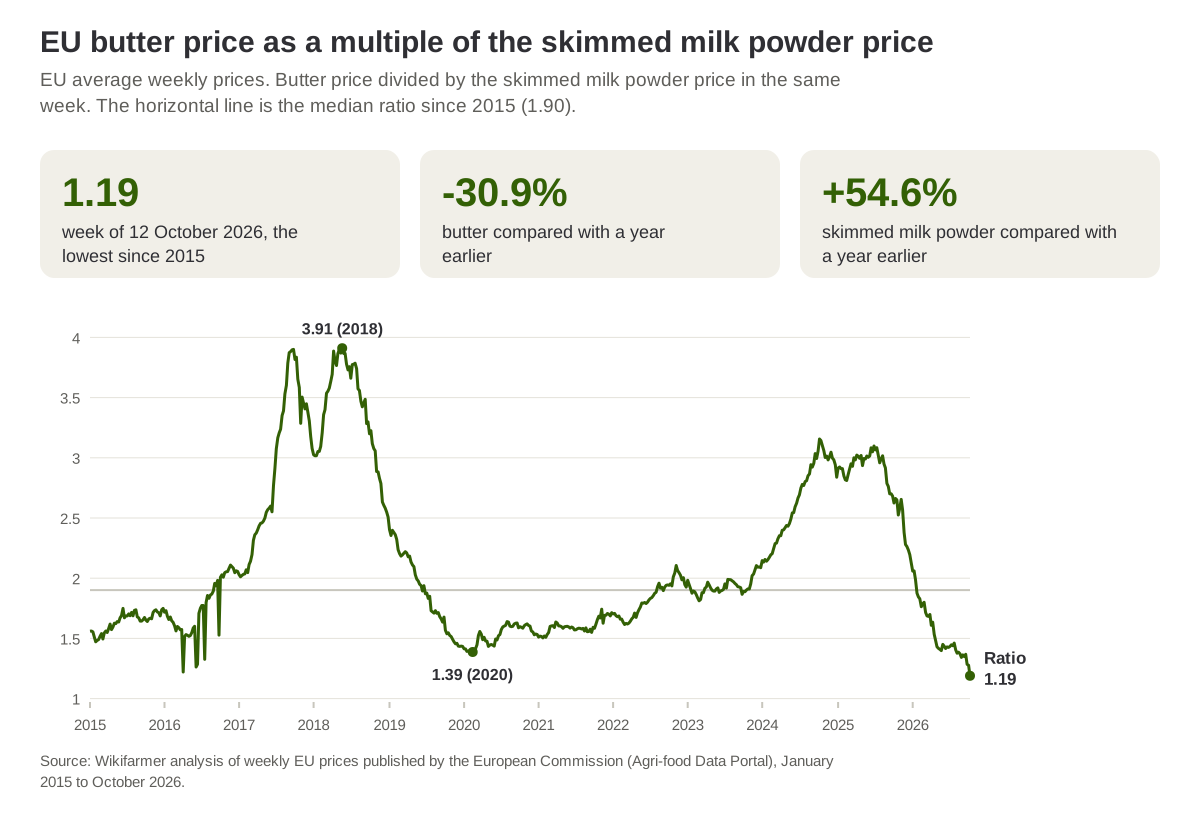
Source: Wikifarmer analysis of weekly EU average prices published by the European Commission. The horizontal line marks the median ratio since 2015.
The median ratio since 2015 is 1.90
Across the 615 weeks from January 2015 to October 2026 the median ratio is 1.90, and in half of those weeks the ratio was between 1.60 and 2.58. The highest was in the week of 21 May 2018, when butter cost 3.91 times as much as skimmed milk powder. In 2024 and 2025 the lowest weekly ratio was 2.13, and in the week of 14 October 2024 the ratio was still 3.14, with butter at €785.83 and skimmed milk powder at €249.97 per 100 kg. Before 2026 the lowest ratios came from late 2019 to early 2020, bottoming at 1.39 in the week of 17 February 2020, and in 2015, with a low of 1.47.
Four weeks of 2016 show ratios between 1.22 and 1.33, but in each of them the EU average butter price fell by 19% to 25% for one or two weeks and recovered straight after. In the week of 4 April 2016, for example, it was €203.78, between €260.45 the week before and €253.04 the week after. The published data do not explain these isolated drops, so they are not used as a benchmark here, although even including them the October 2026 ratio is the lowest in the series.
Butter lost 30.9% in a year while skimmed milk powder rose 54.6%
In the week of 13 October 2025 butter cost €579.81 per 100 kg and skimmed milk powder €217.85, a ratio of 2.66. Butter now costs about €4.01 per kilogram, 49.2% below the series high of €787.94 per 100 kg in the week of 2 December 2024, although butter was cheaper than now in 211 of the 615 weeks, most recently in the week of 10 August 2026. Skimmed milk powder, at about €3.37 per kilogram, has risen 62.5% since the start of 2026 and is the most expensive since the week of 24 October 2022, when it cost €341.54 per 100 kg.
Butter and skimmed milk powder come from the same milk
Both products are made from the same milk. The cream separated from it is churned into butter, and the skimmed milk that remains is dried into powder, so butter carries the milk fat and the powder carries the protein and lactose. The ratio of the two prices is therefore an indicator of how much more the market pays for milk fat than for the other milk solids, and because it compares two prices in euros from the same week it is not affected by inflation. These are also the two dairy products for which Regulation (EU) No 1308/2013 establishing a common organisation of the markets provides for public intervention.
The ratio uses the Commission's weekly EU average prices from the week of 5 January 2015 to the week of 12 October 2026. All changes are simple percentage changes in current euros, and the Commission's separate series including the United Kingdom for 2015 to 2020 was not used. The latest prices may be revised. All numbers were recomputed independently from the original file.
The gap between the two prices matters to dairy farmers and processors
In many countries the price farmers receive for milk is calculated from its fat and protein content, and dairy processors decide what to make from cream and skimmed milk partly on the prices of the two products. The gap also matters to buyers, from bakeries and confectioners that use butter to food and feed manufacturers that use skimmed milk powder, and to trade, since in 2025 EU dairy exports grew on broadly stable volumes and higher prices, especially for cheese and butter. The Commission's figures are processors' wholesale prices, not shelf prices, and EU food prices follow world prices late and only to a small extent.
The data show how prices moved, not what caused the move, and they are not a forecast. The Commission's next weekly prices will show whether the ratio stays below 1.3 or whether the week of 12 October was a one-off.
Sources
- European Commission. (2026). Agri-food Data Portal, API guide and weekly dairy prices. Directorate-General for Agriculture and Rural Development.
- European Union. (2013). Regulation (EU) No 1308/2013 establishing a common organisation of the markets in agricultural products. Official Journal of the European Union.