Practical guide to EU and U.S. blueberry standards for growers, traders, and exporters
Blueberries (Vaccinium spp.) have transformed from a seasonal speciality into one of the world's fastest-growing fresh fruit commodities. In 2024, global blueberry exports reached 1 million tonnes, generating revenues of $6.73 billion. With year-round consumer demand now the norm, meeting international quality standards has become essential for gaining market access and premium pricing.
This guide brings together the latest quality requirements from the UNECE (European), Codex Alimentarius (international), and USDA (U.S.) standards, along with current trade data. Whether you're a grower preparing berries for export or a buyer sourcing from global suppliers, understanding how blueberries are graded, sized, packed, and traded will help you navigate this competitive market.
Highlights at a glance
- Global blueberry exports reached 1 million tonnes in 2024, valued at $6.73 billion, with Peru leading at 31% market share.
- U.S. imports hit 684 million pounds in 2024 (+22%), valued at $2.18 billion.
- The European Union represents over 42% of global blueberry imports by value.
- Premium blueberries must display the characteristic waxy bloom, be free of defects, and meet strict size and firmness standards.
- Storage at 0°C and 90–95% humidity extends shelf life to 3–4 weeks.
What defines a quality blueberry
To qualify for export, fresh blueberries must meet the minimum quality criteria established by the UNECE Standard FFV-57 (2023 edition), the Codex Alimentarius CXS 349-2022, and USDA grading standards.
A high-quality blueberry must be:
- Intact and whole — free from crushing, splits, or leaking juice
- Sound — produce affected by rotting or deterioration is excluded
- Clean — practically free of any visible foreign matter, dirt, or frass
- Fresh in appearance — with good turgidity and characteristic colour
- Practically free from pests and pest damage
- Free of abnormal external moisture (except condensation after cold storage)
- Free of foreign smell or taste
- Free from temperature damage — neither chilling injury nor heat damage
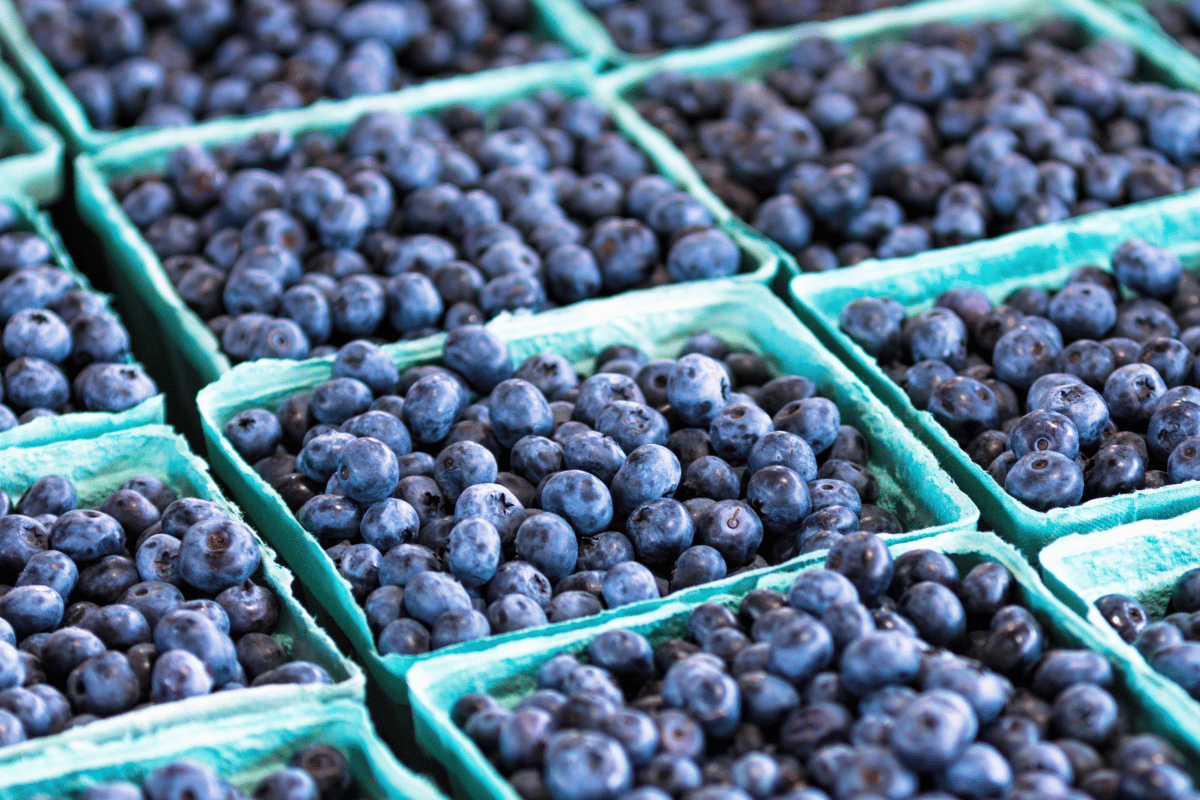
One distinctive quality indicator for blueberries is the natural waxy bloom, the powdery, light-blue coating on the skin. This bloom is a sign of freshness and careful handling. Both UNECE and Codex standards specify that blueberries should be "practically covered with bloom, according to the varietal characteristics". Loss of bloom typically indicates rough handling, moisture exposure, or prolonged storage.
The development and condition of the berries must enable them to withstand transportation and handling while arriving in satisfactory condition at the destination.
If you'd like to explore cultivation techniques and orchard management best practices, visit: Wikifarmer Library — Blueberry Cultivation
Maturity requirements
Unlike some fruits that can ripen after harvest, blueberries are non-climacteric, and their flavour does not improve once picked. This makes harvest timing critical.
According to international standards, blueberries must be sufficiently developed and display satisfactory maturity and ripeness according to the variety, but must not be overripe. Overripe berries that are characterised by soft, mushy flesh are considered seriously damaged and may not be sold.
For optimal quality, berries should show:
- More than half of the surface displays blue, bluish-purple, or bluish-black colour
- Good firmness, not yielding excessively to gentle pressure
- Characteristic varietal flavour development
Commercial quality assessment often uses °Brix as an indicator of sugar content and sweetness. Research indicates that quality blueberries typically fall within a range of 11.2–14.3 °Brix, depending on variety. The cultivar 'Centurion' has recorded values as high as 13.9 °Brix, while others, such as 'Jewel', average around 11.9 °Brix.
Importantly, °Brix and pH values remain relatively stable during postharvest storage when temperature is properly managed, and these values do not improve after harvest.
Classification and quality classes
Both the EU/UNECE and Codex systems divide fresh blueberries into three commercial classes. The USDA employs a slightly different approach, utilising a single grade (U.S. No. 1) along with size categories. Europe almost exclusively requires Class I blueberries as a minimum for retail.
|
Class / Grade |
Description |
Key Requirements |
|
Extra Class |
Superior quality, premium fruit |
Practically free of agglomerated berries and attached stems; must be covered with bloom; free from defects except very slight superficial marks |
|
Class I / U.S. No. 1 |
Good quality, standard commercial grade |
Practically free of agglomerated berries; covered with bloom; very slight leakage of juice and bruising allowed if not affecting general appearance |
|
Class II |
Marketable fruit with visible imperfections |
Slight leakage of juice, slight defects in shape and colouring, and slight bruising allowed |
Specific requirements for blueberries by class
Extra Class blueberries must be of superior quality and characteristic of the variety. They must be practically free of "twins" or "doubles" (agglomerated berries) and attached stems. The waxy bloom must be practically complete according to varietal characteristics.
Class I berries must also be practically free of agglomerated berries and covered with bloom. Very slight defects are permitted — including very slight juice leakage and very slight bruising — provided these do not affect the general appearance, quality, keeping quality, and presentation in the package.
Class II includes berries that don't qualify for higher classes but still satisfy minimum requirements. Slight leakage of juice, slight defects in shape and colouring, and slight bruising may be allowed.
Quality tolerances
Quality tolerances allow for natural variation in each lot:
|
Class |
Tolerance Allowed |
|
Extra Class |
5% by number or weight not meeting class requirements but meeting Class I; max 0.5% meeting only Class II; max 1% for decay |
|
Class I |
10% meeting only Class II requirements; max 2% for produce not meeting minimum requirements or affected by decay |
|
Class II |
10% not meeting class or minimum requirements; max 3–4% for decay |
U.S. grading specifics
The USDA standard for fresh blueberries (U.S. No. 1) requires berries to have similar varietal characteristics, be clean, well coloured, not overripe, and not crushed, split, or leaking. They must be free from attached stems, mould, decay, insects, mummified berries, and clusters.
Tolerances at shipping point allow:
- 10% for berries with attached stems
- 8% additional for berries below grade requirements, with no more than 4% for serious damage (including max 1% for mould or decay)
At destination, tolerances increase slightly to account for transit conditions, up to 12% below grade requirements, with no more than 6% for serious damage (including 2% for mould or decay).
To explore trading opportunities and connect directly with verified buyers and sellers, visit: Wikifarmer Marketplace — Blueberries.
Sizing systems explained
Unlike many fresh fruits, sizing is optional for blueberries under both UNECE and Codex standards. However, sizing according to existing trade practices is permitted and often requested by buyers, particularly for premium retail markets.
When sized, the U.S. system provides clear size classifications based on berry count per cup (237 ml):
|
Size Code |
Berries per Cup |
Market Notes |
|
Extra Large |
Less than 90 |
Premium retail; "jumbo" blueberries commanding the highest prices |
|
Large |
90–129 |
Standard retail premium |
|
Medium |
130–189 |
Commercial standard |
|
Small |
190–250 |
Often for processing or value packs |
Larger berries typically command higher prices at retail, though the size-quality relationship depends heavily on variety.
When size is specified, tolerances permit no more than 10% of samples (by number or weight) to fall outside the designated size range.
Packaging and labelling
Proper packaging protects blueberries from mechanical damage, maintains freshness, and supports brand traceability. Both Codex and UNECE require packaging materials to be food-grade, clean, and of sufficient quality to avoid causing external or internal damage.
Common packaging formats
The blueberry industry has standardised around several packaging types for different market segments:
Consumer retail (clamshells/punnets):
- 125g (4.4 oz) — Standard size for European and Asian markets; typically 12 clamshells per shipper box
- 170g (6 oz) — Common U.S. retail size
- 280g (9.8 oz) — U.S. "jumbo" pack
- Pint (473 ml) — Traditional U.S. measure
- 400–510g (16–18 oz) — Larger family packs, increasingly popular
Wholesale/food service:
- Bag-in-box for bulk (3–4 kg) — Used for processing or repacking
- Shakers or buckets (250g, 500g) — Often done by packing companies at the destination
Sustainable packaging trends
European retailers increasingly demand recyclable or biodegradable packaging. Innovations include:
- Many packaging units are introducing zero-waste, zero-residue blueberries in plastic-free packaging
- EU-funded FRIETS project developing edible seaweed-based coatings to preserve berries and avoid plastic
Most modern clamshells are made from rPET (recycled polyethylene terephthalate) with post-consumer recycled content. Ventilated designs help maintain freshness while promoting recyclability.
Labelling Requirements
Each package must display:
- Packer/exporter identification — Name and physical address or officially recognised code mark
- Product name — "Blueberries" if contents are not visible from the outside
- Variety name — Optional but recommended
- Country of origin — Required; optionally including region or place name
- Class — Commercial grade designation
- Size — If sized, expressed as size code or count range
- "Wild" designation — Where appropriate
For consumer packages (pre-packaged retail), additional requirements follow the Codex General Standard for the Labelling of Pre-packaged Foods and EU Regulation No. 1169/2011.
Storage and cold chain management
Blueberries are highly perishable, and temperature is the most critical factor affecting postharvest quality. At room temperature, fresh blueberries typically last only 3–6 days before significant quality loss.
Optimal storage conditions
|
Parameter |
Optimal Range |
Notes |
|
Temperature |
0°C to −0.5°C (32°F) |
Highest freezing point is −1.3°C (~29°F) |
|
Relative Humidity |
90–95% |
Prevents dehydration and shrivelling |
|
Storage Life |
3–4 weeks |
Under optimal conditions |
|
Controlled Atmosphere |
3–5% O₂, 4–8% CO₂ |
Extends storage to 5–6 weeks; prevents decay |
Pre-cooling
Blueberries must be rapidly pre-cooled after harvest, ideally to below 7°C (~44.6°F) within 2 hours. Berries cooled quickly to near 0°C (~32°C) show significantly less decay after storage than those cooled more slowly.
Temperature abuse is a leading cause of quality claims. Research indicates that temperature issues cause 32.2% of blueberry export claims during transit.
Modified atmosphere packaging
For supply chains where controlled atmosphere storage isn't feasible, Modified Atmosphere (MA) packaging offers an alternative. MA retail packages allow higher CO₂ and lower O₂ levels than normal air. Combined with cold temperatures, MA packaging may extend shelf life similarly to CA storage, but the cold chain must be strictly maintained.
Caution: CO₂ levels higher than 12% can cause off-flavours.
Transport best practices
Whether shipping by reefer container or refrigerated truck:
- Maintain product temperature below 2°C (~35.6°F) throughout transit
- Never break the cold chain
- Use continuous temperature monitoring
- Pre-cool containers before loading
- Allow adequate ventilation — 0–10 m³/hr is typical
Common quality defects
Understanding common defects helps growers, packers, and traders minimise losses and meet quality specifications.
Shrivelling and water loss
Blueberries are susceptible to water loss, which causes the fruit to shrivel and lose its gloss. A 5–7% water loss during postharvest storage significantly reduces marketability, as it results in too-soft or shrivelled fruit.
According to USDA standards, shrivelling is scored as damage when wrinkling is readily noticeable. Under processing standards, damage occurs when more than 25% of berries (by volume) are badly wilted, withered, or shrivelled.
Bruising and mechanical damage
Bruising can occur at many points from the field to the consumer, resulting in firmness loss and internal browning. Even slight pressure or dropping a crate can cause invisible bruises that result in rotting within 24–48 hours.
Clusters, defined as three or more joined capstems (small stems) with at least one berry attached, are also considered damaged.
Decay and fungal diseases
The main postharvest diseases affecting blueberries are:
Grey Mould (Botrytis cinerea): Grey, fluffy mycelium — one of the most common moulds found on blueberries. While cooler temperatures slow but don't stop growth, rapid cooling significantly extends shelf life.
Alternaria Rot (Alternaria spp.): The most common and severe postharvest rot of blueberry, typically entering through the stem scar after harvest.
Anthracnose Rot (Colletotrichum acutatum): Causes berries to decay rapidly with sunken brown lesions and orange mycelium. The optimum development temperature is 20–27°C; maintaining the cold chain below 15°C significantly reduces the risk.
Other defects affecting quality
|
Defect |
Classification |
Notes |
|
Attached stems |
Damage |
Separate 10% tolerance in USDA grading |
|
Green berries |
Damage if ≥50% of the surface is green |
Indicates immaturity |
|
Broken skins |
Damage if not well healed or readily noticeable |
Except within 3.2mm of the stem scar |
|
Scars |
Damage if >20% of surface; serious damage if >50% |
|
|
Mummified berries |
Serious damage |
Dried up, withered, or shrunken |
|
Overripe berries |
Serious damage |
Dead ripe, soft and mushy, past commercial utility |
Phytosanitary and compliance requirements
European Union requirements
Fresh blueberries must pass plant health checks before entering or moving within the EU.
Key requirements:
- Products must be properly inspected in the country of origin
- Must be accompanied by a phytosanitary certificate
- Must be free from quarantine pests and within requirements for regulated non-quarantine pests
- Must comply with EU Regulation 2019/2072
For Vaccinium genus fruits originating from Canada, Mexico, and the USA, the EU specifically requires freedom from Grapholita packardi Zeller (cherry fruit worm), which must be certified by the national plant protection organisation.
Pesticide Residues: The EU has set Maximum Residue Levels (MRLs) for pesticides. Note that some EU retailers apply even stricter limits — German retailer LIDL, for example, allows only 33% of legal MRLs.
Contaminant Limits: Lead contamination must remain below 0.10 mg/kg and cadmium below 0.030 mg/kg.
Microbiological Criteria: Berries may be withdrawn if Salmonella, norovirus, E. coli, or other harmful bacteria are present, as per Regulation No. 2073/2005.
United States requirements
The USDA issues voluntary grade standards under the Agricultural Marketing Act of 1946. These standards apply only to highbush (Vaccinium corymbosum, V. australe) and rabbiteye (V. ashei) blueberries produced under cultivation — not to other Vaccinium species or true huckleberries (Gaylussacia).
Final insights for growers and traders
High-quality blueberries begin with optimal harvest timing and conclude with cold chain integrity. To ensure compliance and customer satisfaction:
- Harvest at optimal maturity — colour and °Brix should meet varietal standards; flavour does not improve post-harvest
- Preserve the bloom — handle gently to maintain the natural waxy coating
- Pre-cool rapidly — achieve near 0°C (32°F) within 2 hours of harvest
- Maintain strict cold chain — never break the 0–2°C (32-35°F) temperature during storage and transport
- Follow destination-market standards — UNECE/Codex for EU; USDA for U.S. markets
- Use appropriate packaging — match container size and materials to market requirements
- Ensure traceability — proper labelling with origin, class, and packer identification
Growers and exporters who monitor maturity levels, adopt gentle handling practices, maintain rigorous cold chain management, and ensure accurate grading can access premium market segments and reduce post-harvest losses. In a market where Peru has risen from virtually zero production to world leadership in just 15 years, quality and compliance separate success from rejection.
Sources
Entering the European market for blueberries
Codex Alimentarius: STANDARD FOR BERRY FRUITS
United States Standards for Grades of Blueberries for Processing
UNECE STANDARD FFV-57 concerning the marketing and commercial quality control of berry fruits