

In September 2026 a kilogram of arabica coffee cost 1.97 times as much as a kilogram of robusta on world markets, close to the median ratio of the months since 2000, which is 1.89, while in September 2024 the same ratio had fallen to 1.15, its lowest level since December 1995, according to a Wikifarmer analysis of World Bank monthly commodity prices. The gap between the two coffee species widened again as, after the February 2025 peak, robusta lost 36.5% and arabica 19.8%.
In September 2024 arabica cost only 1.15 times as much as robusta
In September 2024 arabica was priced at $6.12 per kilogram and robusta at $5.33, so the ratio fell to 1.15, a level last seen in December 1995 and reached by no other month since 2000 (World Bank). Robusta had risen from $2.12 per kilogram in January 2023 and reached $5.81 in February 2025, a rise of 174.1% and its highest level since May 1977. Over the same period drought in Vietnam cut the 2023/24 robusta crop in the largest producing country of that species.
Since 2000 arabica has usually cost almost twice as much
The median ratio of the months from January 2000 to September 2026 is 1.89, and in half of those months the ratio stood between 1.58 and 2.19. From 1960 to 1999, by contrast, the median ratio was only 1.25 times, and by decade the median ratio was 1.27 in the 1960s, 1.11 in the 1970s, 1.20 in the 1980s, 1.51 in the 1990s, 1.97 in the 2000s, 1.80 in the 2010s and 2.00 since 2020. In January 2023, before the rise in robusta, the ratio was 2.15.
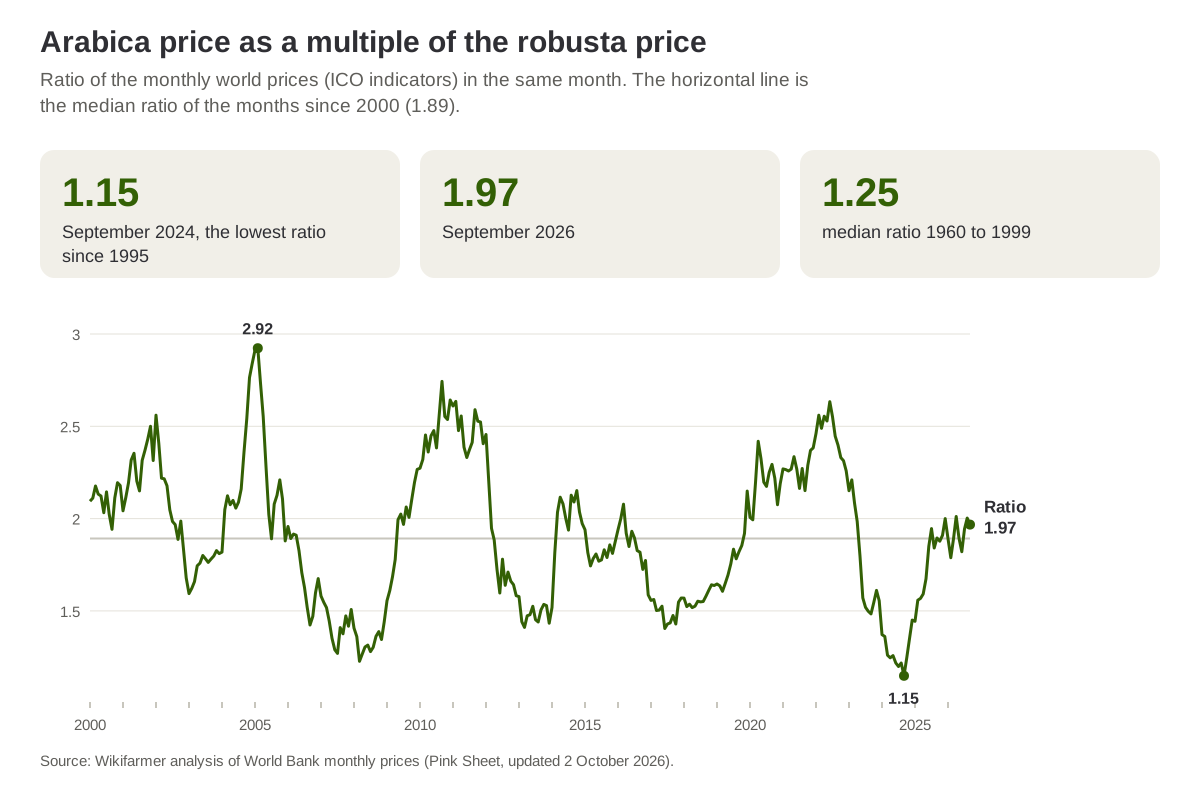
Source: Wikifarmer analysis of World Bank monthly prices (Pink Sheet, updated 2 October 2026). The horizontal line marks the median ratio since 2000.
Robusta fell 36.5% from its peak and arabica 19.8%
Arabica reached $9.05 per kilogram in February 2025 and again in November 2025, the highest price in the series since 1960 in current dollars, not adjusted for inflation, and in September 2026 it was $7.26, 19.8% below that peak and 17.8% below September 2025. Robusta fell more steeply, to $3.69, 36.5% below its February 2025 peak and 20.8% below a year earlier, so the ratio of 1.97 is now higher than in 55.8% of the months since 2000. Cocoa followed a similar path of a steep rise and a quick retreat in the same years, and cocoa gave back more of its rise in one year than in any earlier price spike.
The ratio is not affected by inflation
The ratio is the arabica price divided by the robusta price in the same month, so inflation does not affect it, since both prices are in dollars of the same year. The World Bank's arabica price is the International Coffee Organization (ICO) indicator for "other mild Arabicas", an average of the New York and Bremen/Hamburg markets, while its robusta price is the ICO indicator for Robustas, an average of New York and Le Havre/Marseilles, both ex-dock.
The gap between the two prices matters to growers and roasters
Arabica is grown mainly in Brazil, Colombia, Ethiopia and Central America, and robusta in Vietnam, Brazil, Indonesia and Uganda, so the gap between the two prices affects growers in each country differently. For roasters who use both species in their blends, the ratio shows how much more arabica costs each month, and in 2024 the difference was the smallest since the mid-1990s.
The figures show how prices moved, not what caused the moves, and are not a forecast. In the coming months, the World Bank monthly prices for October, published in early November, and the ICO monthly coffee market reports are worth following.
Sources
- World Bank. (2026). Commodity Markets, Pink Sheet monthly prices. World Bank Group.