In the global table olive trade, buying olives in bulk requires a solid understanding of quality standards, traceability, origin labelling, and supplier verification. Demand for premium olives continues to grow, while international quality standards have become stricter to reduce fraud and improve transparency across the supply chain. This guide explains how the global olive market works and shows importers, food manufacturers, retailers, and private-label brands how to reliably source olives.
What are table olives?
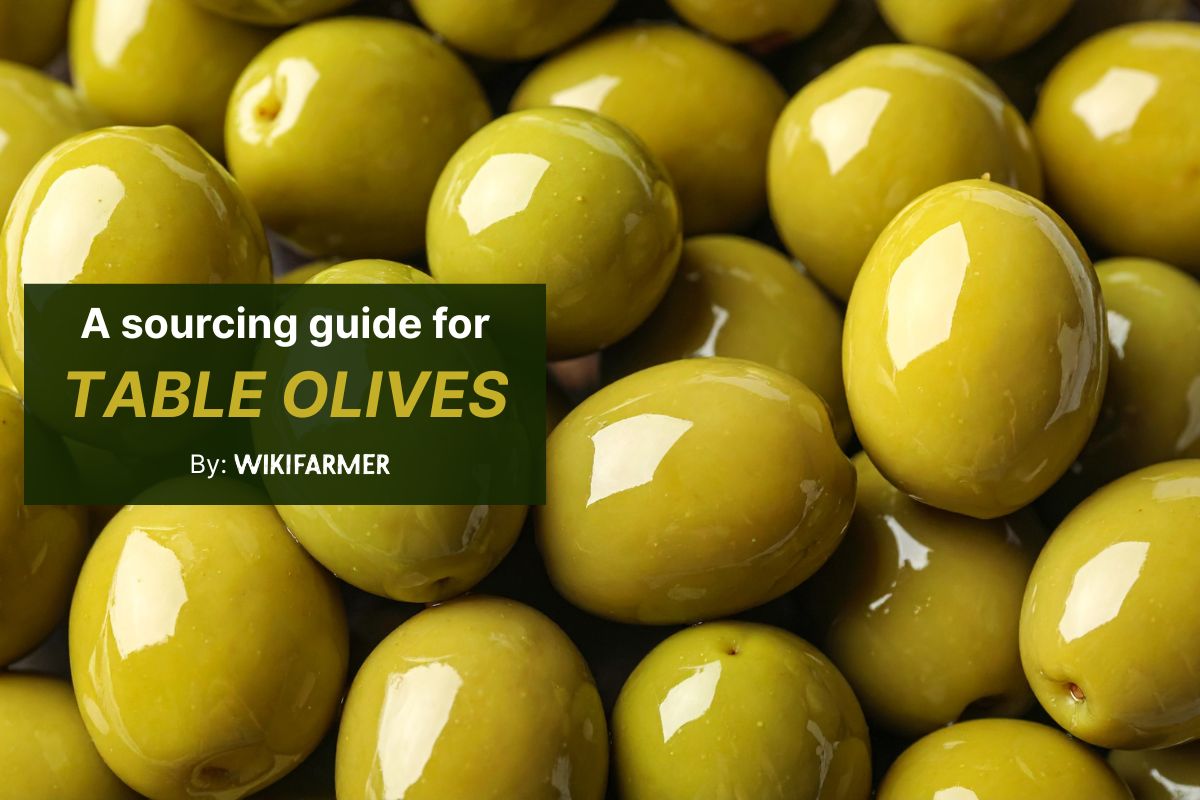
Table olives are fruit harvested from the olive tree, Olea europaea L., and then cured to remove natural bitterness. They are a separate category from olive oil and require different equipment, different fruit varieties, and different commercial standards.
What the table olive market looks like
Here are a few facts from the International Olive Council that every buyer should know going into a sourcing conversation:
- Global production: 3,316,500 tonnes in 2024/25, with a slight decrease in 2025/26
- Top producing countries: Türkiye (newly #1), Egypt (~18% of global production), Spain, Algeria, Greece, Morocco, Argentina
- Top supplier countries in international trade: Argentina (18.1% of imports into key markets), Egypt (17.6%), Spain (17.5%), Greece (12.9%), Morocco (10.1%)
- Largest single exporter: Spain is the world’s top table olive exporter by volume
- Olive growing area worldwide: roughly 11.7 million hectares, of which Spain alone accounts for 2.7 million hectares
Ripeness categories
The Codex standard classifies table olives by the stage at which the fruit is harvested:
- Green olives: harvested when the fruit has reached full size but before colour change. Colour ranges from yellow-green to pale green. Ex. Spanish-style green olives.
- Olives turning colour (often called "blonde" or "rose" olives): harvested mid-ripening. Colour ranges from pink to brown. Ex. Kalamata-style olives.
- Black olives: harvested fully ripe. Natural colour range is purple to deep black (some "black" olives sold commercially, like California-style, are actually green olives darkened by oxidation with iron salts)
Official quality grades
The IOC Trade Standard for Table Olives has four commercial categories that determine how a shipment can be sold and labelled in international trade.
- "Extra" or "Fancy": the top grade. Olives with the variety’s full characteristics and effectively no defects.
- "First", "1st", "Choice" or "Select": good quality olives with slight permitted defects in colour, shape, or skin, as long as overall appearance and flavour are unaffected
- "Trade", "Standard" or "Second": olives meeting basic specifications but with more visible defects. Used in foodservice, ingredient supply, and some private label.
- "Substandard": fruit that fails to meet the higher categories but can still be used in further processing such as pitting, slicing, stuffing or paste production.
Sizing
Olives are sized by the number of fruits per kilogram, not by diameter. The smaller the number, the larger each fruit. Common scales run from 60/70 (very large) to 401/420 (small), with smaller intervals for stuffed olives. A proper bulk specification includes the size range (fruits per kilogram).
What countries to source olives from
About seven countries supply the majority of internationally traded table olives. Each has its own varieties, processing traditions, and trading expectations one needs to understand before sourcing.
Spain
Spain is the world’s top table olive exporter, anchoring the global market. Production primarily comes from Andalusia, particularly the provinces of Seville, Córdoba, and Málaga. The most common Spanish varieties include:
- Manzanilla: medium-sized, round, the world’s most widely traded green olive variety. Often pitted and stuffed.
- Gordal ("Queen Olive"): very large, meaty, premium price.
- Hojiblanca and Cacereña: dual-purpose varieties used as table olives and for oil, common in ripe/oxidized "black" olive production.
Spain has two table olive Protected Designations of Origin recognized by the EU: Aloreña de Málaga and Aceituna de Mallorca, with applications underway for Gordal de Sevilla and Manzanilla de Sevilla
The most common trade bodies are Spanish Association of Table Olive Exporters and Producers (ASEMESA) and the Interprofessional Organisation of Table Olives (Interaceituna).
Greece
Greece is Europe’s second-largest table olive producer and exporter. The US is the largest single-country market for them. The most common Greek olives are:
- Kalamata olives: almond-shaped, dark purple, harvested ripe. EU PDO protected since 1996, only olives from Kalamata, Peloponnese can use the name.
- Conservolia: large round olives, used both green and black, primarily from Amfissa and Volos.
- Halkidiki: large green olives from northern Greece, often pitted and stuffed.
Türkiye
Türkiye’s table olive production rose 53% in the 2024/25 crop year, the largest single producer in the world for the first time, a big change in the global supply map. Domestic consumption is rising sharply as well, up 13% in the same period, the strongest growth of any major market in that season. Türkiye exports large amounts of table olives to the Europe. Key varieties include Gemlik (small, oil-rich black olives from the Marmara region, just recognised by the EU for PDO status), Memecik, and Domat.
Egypt
Egypt accounted for roughly 18% of world table olive production in 2024/25, despite a 20% year-on-year decline. Production mainly comes from the western desert (Siwa, Marsa Matruh) and the Sinai Peninsula. The main commercial variety is the Picual-derived Egyptian. The US is a large importer of Egyptian olives, especially since 2018 U.S. tariffs levied on Spanish ripe (black) olives.
Morocco
Morocco is a significant olive supplier to Europe and North America, particularly for the Picholine Marocaine variety, although exports to Europe have softened slightly in recent years. Climate stress is a large risk factor for Moroccan supply.
Argentina
Argentina is the largest individual supplier country in international table olive trade flows, accounting for 18.1% of imports into key markets in the September 2024–April 2025 trade period. Production comes primarily from the provinces of Mendoza, La Rioja, San Juan, and Catamarca. The most common variety is Arauco, a large, green-purple variety with a distinctive flavour profile.
Italy, Portugal, and emerging origins
Italy is a major table olive producer (the primary producing regions are Cerignola, Bella di Cerignola, Nocellara del Belice from Sicily, and Ascolana Tenera from Marche), but it consumes most of its production domestically. Italy also imports large amounts of bulk olives for re-processing and re-export.
Portugal’s table olive sector has been expanding rapidly since the imposition of US tariffs in 2018.
Outside the Mediterranean, 58 countries produce olives commercially, including newer entrants such as Uzbekistan, Azerbaijan, and El Salvador.
Where to buy olives in bulk
How and where do you place an order for bulk olives? Four sourcing channels dominate international bulk olive trade:
Cooperatives and producer groups
Cooperatives collect production from small and mid-sized producers within a region. They are best for traceable single-origin and often single-variety table olives, as well as for PDO-protected products. However, they function seasonally, offer depends on how the local season is going.
Industrial processors and exporters
Industrial processors and exporters buy from cooperatives and farmers, cure and grade the fruit, and ship in container-load volumes. They offer a year-round supply, coordinated specifications, export documentation, and the capacity to handle large quantities. However, processors blend across farms and sometimes across origins, which can be a challenge if consumers require a single-origin claim.
Private label and contract packers
Private label processors produce finished, retail-ready or foodservice-ready products, such as custom jars, cans, pouches, and IBC totes, branded for the buyer. This channel is for supermarket private label, D2C food brands, and foodservice operators who want a finished SKU rather than a raw drum. MOQs are typically higher for these than for industrial bulk because of packaging tooling costs.
B2B trade platforms
Digital sourcing platforms, such as the Wikifarmer Marketplace and regional platforms, give buyers access to multiple verified producers and exporters in one place. They are valuable for identifying suppliers, comparing quotes, benchmarking market prices and issuing RFQs.
Official standards for table olives
The following international reference documents define what bulk olives are, how they are classified, and how they are to be tested:
Codex Alimentarius CXS 66-1981, Standard for Table Olives
The Codex standard for table olives is the global food-safety reference, issued by the FAO and WHO (Codex Alimentarius Commission, CXS 66-1981, adopted 1981, revised 1987 and 2013, with amendments to Section 8.2 in 2022). It defines table olives, sets the three ripeness categories, specifies trade preparations, defines minimum quality factors, and establishes the size-grading scale by fruits per kilogram. Importers should require Codex compliance in contracts.
IOC Trade Standard COI/OT/NC No 1/2004
The IOC’s Trade Standard for Table Olives, adopted in 2004, is the global commercial reference document (IOC, COI/OT/NC No 1/2004). It establishes the four commercial categories, defines authorized additives and flavourings, specifies labelling requirements, and sets allowable defect levels per category. IOC member countries must apply this standard in their national legislation.
- IOC Sensory Analysis Method: Outlines standardized tasting panel methodology for assessing table olive quality, covering positive attributes (saltiness, acidity, bitterness, hardness, fibrousness, crunchiness) and defects (rancidity, soapy, putrid, musty, butyric, zapateria).
- IOC Quality Management Guide: Outlines best-practice manufacturing standards for processors.
EU regulatory framework
For table olives entering the EU, food law follows the framework of Regulation (EC) No 178/2002 (the General Food Law), Regulation (EU) No 1169/2011 (Food Information to Consumers), and the EU’s Protected Designation of Origin (PDO) and Protected Geographical Indication (PGI) framework administered via the eAmbrosia register (European Commission Directorate-General for Agriculture and Rural Development).
What to verify before you sign
Here are several factors to take into account before sourcing table olives from a new supplier:
- Variety and origin verification: Pollen-DNA or chemical varietal profiling can confirm the claimed variety. This is especially important for premium varieties where substitution is common.
- Microbiological safety: Fermentation in green olives is a controlled process. Inadequate brine acidity or low salt concentration creates risk of Clostridium botulinum in finished product
- Pesticide residues: Codex Alimentarius and the EU set maximum residue limits for pesticides on olives. Independent residue testing is common.
- Heavy metals: lead, cadmium, and tin may be tested, particularly for olives packed in cans or with iron-based colourants.
- Brine and packing media specifications: Check minimum salt content, acidity, and authorized additives. Variation outside these limits affects shelf life and food safety.
- Drained weight and uniformity: A common commercial dispute. The drained weight of the product should not be less than 60% of the water capacity of the container and buyers should verify on arrival.
Recognized testing laboratories
For independent verification, common laboratories for olive analysis include Eurofins, SGS, Intertek, and the network of Spanish technical institutes including Instituto de la Grasa (CSIC) and IFAPA (Andalusian Institute for Agricultural Research).
Common mistakes to avoid
- Specifying only the colour without variety, ripeness, category, and size in fruits per kilogram leaves too much room for substitution.
- Confusing oxidized black with naturally ripe black. California-style black olives are typically green olives darkened by oxidation with iron salts and are a different product from Kalamata or natural Greek black olives.
- Ignoring brine specifications. Salt content, acidity, and authorized additives must be in the contract.
- Not factoring in tariffs. Buyers sourcing without factoring in added rates produce landed-cost surprises.
- Trusting variety claims without verification. Fraud, especially for PDO categories, is common.
- Basing purchasing solely on quotes. Prices significantly below the market range may reflect lower quality grade or substitution risk.
Conclusion
Global olive supply is diversifying away from the traditional Mediterranean core, and consumer demand in non-producing markets continues to grow. Bulk olive sourcing is evolving as buyers seek a consistent, reliable supply and traceability rules tighten. Successful buyers depend on knowing where to source, how to verify quality, and how to assess supplier reliability. The strongest procurement strategies are built on clear specifications, transparent documentation, and careful supplier qualification.