

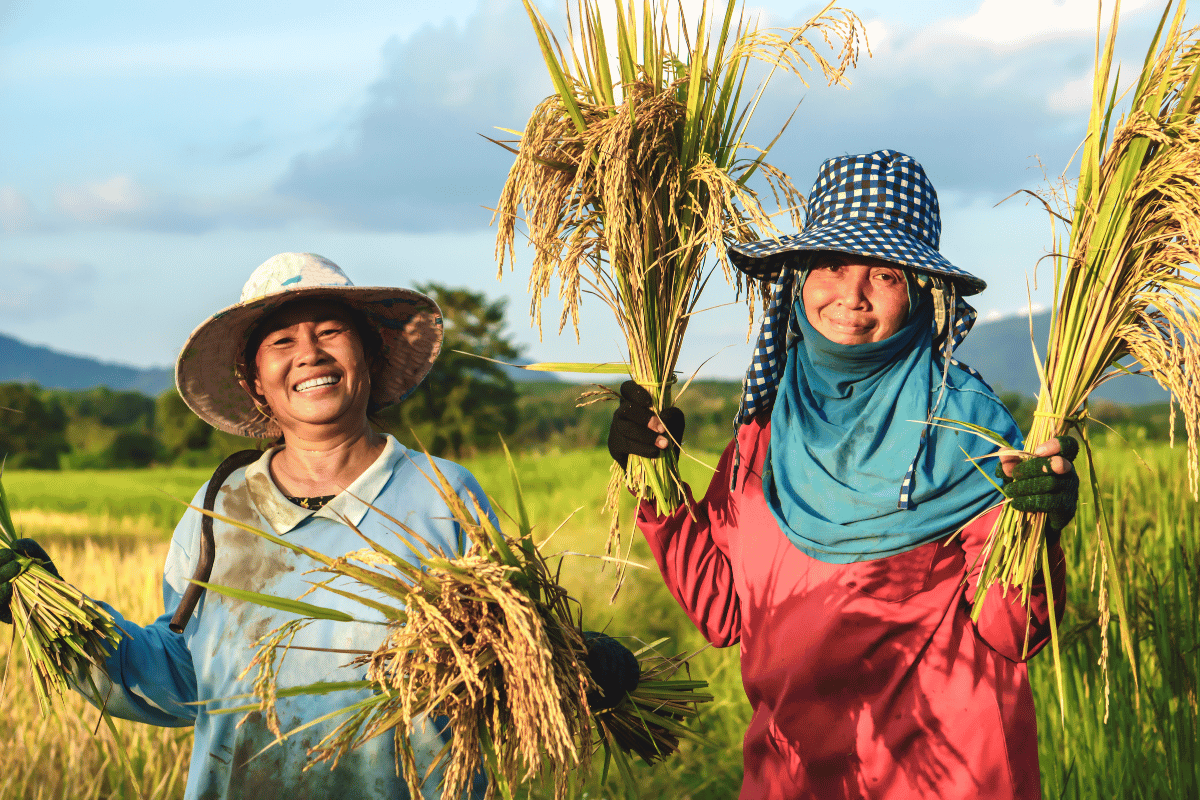
Women hold 42% of the jobs in the world's agrifood systems, about 1.39 billion people, and that share has barely shifted since 2000. The figure comes from FAO's Suite of Gender Indicators, released in June 2026, and it settles one question while opening a harder one. Women are already a large, steady part of the workforce that grows, processes, moves and sells food. The gap that matters is no longer whether women take part. It is the quality, security and pay of the work they do once they are in.
What the participation figure hides
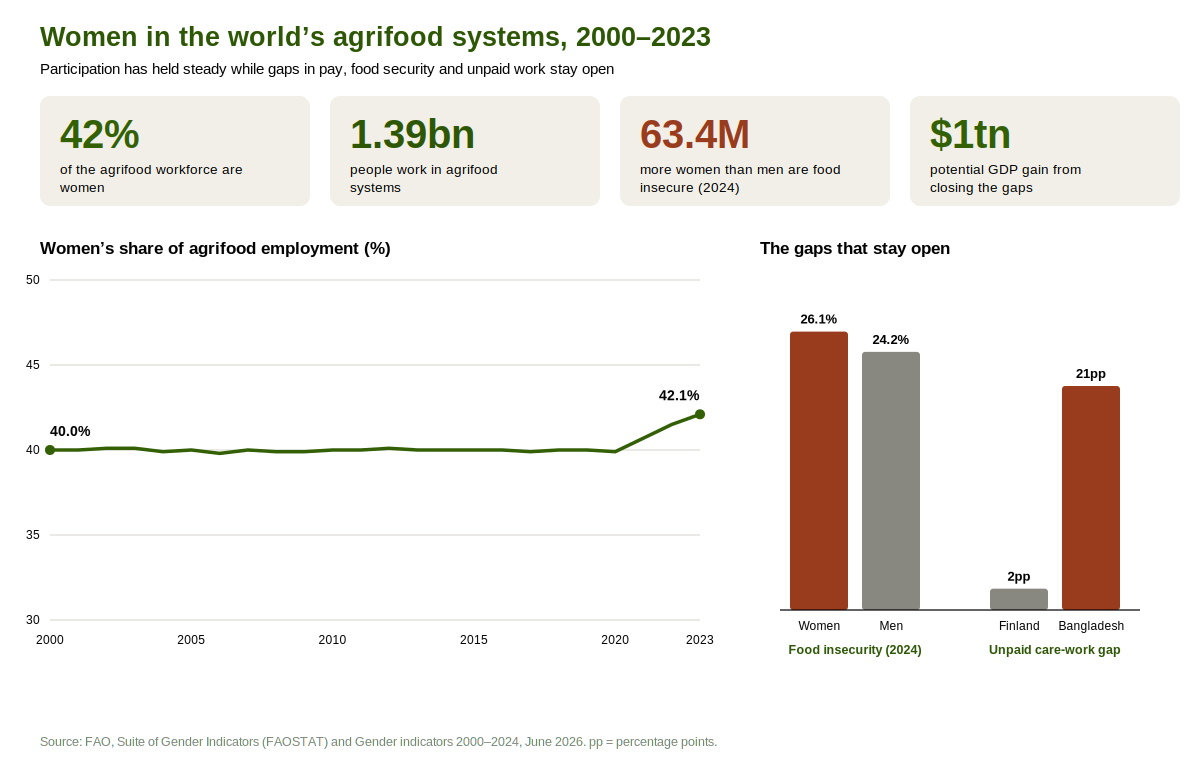
Women's share of global agrifood employment, 2000–2023, alongside persistent gaps in food security and unpaid care work. Source: FAO Suite of Gender Indicators (FAOSTAT), June 2026.
A stable 42% share looks like equilibrium, but the number behaves differently across regions. In much of Africa and Asia women are more concentrated in agrifood work than men, which reflects how few other jobs are open to them where farming still dominates the economy. In the Americas and Europe the pattern flips and men hold the larger agrifood share, as women move into other sectors. The same headline percentage therefore describes a constraint in one place and a choice in another, and the global average smooths over both.
The type of job also tracks income levels. In lower-income countries women in agrifood systems are more likely than men to be self-employed rather than employed, often in informal, lower-productivity activity. As GDP per capita rises the balance shifts and more women move into wage employment, which tends to be more stable and better protected. Where a woman sits on that spectrum shapes almost everything else about her work.
Informal jobs, lower pay, weaker protection
Informality runs through the whole sector. In more than half of countries with data, over 90% of agrifood employment is informal, and within that, women are consistently more likely than men to hold the informal jobs that carry no contract, no social protection and little security. The gap between women and men is narrower in agriculture, where informality is close to universal for everyone, and wider in off-farm agrifood work such as processing, distribution and retail, where formal jobs exist but reach men more often.
Pay does not follow a single rule. Women earn less than men among agricultural employees in roughly 60% of countries, but the size and even the direction of the gap vary widely. Several countries in Latin America, parts of Europe and parts of sub-Saharan Africa show parity or higher earnings for women, while men tend to earn more across Northern America and Asia. The wage gap is real in most places and reversed in a meaningful minority, which is why a global average understates how much depends on local labour markets, law and social norms.
Land, finance and phones remain out of reach
Secure rights over agricultural land sit behind much of the income gap, because land underpins investment, technology adoption and the productivity that follows. In 85% of countries with data, women report weaker ownership or secure tenure than men. The gap is consistently against women in sub-Saharan Africa and Asia and smaller in higher-income regions such as Europe. Legal protection helps but does not settle the matter on its own. FAO finds only a weak link between strong legal frameworks for women's land rights and the gaps actually observed, because customary law, social norms and patchy enforcement keep formal rights from translating into control on the ground.
Digital access shows the same shape at a smaller scale. Women generally own smartphones at lower rates than men, with the widest gaps in South Asian countries such as Pakistan, Bangladesh and India where overall ownership is also lowest. Where ownership is high the gap between women and men shrinks toward zero. The pattern points to specific barriers around cost and household control rather than a simple lack of devices, and it carries into access to mobile services, market prices and the kind of agritech tools that depend on a phone in the user's hand.
Education improved without closing the work gap
Gaps in basic schooling have narrowed in many countries and reversed in some, with girls outpacing boys in upper secondary completion across parts of the Americas. The progress thins out at the edges. Disparities persist at higher education levels and in rural areas, literacy runs lower in the countryside for both sexes, and the widest gaps between men and women cluster in countries with low overall literacy. In an analysis of 59 countries, young women in the poorest households were four times as likely to be illiterate as those in the richest, so income inequality and gender inequality compound each other.
Higher attainment has not bought equal access to decent work. Women have not moved into agriculture, forestry, fisheries and veterinary degrees at the same rate as men, and in most countries men make up the larger share of graduates from those programmes. Education raises what a woman could do, but what she actually does still depends on land, finance, law and the time she has available.
Unpaid work and social rules set the limit
Across every country measured, women spend more time than men on unpaid domestic and care work, with the gap running from about 2 percentage points in Finland to 21 percentage points in Bangladesh. In rural areas the load is tied to concrete tasks such as collecting water for the household and for livestock, which eats directly into the hours available for paid or productive work. Time spent unpaid is time not spent earning, and it falls hardest where infrastructure is weakest.
Formal and informal rules sit underneath all of it. The OECD's Social Institutions and Gender Index shows lower discrimination in Europe and the Americas and higher levels across much of Africa and Asia, with wide variation even between neighbouring countries at similar income. Laws against gender-based violence have spread over the past two decades but still do not exist in parts of Africa, the Near East and Asia. These rules shape who controls assets, who makes decisions and who can take a job at all.
Closing the gaps is an economic argument
The case for acting is measurable. Research cited by FAO estimates that reducing gaps between women and men in income, employment and education could close up to 52% of the gender gap in food insecurity. Closing gaps in farm productivity and wages could add about USD 1 trillion to global GDP and reduce the number of food-insecure people by 45 million. Women already face higher rates of moderate and severe food insecurity, with 63.4 million more women than men aged 15 and over food insecure in 2024, so the same interventions that improve fairness also improve food security and output.
The data points consistently in one direction. Participation is settled, and the unfinished work lies in pay, tenure, finance, time and the institutions that govern them. The contributions of women already running farms and food businesses are visible across the sector. What changes the outcome is whether the conditions around that work are made equal.
Sources
- FAO. Gender indicators 2000–2024 – June 2026 update. FAOSTAT Analytical Briefs, No. 128. Rome, 2026.
- FAO. FAOSTAT: Suite of Gender Indicators. Accessed June 2026.
- FAO. FAO releases most comprehensive dataset to date on women in agrifood systems. FAO Newsroom, 17 June 2026.