
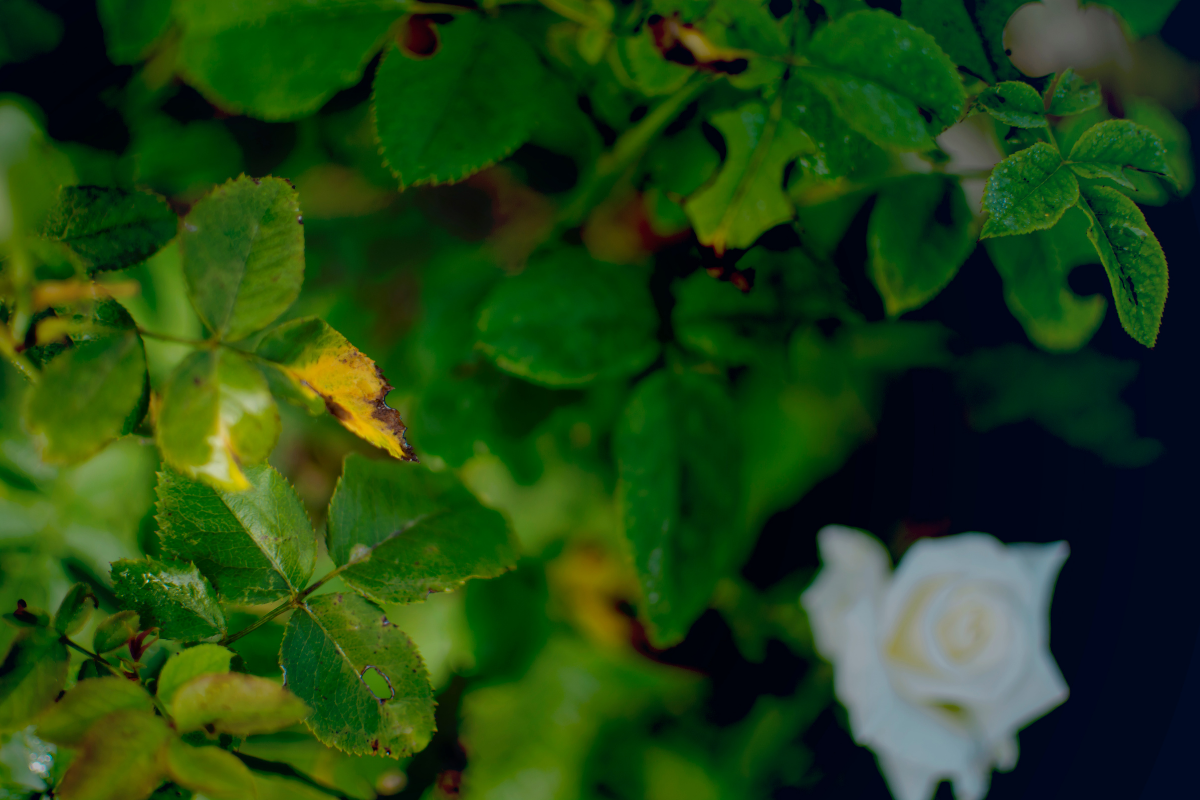
Yellow leaves on a rose are a symptom rather than a disease, and four broad groups of causes sit behind them. Watering mistakes, fungal diseases, insect and mite attack, and nutrient deficiencies. The diagnosis never comes from the yellowing itself but from what accompanies it, meaning the spots, the webbing, the powder on the leaves, where on the plant the yellowing starts, and the season. This guide opens with a table linking each symptom to its likely cause, then takes each cause in turn along with how to deal with it.
Symptom and cause table
| What you see | Likely cause | First move |
|---|---|---|
| Yellow leaves with black blotches, falling early | Black spot | Strip and bin affected leaves, improve airflow, treat preventively |
| White, floury coating on leaves and buds | Powdery mildew | Open the bush up, remove infected shoots, sulphur-based treatment |
| Orange pustules on the underside of leaves | Rose rust | Remove leaves, keep foliage dry, copper spray |
| Dull, scorched-looking leaves with fine webbing and pale stippling | Spider mite | Jet of water under the leaves, predatory mites |
| Distorted young shoots with clusters of small insects | Aphids | Wash off with water, encourage beneficial insects |
| Even yellowing with no spots, and soft stems | Overwatering or poor drainage | Check the soil at depth, water less often |
| Drooping leaves drying from the edges inward | Drought or heat stress | Deep watering at the root, then mulch |
| Yellow leaf blade with veins staying green, on young growth | Iron deficiency | Chelated iron and a check on soil pH |
| Pale, yellowish lower leaves on a plant that is not growing | Nitrogen deficiency | Balanced feed in spring |
Watering mistakes
Watering is the first thing to check, because both extremes produce yellow leaves. Too much water, or soil that does not drain, fills the pore spaces and leaves the roots without oxygen, so they rot while the plant yellows evenly, drops leaves and flowers, and becomes far more prone to fungal disease. At the other extreme, prolonged drought dehydrates the plant, the leaves droop, dry from the edges inward and fall.
The check is done by hand. Scrape into the soil 5 to 8 cm down and water only when it has dried at that depth, not because the surface looks dry. In containers, water should run freely from the drainage holes and never sit in a saucer. Water goes to the root and not over the foliage, since wet leaves are the ideal condition for fungal spores.
Spider mites
Spider mites are the most common rose pest and the most misdiagnosed cause of yellowing, because the mite itself is barely visible to the naked eye. It lives on the underside of the leaves and sucks the sap, leaving dense pale stippling and, in advanced attacks, fine webbing between leaves and stalks. The foliage takes on a dull, bronzed look, yellows and eventually dries as if scorched. When yellowing starts on the lower leaves in hot weather, spider mite is the first thing to rule out.
Hot, dry, dusty conditions favour them. The first intervention is mechanical, with a jet of water directed at the underside of the leaves, which removes a large part of the population. Biological control with the predatory mite Phytoseiulus persimilis follows, and chemical miticides are a last resort under professional advice, since spider mites develop resistance quickly.
Aphids and other insects
Aphids appear mainly in spring, clustered on soft new shoots and flower buds. They suck the sap, young leaves distort and yellow, and their sticky honeydew gets colonised by sooty mould, a black film that blocks photosynthesis. Washing them off with water, encouraging ladybirds and lacewings, and treating only heavy infestations resolves the problem. Caterpillars chew notches from the leaf margins, while thrips work inside the buds and are a frequent reason flowers open damaged or not at all.
Black spot
Black spot, caused by the fungus Diplocarpon rosae, is the most serious rose disease in temperate and Mediterranean gardens and the usual reason a plant stands half bare by midsummer. It starts as irregular black blotches on leaves and young stems, the tissue around them yellows, and the leaves drop early. Without enough foliage the plant cannot photosynthesise, so it weakens, and repeated infections year after year can kill it.
Moisture and wet foliage drive it. Control begins with removing every affected leaf, including those already on the ground, which go in the bin and never the compost, since the fungus overwinters on them. Preventive sprays follow, along with the single most effective long-term measure, which is choosing resistant varieties when buying.
Powdery mildew
Powdery mildew, caused by Podosphaera pannosa, formerly known as Sphaerotheca pannosa var. rosae, is recognised instantly by the white, floury coating over leaves, stalks and buds. Affected leaves distort, yellow and dry, and buds often fail to open. It behaves differently from the other fungal diseases, because it is favoured by warm days and humid nights with dry foliage rather than by rain, and free water on the leaf surface actually destroys its spores.
Good airflow through correct pruning is the most effective prevention. Sulphur-based products treat it, applied with care in high temperatures where they scorch foliage. The familiar homemade baking soda solution works mainly as a preventive and does little for a plant already heavily infected.
Rust and downy mildew
Rose rust, caused by fungi of the genus Phragmidium, shows as small orange pustules on the underside of the leaves, with yellow blotches appearing on the upper surface. Downy mildew, from Peronospora sparsa, produces irregular blotches that turn from yellow-green to purple or brown, with greyish growth underneath in humid conditions, and it attacks the softest tissues of the plant. Both respond to the same combination of measures. Remove affected leaves, improve airflow, keep the foliage dry, and spray preventively with copper.
Nutrient deficiencies
When the yellowing is even, with no spots, webbing or powder, the cause usually lies in nutrition. Nitrogen deficiency shows as pale, yellowish lower leaves on a plant that has stopped growing, while iron deficiency appears first on young leaves, with the blade turning yellow and the veins staying green, a picture linked to alkaline soils where iron is locked up and unavailable to the plant.
The answer is not more fertiliser but the right one. A balanced feed in spring covers the basics, while iron chlorosis calls for chelated iron, which stays available even at high pH. Overfeeding, especially with nitrogen during hot weather, does the opposite of what is intended, scorching roots and dropping leaves.
Stress from heat, transplanting and mistimed pruning
A rose that wilts suddenly, with no spots and no insects, has usually taken some kind of shock. Recent transplanting, particularly when it comes with an abrupt change in sun exposure and temperature, causes wilting that passes on its own with light shading and regular deep watering. A heatwave produces the same picture, with leaves drooping at midday and recovering by evening.
Two further causes go unnoticed. Hard pruning in summer, followed by hot weather, leaves the plant exposed and triggers yellowing, which is exactly why the main prune belongs in late winter. The second is position, since roses need at least 6 hours of direct sun a day and grow weak and pale in shade.
Why buds fail to open
Buds that form but then wither or rot before opening usually come down to three factors. Attack by powdery mildew or thrips, which destroy the flower tissue. Prolonged wet weather as the flowers are due to open, which glues the outer petals together in what growers call balling, a problem that hits many-petalled varieties hardest. And excess nitrogen, which produces lush foliage at the expense of flowering. Removing the affected buds and shifting to a feed higher in phosphorus and potassium corrects the picture within the same season.
Prevention that solves most problems
- Water at the root, never over the foliage, and preferably early in the day so the plant dries out by evening
- Spacing and pruning that ventilate the centre of the bush, because moving air breaks the fungal cycle
- Prompt removal of affected leaves, including fallen ones, into the bin rather than the compost
- Disinfected tools between plants, since blades carry pathogens from bush to bush
- Resistant varieties at the point of purchase, which cut black spot and mildew dramatically
Frequently asked questions
Why are the lower leaves of my rose turning yellow
When yellowing starts on the lower leaves in hot weather, spider mite is the most likely cause, so check the underside for fine stippling and webbing. Overwatering and nitrogen deficiency come next.
How do I tell watering problems from disease
Yellowing from watering is even, with no spots, powder or webbing. Black blotches mean black spot, a white coating means powdery mildew, and orange pustules underneath mean rust.
Can a rose that has dried out be saved
Often yes. Scratch the bark lightly on a cane, and if the tissue underneath is green, the plant is alive. Cut dead canes back to healthy white pith, correct the watering and wait for new growth.
What should I spray for yellow leaves
There is no single spray, because yellowing is a symptom of many different causes. Copper covers black spot, rust and downy mildew, sulphur covers powdery mildew, while spider mites and aphids need entirely different products.
Should I remove yellow leaves from a rose
Yes, when the yellowing comes from a fungus or a pest, because those leaves are a source of reinfection. Remove them along with any that have fallen, and put them in the bin.
Why did my rose wilt right after planting
This is transplant shock, made worse when the plant moves abruptly into a sunnier or hotter position. With light shade for the first few days, deep watering and some patience, it usually recovers.
Important notes
Conditions differ from garden to garden, and the same set of symptoms can have different causes in different places, so treat this guidance as a starting point and get a local diagnosis for persistent or severe problems.
Try non-chemical measures first, and where treatment is needed, use only products approved for roses in your country, strictly according to the label.
References
- Royal Horticultural Society, Rose black spot.
- Clemson Cooperative Extension, Rose diseases.
- Pacific Northwest Pest Management Handbooks, Rose powdery mildew.