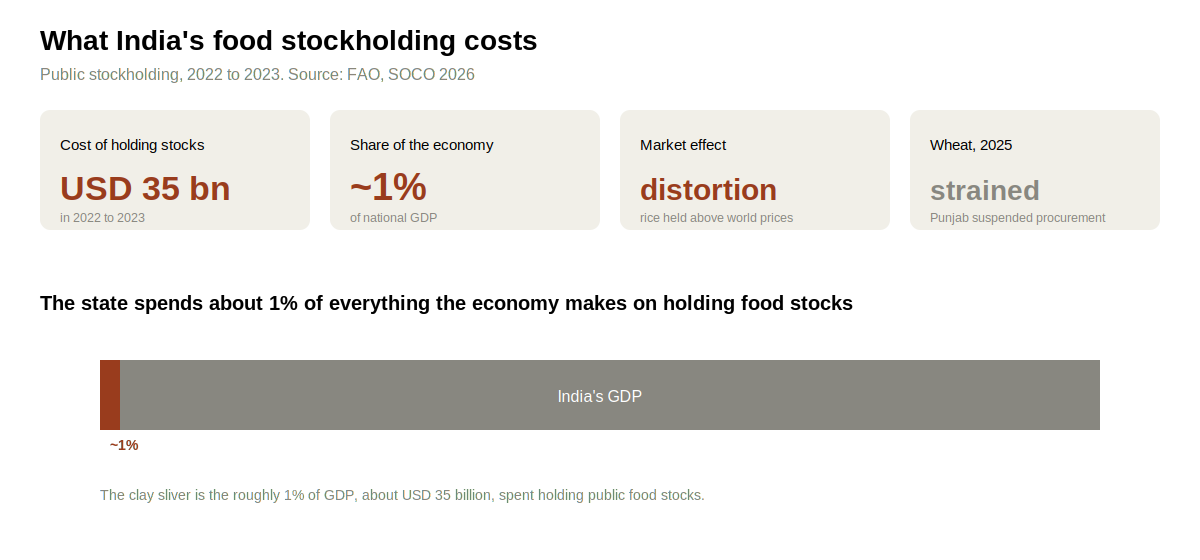
Governments hold public food stocks to keep staples affordable and available, and few do it on the scale of India, whose public stockholding cost about USD 35 billion in 2022 to 2023, close to 1% of its GDP. FAO's State of Agricultural Commodity Markets 2026 asks whether that money buys what it is meant to, and draws a sharp line between the kinds of stock a government can hold. The large buffer stocks meant to hold prices steady turn out to be the costliest and the least effective, while smaller, targeted tools do more for far less.
The confusion comes from treating one word, stocks, as if it described a single policy. A reserve released after a cyclone is not the same instrument as a warehouse full of grain bought to fix a price, and the report keeps the three main types apart because they succeed or fail on very different terms.
Key takeaways
- India's public stockholding cost about USD 35 billion in 2022 to 2023, close to 1% of GDP.
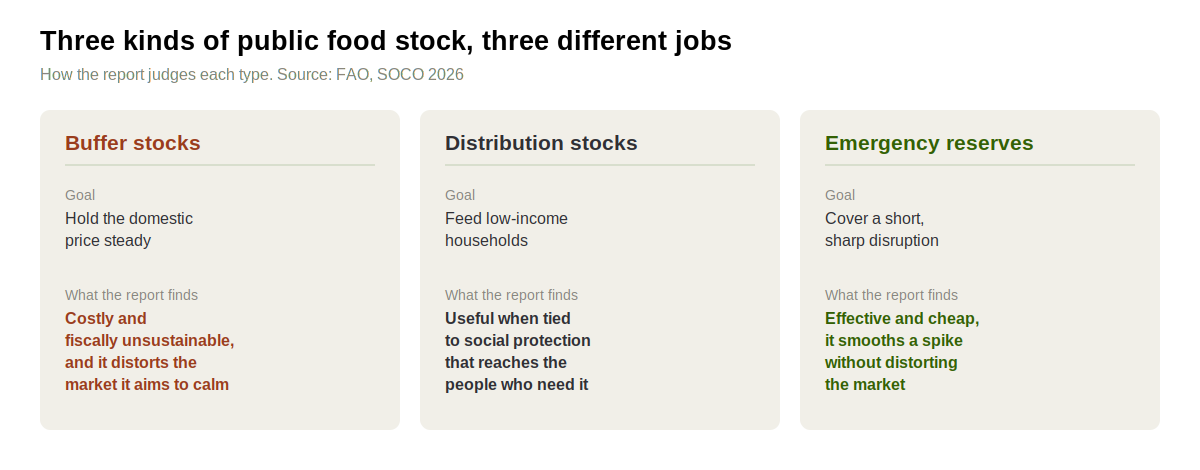
- Price-stabilising buffer stocks are the weak link. The report calls them costly, fiscally unsustainable, and historically unable to hold prices steady for long.
- They distort the market they aim to calm. Buying and selling at administered prices has kept India's domestic rice above world prices and dulled farmers' incentives.
- Targeted tools do better. Emergency reserves and cash transfers protect vulnerable households at a fraction of the cost and without distorting prices.
- Open trade is the durable buffer. Countries well connected to world markets need smaller and cheaper national stockpiles.
Three kinds of public stock, doing three different jobs
Pd to steady. In India, procurement and releases at administratively set prices have kept the domestic rice price above the world price, which sounds like support for farmers but weakens the signal that tells them what and how much to plant. At the global level the report is blunt that buffer stock schemes have historically failed to deliver sustained price stabilisation, and that holding grain off the market in one large producer can move prices for everyone else. A tool meant to add stability can end up adding distortion that travels through trade to other countries.
What works better and costs less
The report points to two cheaper tools that do the job the buffer stock cannot. Emergency food reserves, kept small and tied to social protection for the most vulnerable, can smooth a short, sharp shock and add supply when it is needed without holding the whole market above its natural level. Alongside them, cash transfers and food assistance protect the households most at risk during a price surge, and they do it at lower cost than a national stockpile, while helping families keep buying the varied food that protects against micronutrient gaps. Cash reaches the people who need help directly, rather than subsidising a price for everyone whether they need it or not.
The durable buffer is deeper trade connections
The most reliable protection against a domestic shortfall is access to a wide, well-connected market. A country able to import from several suppliers when its own crop fails does not need to sit on an expensive mountain of grain as insurance. Deeper integration and diversified trade links lower how much a government must spend on stocks to feel secure, which is why the report frames open trade, targeted reserves and social protection as the combination that delivers food security, rather than large price-fixing stockpiles that drain budgets and distort markets.
Sources
- FAO. 2026. The State of Agricultural Commodity Markets 2026. Rome.