In 2021, 40 net food-importing countries were buying more than 30% of their wheat from Ukraine and the Russian Federation. When the war closed Ukraine's Black Sea ports in February 2022, all of them discovered at the same moment how much rested on a single trade route. The FAO Food Price Index reached 159.3 in March 2022, the highest value ever recorded.
FAO's State of Agricultural Commodity Markets 2026 uses that episode as its clearest case study in trade vulnerability, and the interesting part is not the shock itself. It is the difference between the countries that absorbed it within weeks and the ones that could not, because that difference was decided long before February 2022.
Key takeaways
- 40 net food-importing countries relied on Ukraine and Russia for more than 30% of their wheat in 2021.
- The FAO Food Price Index hit 159.3 in March 2022, its highest level on record.
- Corridor disruptions added 18 percentage points to food commodity prices, alongside rising fertiliser costs.
- Wheat prices fell 7.9% once the Istanbul agreements were signed and implemented.
- 32.9 million tonnes moved through the corridor between August 2022 and July 2023, and 57% of it went to developing countries.
One route carried a large share of the world's wheat
Ukraine and Russia were major exporters of wheat, barley, maize, rapeseed, rapeseed oil, sunflower seed, and sunflower oil before 2022. The Black Sea route that carried those goods was well established, and countries across the Near East and Northern Africa relied on it heavily for practical reasons. Geographical proximity meant lower shipping costs, so buying from Odesa or Novorossiysk was simply cheaper than buying from Australia or the Americas.
That logic works until the route stops. The war blocked Ukraine's Black Sea ports, raised shipping risk and insurance costs across the region, and left buyers competing for cargoes from further away. Disruption to the Black Sea and Red Sea corridors, combined with a steep fall in fertiliser exports from Russia, pushed food commodity prices up by a further 18 percentage points. Energy compounded it, since Russia was, at the time, the second-largest producer of oil and natural gas, and higher fuel prices feed straight into freight and fertiliser costs.
Who could switch suppliers and who could not
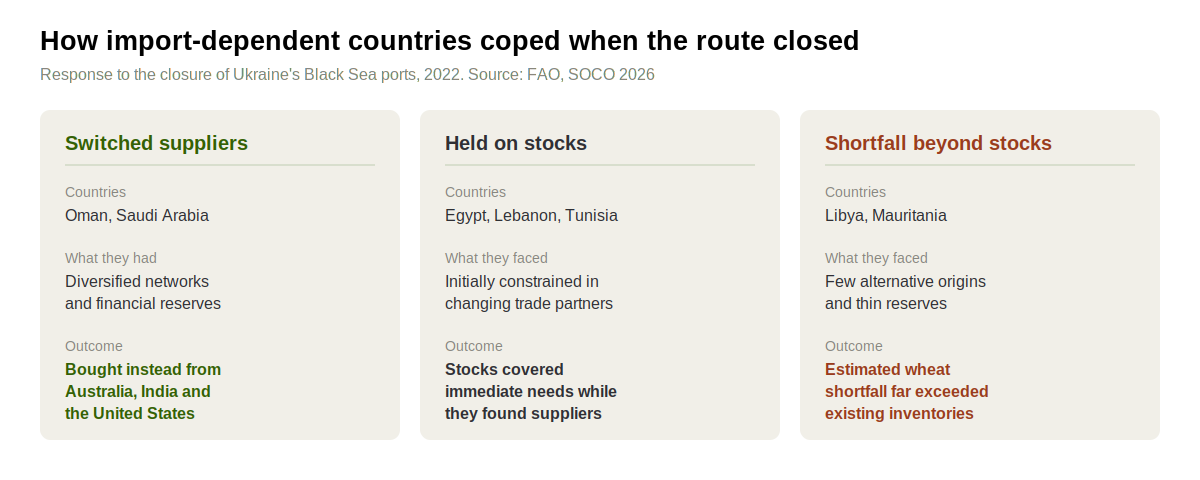
Oman and Saudi Arabia had diversified trade networks and the financial resources to use them, and they replaced Black Sea wheat with cargoes from Australia, India and the United States. Egypt, Lebanon and Tunisia found themselves initially constrained in changing trade partners, but they held enough stocks to cover immediate needs while they worked the problem. Libya and Mauritania had neither option, and their estimated wheat import shortfalls far exceeded the inventories they held.
Dependence on one origin was the common starting point for all of them. What separated the outcomes was the number of alternative suppliers each country could actually reach and the money available to pay a higher landed price. The countries that came through were the ones that had built a wider network before they needed it, which is the same finding that runs through the report's wider work on how concentrated trade routes transmit a shock.
Reopening the corridor brought prices down almost immediately
The halt in maritime exports from Ukraine lasted until late July 2022. On 22 July, after mediation by the United Nations and Türkiye, two agreements were signed in Istanbul. The Initiative on the Safe Transportation of Grain and Foodstuffs from Ukrainian Ports, commonly known as the Black Sea Grain Initiative, established a safe maritime humanitarian corridor for exports from three Ukrainian Black Sea ports. A separate Memorandum of Understanding provided assurances that Russian food and fertiliser exports would not be impeded by measures imposed on Russia, for a period of three years, although ammonia exports never resumed under it.
Implementation ran through a Joint Coordination Centre in Istanbul, staffed by senior representatives from Russia, Türkiye, Ukraine and the United Nations. Wheat prices, which had climbed sharply when the war broke out, were estimated to have fallen by 7.9% on the signature and implementation of the agreements. Prices responded to the restoration of predictability rather than to any new physical supply, which is worth noting for anyone reading grain markets, since expectations move before cargoes do.
What the corridor delivered while it lasted
Between August 2022 and July 2023 the initiative moved 32.9 million tonnes of foodstuffs out of Ukraine. Of that volume, 57% went to developing countries, many in Africa and the Near East, and the flows also freed up grain for humanitarian operations in Afghanistan, Yemen and the Horn of Africa.
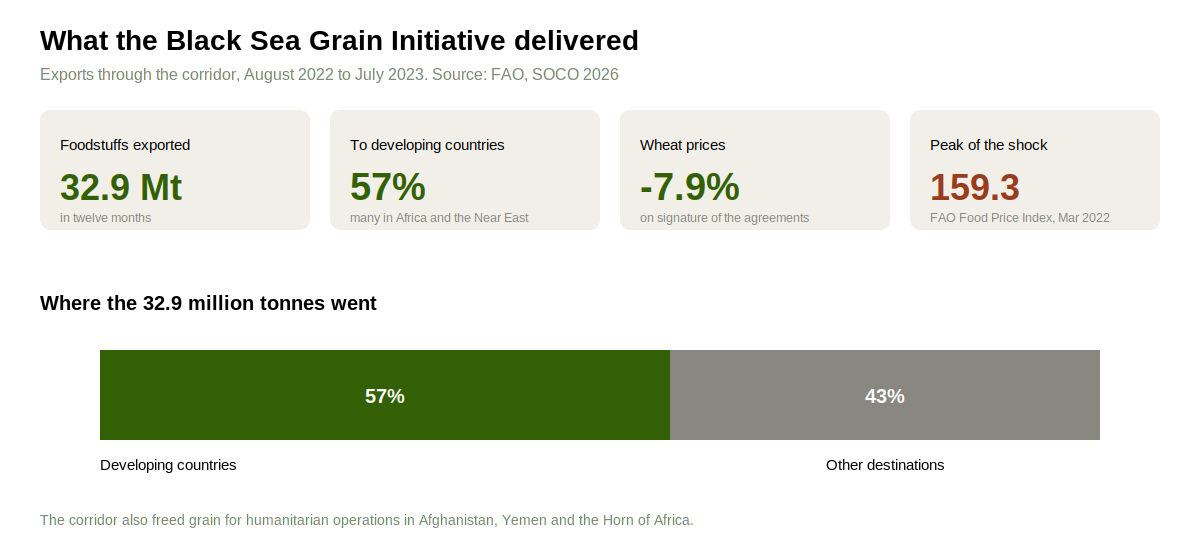
The agreement lapsed in July 2023. What it demonstrated in twelve months is that a trade route can be restored by negotiation faster than supply chains can be rebuilt around it, and that the gain shows up in prices for everyone rather than only for the countries at either end of the corridor.
The lesson for countries that import their grain
Import dependence is not itself a weakness, and the report is careful about this. A country that imports wheat from six suppliers on three continents is in a stronger position than one that grows a little more of its own but buys the rest from a single neighbour. Armenia illustrates the risk, with a cereal import dependency of 75% and a wheat market closely tied to the Black Sea, mainly to Russia as its principal supplier, which produces a strong if short-lived price response whenever that market moves.
The practical implication sits with procurement rather than production. Spreading purchases across origins costs a little more in normal years and pays for itself in the year a route closes, and the same applies to keeping working relationships with well-connected trading hubs rather than relying on the cheapest single lane. Emergency reserves sized for a short disruption are the complement to that, not a substitute for it.
Cost is the other half of the story. In low-income countries, 72% of the population could not afford a healthy diet in 2024, so a higher import bill does not simply move a line in a national account. It changes what families can put on the table, which is where trade policy stops being abstract and becomes a question of food security.
Sources
- FAO. 2026. The State of Agricultural Commodity Markets 2026. Rome.