
In greenhouse vegetable production, nutrients are almost always delivered together with the irrigation water, through fertigation. The most widely used products for this are crystalline water-soluble fertilizers, and two grades stand out, the balanced 20-20-20 and the high-potassium 12-12-36. Knowing when each one fits, along with how to manage electrical conductivity, pH and calcium, largely determines both yield and fruit quality.
What crystalline water-soluble fertilizers are
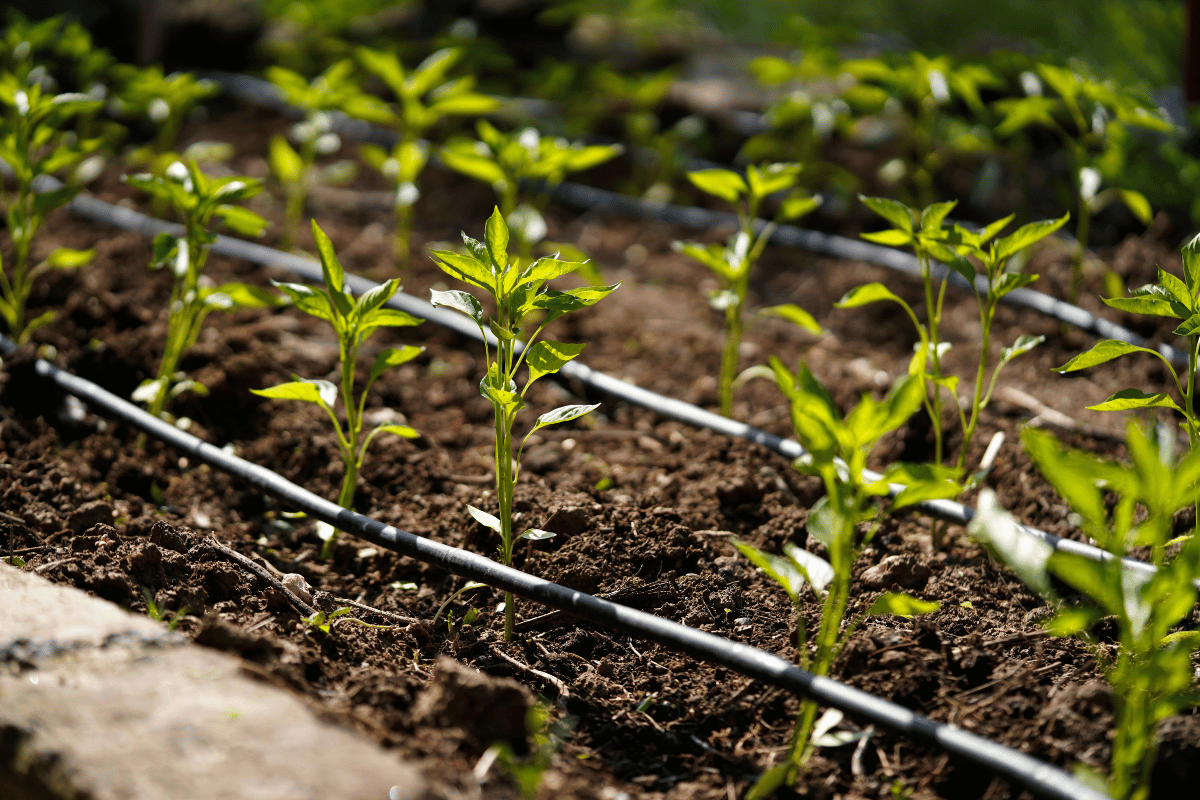
Crystalline fertilizers dissolve completely in water and leave no residue, which makes them well suited to drip irrigation. They contain very little chloride and sodium, so they do not raise salinity or clog the emitters. The label shows the NPK ratio, that is the units of nitrogen, phosphorus and potassium, and many grades also include micronutrients in chelated form.
How nutrition shifts from vegetative growth to fruiting
A plant's needs are not constant through the season, and feeding follows three stages. Early on, just after transplanting, nitrogen is kept low, around 60 to 70 ppm, so the plant does not put on excessive vegetative growth. Potassium and calcium are also kept moderate, since they are not yet needed in large amounts and any excess is simply wasted cost. In the second stage, as the plant grows and the first fruits set, nitrogen, potassium and calcium are all increased together. In the third stage, with a full fruit load, feeding reaches its highest concentration, with more potassium for fruit sizing and sugar accumulation, enough calcium to prevent fruit rot, and nitrogen at the level the continuing growth requires.
In practice, the potassium-to-nitrogen ratio shifts. During the vegetative phase it sits at roughly 1:1, while during fruit sizing it reaches about 1.5:1 in favour of potassium. That is why we start with the balanced 20-20-20 and, once the crop enters production, move to 12-12-36, which supplies almost three times as much potassium as nitrogen.
Calcium and blossom-end rot
One of the most common problems in tomato and pepper is blossom-end rot, a brown sunken patch at the base of the fruit. It is not caused by a fungus but by a shortage of calcium within the fruit, usually combined with sharp swings in moisture and with excess ammonium nitrogen. Ammonium competes with calcium for uptake, so the more of it is supplied, the less calcium reaches the fruit. To prevent it, calcium is supplied as calcium nitrate, ammonium nitrogen is kept low in favour of nitrate, and irrigation is kept steady. In substrate, calcium in the solution should stay above 150 ppm, and higher in rockwool.
EC and pH in the nutrient solution
Two parameters are monitored constantly, pH and electrical conductivity. The pH is held between 5.5 and 6.5, because above that range phosphorus and most micronutrients become locked up and the plant struggles to take them up. It is also adjusted through the nitrate-to-ammonium ratio, since ammonium acidifies the root zone, while in hard water with high bicarbonates it is lowered by adding acid. Electrical conductivity (EC) reflects the total salt concentration in the solution and changes with the crop, the stage and the light.
In tomato it usually runs at 2.5 to 3.0 mS/cm, in cucumber it stays lower, at 2.0 to 2.5, while pepper sits in between. During low-light periods in winter the EC is raised slightly, whereas under high temperatures and strong light it is lowered to avoid stressing the plant. It is also worth measuring the EC of the drainage, and if it exceeds the supply by more than 0.4 to 0.5 mS/cm, salts are building up in the root zone. Micronutrients are supplied in chelated form, with iron as EDTA in acidic solutions and as DTPA or EDDHA as the pH rises.
Preparing the solution and the A and B tanks
Not all fertilizers can be combined in the same tank. Calcium nitrate, added to cover the crop's calcium needs, must not share a concentrate tank with phosphate or sulfate fertilizers. If they meet in a concentrated solution they react and form gypsum and calcium phosphate, which precipitate and clog filters and emitters. For this reason the feed is prepared in two tanks. Tank A holds the calcium nitrate and tank B the phosphates and sulfates, and the two solutions mix only after they are diluted in the line. Each fertilizer is dissolved fully before the next is added, and every new combination is first tested in a small sample to confirm the solution stays clear.
A practical program by crop
In tomato, cucumber and pepper the same logic applies. Before starting, we analyse the irrigation water, so we know the calcium, magnesium and salts it already carries and can account for them in the recipe. From transplanting to the first fruit set we apply a balanced grade such as 20-20-20, at a lower EC and with restrained nitrogen, so the plant builds a strong root system without excessive growth. As the first fruits begin to size we move gradually to 12-12-36, raise potassium and calcium, and increase the EC slightly. The rate and frequency are adjusted to the stage, the season and the light, with regular EC and pH readings in both the solution and the drainage.
Frequently asked questions
When do we use crystalline fertilizers?
Crystalline grades suit any system watered by drip or fertigation, mainly greenhouses and intensive open-field vegetables. Because they dissolve fully, the recipe can be adjusted at every stage and the nutrients delivered gradually with the water. In extensive crops, where fertilizer is spread on the soil, granular products are usually preferred.
Why choose crystalline fertilizers over granular?
Because they dissolve without residue and do not clog the emitters, they are taken up quickly, they are low in chloride and sodium, and they allow precise control of NPK, EC and pH. The trade-off is a higher cost per unit of nutrient and the need for a fertigation system and regular monitoring.
When do we apply 20-20-20 and when 12-12-36?
During the vegetative phase and up to the first fruit set we use the balanced 20-20-20, and as the fruit begins to size we move to the high-potassium 12-12-36. Within the same season both grades are often used, depending on the stage.
Can they be applied as a foliar feed?
Yes. Being fully water-soluble, they can also be applied to the foliage at a low concentration as a supplementary feed. It is best to test on a few plants first to avoid leaf burn.
Sources
Ohio State University Extension. Hydroponic Nutrient Solution for Optimized Greenhouse Tomato Production.
University of Florida IFAS Extension. Fertilizer Management for Greenhouse Vegetables, Florida Greenhouse Vegetable Production Handbook.
University of Georgia Extension. Fertilizer Injectors, Selection, Maintenance and Calibration.